
Where the city meets the river
Montreal’s old harbour now works as its front porch. The Vieux-Port is a long ribbon of former docks along the St. Lawrence. Rue de la Commune and the grey-stone warehouses of Old Montreal run along one side, and open water and the hump of Île Sainte-Hélène sit on the other.
You walk it on wide paved promenades and grassy quays that stick out into the river like fingers. Each pier has its own job. One holds a science museum, one a Ferris wheel, and another the ferry dock. Bikes, strollers and joggers share the same paths, so keep to the right and listen for bells.
Walking the quays, east to west
The simplest way to see the whole port is one straight walk. Start at the east end and drift west with the river on your left.
- Clock Tower (Tour de l’Horloge): a white tower at the tip of Quai de l’Horloge, finished in 1922 as a memorial to sailors lost at sea. You can climb its narrow staircase for a view over the river and the Jacques Cartier Bridge.
- Clock Tower Beach: an urban beach with sand and parasols facing the water. It’s for lounging, not swimming.
- Quai Jacques-Cartier: the busiest pier, with food stands and the seasonal river shuttles to Parc Jean-Drapeau and Longueuil.
- La Grande Roue de Montréal: the large Ferris wheel by the water, with enclosed gondolas.
- Montreal Science Centre: on Quai King-Edward, with interactive exhibits and an IMAX screen. It’s a good backup when it rains.
- Silo No. 5 and the Lachine Canal: at the west end, the huge concrete grain silo marks the start of the canal path.
Walking the full length at an easy pace takes about 45 minutes. Allow a half day if you’re stopping at the attractions.
Looking across the water
Most of the views here point outward, not at the port itself. From the western quays you can see Habitat 67 across the water. Moshe Safdie’s stacked concrete boxes were built for Expo 67, and from here they look like a child’s pile of blocks.
To the east, the steel Jacques Cartier Bridge crosses to the islands. Behind you, the silver dome of Marché Bonsecours rises above Rue de la Commune. Turn around at the Clock Tower and you get the classic skyline: old stone in front, glass towers of downtown behind.

Beating the weekend crush
The port is very popular, and the crowds come at predictable times. On weekends, try not to arrive between 12pm and 10pm. That’s when the Ferris wheel queue grows, the Jacques-Cartier pier gets packed shoulder to shoulder, and restaurant patios fill up.
The quietest window every day is 7am–9am. Early morning suits the place well: the promenades are mostly runners and cyclists, the river is calm, and the Clock Tower quay is close to empty. On weekdays, 10pm–11pm is quiet too. It’s a good time for a stroll by the lit-up bridge after dinner in Old Montreal.
Google currently lists the grounds as open 6am to midnight. Attractions on the piers keep their own seasonal hours, so check each one before you go.
Paying, tipping and saying bonjour
Montreal runs on a two-word greeting. Staff at the kiosks and patios will usually open with “Bonjour, hi” and switch to whichever language you answer in. Replying with “Bonjour” first is a small courtesy that people notice.
- Payment: cards and tap-to-pay are accepted almost everywhere along the port, including most food stands.
- Tipping: at sit-down restaurants and bars, tip on the card terminal. It will offer percentage options, usually starting around 15%.
- Prices: ticket prices for the wheel, the Science Centre and the shuttles are posted at each ticket office and on the official sites.
- Bikes: BIXI share docks sit near the port entrances, and the riverside path links straight onto the Lachine Canal trail.
The port by season
This waterfront changes completely with the calendar. In summer it’s at its fullest. The beach is set up, patios spill onto the quays, and river shuttles run. In summer the fireworks competition at La Ronde on Île Sainte-Hélène lights up the sky across the water, and the quays are a popular place to watch.
Winter brings the outdoor skating rink and, in January, Igloofest, the open-air electronic music festival held on the quays. Dress for real cold, because the wind off the river bites harder than in the streets a block inland. Spring and autumn are quieter and often the most pleasant time to walk the full length.
Getting there and what’s next door
The port is easy to reach on foot from the Metro. All three stations below are a short downhill walk away.
- Champ-de-Mars (Orange Line): best for the east end. Walk down through Place Jacques-Cartier and you come out at the pier of the same name.
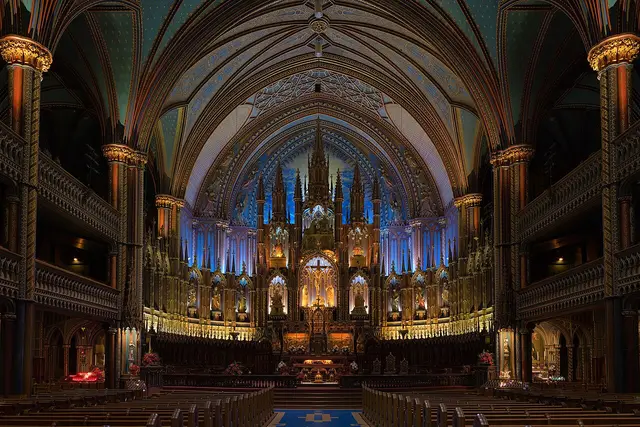
- Place-d’Armes (Orange Line): puts you by Notre-Dame Basilica, a few blocks up from the central quays.
- Square-Victoria–OACI (Orange Line): closest to the western quays and the Pointe-à-Callière archaeology museum.
Pair the waterfront with Old Montreal behind it. Notre-Dame Basilica, the cobbled Place Jacques-Cartier, Marché Bonsecours and Pointe-à-Callière are all within ten minutes of the water. A full morning of port plus old town is easy to fill.
Frequently asked questions
When is the quietest time to visit the Vieux-Port de Montréal?
Every day, 7am–9am is the calmest window. On weekdays, 10pm–11pm is quiet too. Avoid weekends from 12pm–10pm, which is the busiest stretch.
Which Metro station is closest to the Old Port?
Champ-de-Mars (Orange Line) is best for the east end and the Clock Tower. Place-d'Armes suits the central quays, and Square-Victoria–OACI is closest to the western end. All three are a short walk downhill.
How long should I spend at the Old Port?
Walking the roughly 2 km waterfront takes about 45 minutes. Allow a half day if you're adding the Clock Tower, the Ferris wheel or the Science Centre, and longer if you're pairing it with Old Montreal.
Can you swim at Clock Tower Beach?
No. Clock Tower Beach is an urban beach for lounging in the sand and under the parasols. Swimming in the river isn't part of it.
What is there to see near the Vieux-Port?
Notre-Dame Basilica, Place Jacques-Cartier, Marché Bonsecours and the Pointe-à-Callière museum are all within a few minutes' walk. The Lachine Canal path starts at the port's western end.
Plan your trip to Montreal
Canada eSIM & staying connected →
Some links above are affiliate links — if you book through them, Wander Atlas earns a small commission at no extra cost to you. It's how we keep every guide free.
Related guides
 attraction
Notre-Dame Basilica of Montreal: Travel Guide (4.7★)
 attraction
Parliament Hill: Ottawa Travel Guide (4.7★)
 attraction
Fairmont Le Château Frontenac: Quebec City Travel Guide
 attraction