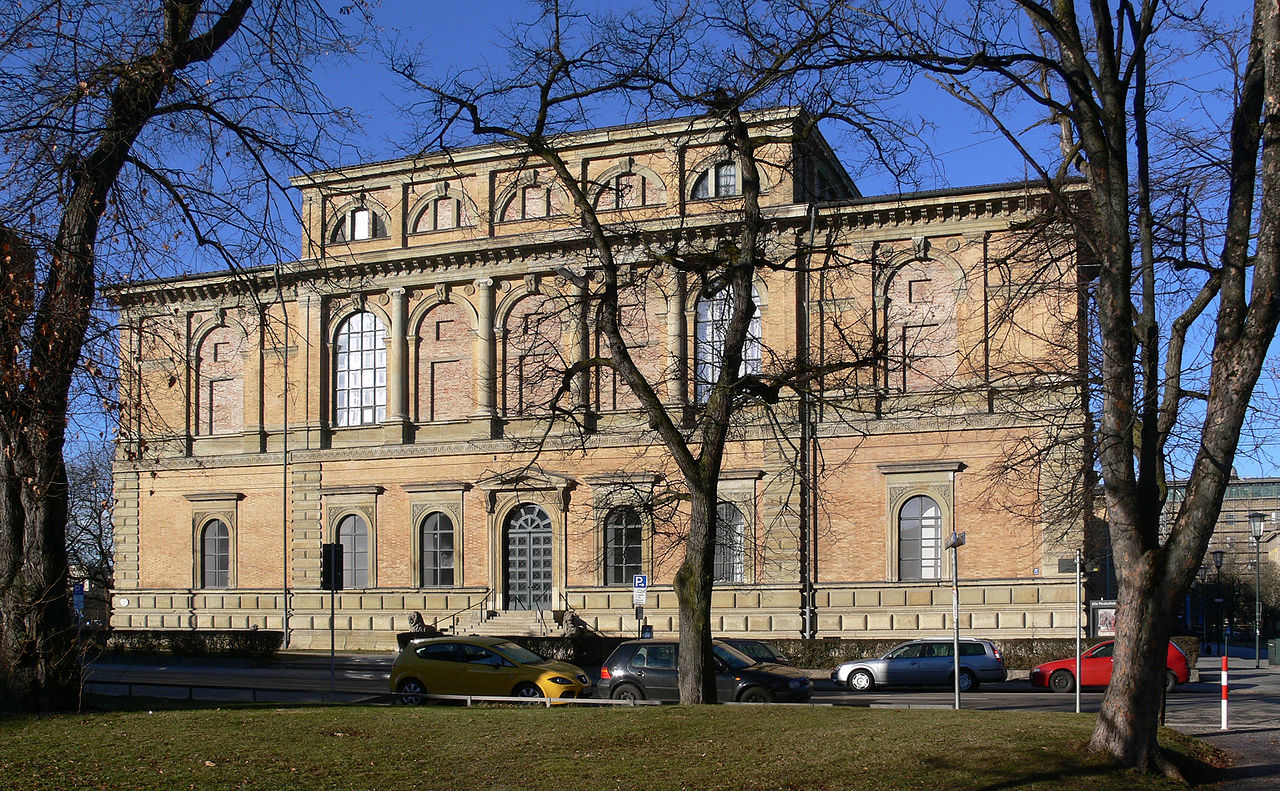
A long brick palace built for paintings
From Barer Straße you see a long, low neoclassical block set back behind lawns. King Ludwig I commissioned it, Leo von Klenze designed it, and it opened in 1836. When it was built, it was one of the largest buildings anywhere designed only to show pictures.
Look closely at the south façade. Some stretches are plain, unrendered brick with no ornament at all. That is the Second World War damage, repaired by architect Hans Döllgast, who chose to leave the wound visible rather than fake the old decoration. It’s a good thing to notice before you go inside.
What hangs on the walls
The building holds about 900 paintings at any one time. Most date from the 14th to the 18th century, grouped by national school: German, Dutch and Flemish, Italian, French and Spanish. The main galleries sit on the upper floor in a row of tall, top-lit halls, with smaller cabinet rooms running alongside them.
These are the works people come for:
- Albrecht Dürer, Self-Portrait with Fur-Trimmed Robe (1500): the frontal, almost Christ-like face that is reproduced everywhere.
- Dürer, The Four Apostles: two tall panels that he gave to his home city of Nuremberg.
- Albrecht Altdorfer, The Battle of Alexander at Issus: thousands of tiny soldiers under a curving, burning sky.
- Leonardo da Vinci, Madonna of the Carnation: one of the few Leonardos in Germany.
- Raphael, the Canigiani Holy Family.
- Pieter Bruegel the Elder, The Land of Cockaigne.
- François Boucher, Madame de Pompadour.
The Rubens hall
The central hall on the upper floor is big because one painting needed it. Klenze sized it for Rubens’s Large Last Judgement, a canvas more than six metres tall. The Wittelsbach rulers collected Rubens so heavily that this is one of the largest Rubens holdings in the world.
Give this hall more time than you think you need. Step back to the far wall to see the whole composition. Then walk up close to the bodies tumbling at the bottom edge, which you cannot read from a distance. The neighbouring cabinet rooms hold smaller Rubens oil sketches and portraits, including pictures of his wife Helena Fourment.
The Tuesday and Wednesday late opening
The schedule has one useful oddity. On Tuesdays and Wednesdays the doors stay open until 8pm. Thursday to Sunday they close at 6pm, and on Mondays the building is closed altogether.
Weekends are busy all day, from 10am to 6pm, so there is no quiet slot to aim for on a Saturday or Sunday. A Tuesday or Wednesday evening is the obvious alternative. Office workers and tour groups have mostly gone by late afternoon, and two extra hours let you visit without rushing. If you can only come on a weekend, start with the Rubens hall and the Dürers before the rooms fill up.
Getting to Barer Straße 27
The museum stands in the Kunstareal, Munich’s museum quarter in Maxvorstadt, a short walk north of the old town. You have three easy ways in:
- Tram 27: get off at Pinakotheken, practically at the door.
- U-Bahn: take the U2 to Theresienstraße, or the U2 or U8 to Königsplatz, then walk about ten minutes.
- Bus 100 (the “Museumslinie”): runs between the main station and Ostbahnhof, stopping near the Pinakotheken.
Driving is not worth it. Parking in Maxvorstadt is scarce, and the tram is quicker.
Moving through the galleries without wasting time
Plan on two to three hours for the highlights, or half a day if Old Masters are your thing. Before you go, check the official Pinakotheken website for current admission and for any rooms closed for renovation. The building has been renovated in stages, and some sections have been shut for long periods.
A few habits make the visit easier:
- Bags: large bags and backpacks normally go into the lockers or cloakroom downstairs. Arrive with that in mind instead of hauling a daypack.
- Plan by room: grab a floor plan at the entrance. The galleries run in long lines, and doubling back to find one picture eats time.
- Audio guide: worth it for Altdorfer and Rubens, whose crowded canvases reward being walked through detail by detail.
- Phones: keep them silent in the halls. Staff are attentive and German museum etiquette favours quiet.
Visitors here tend to stand still for a long time in front of the major pictures. If someone is close to the Dürer, wait your turn rather than leaning in beside them.
Making a day of the Kunstareal
You are surrounded by more museums. The Pinakothek der Moderne is just across the lawn, with modern art, design and architecture under one rotunda. Next door, Museum Brandhorst is easy to spot by its façade of coloured ceramic rods and focuses on contemporary work. The Neue Pinakothek’s 19th-century collection has been closed for a major renovation. Check whether its highlights are currently on display elsewhere before you count on seeing them.
A few blocks south is Königsplatz, Ludwig I’s Greek-style square, with the Glyptothek’s ancient sculpture on one side. Sit on the Alte Pinakothek’s lawns between museums, as many visitors do in good weather. Then walk south down Barer Straße towards the old town for dinner.
Frequently asked questions
When is the quietest time to visit the Alte Pinakothek?
Weekends are busy for the whole day, from 10am to 6pm, so avoid Saturdays and Sundays if you can. Go on a weekday instead. Tuesday and Wednesday evenings are the best bet because the museum stays open until 8pm, after most groups have left.
Is the Alte Pinakothek open on Mondays?
No. It's closed on Mondays. It opens 10am to 8pm on Tuesdays and Wednesdays and 10am to 6pm from Thursday to Sunday.
How do I get to the Alte Pinakothek?
Tram 27 stops at Pinakotheken, right outside. You can also take the U2 to Theresienstraße, or the U2 or U8 to Königsplatz, and walk about ten minutes. Bus 100 also stops nearby.
How long should I spend there?
Allow two to three hours for the highlights, including the Dürer self-portrait, Altdorfer's Battle of Alexander and the Rubens hall. Allow half a day if you want to see every school properly.
What else is nearby?
The Pinakothek der Moderne and Museum Brandhorst are both a few minutes' walk away in the Kunstareal. Königsplatz and the Glyptothek are a short walk south.
Plan your trip to Munich
Some links above are affiliate links — if you book through them, Wander Atlas earns a small commission at no extra cost to you. It's how we keep every guide free.