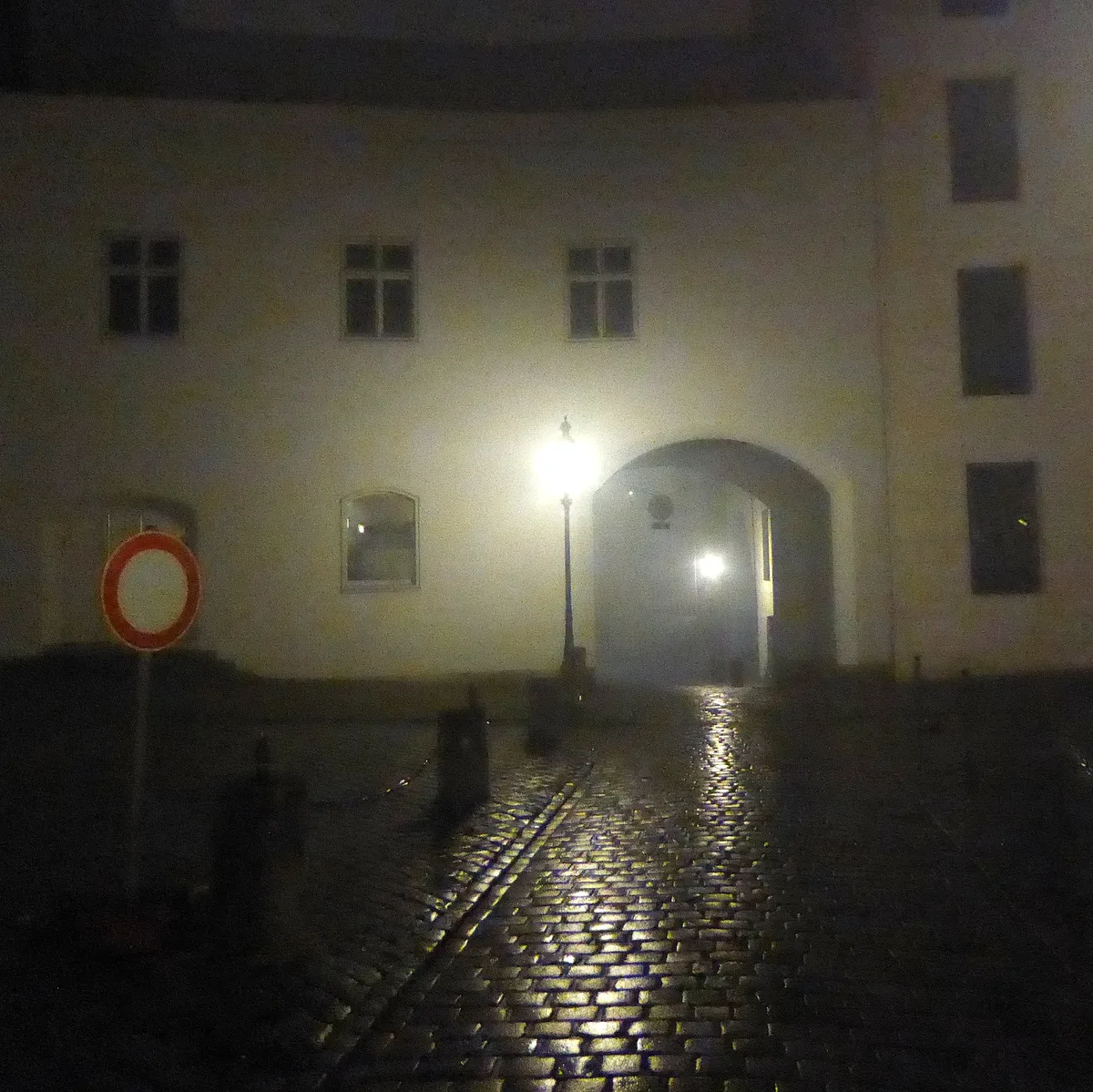
A courtyard most people walk past
A plain archway off Burgstraße leads into the oldest seat of power in Munich. Pass through it and the shopping-street noise falls away. You’re standing in a cobbled courtyard closed in by pale plastered wings, with steep roofs above.
Thousands of people cross Marienplatz every hour, and few of them make it the few hundred metres to this spot. That’s the appeal. You get a medieval castle complex in the middle of the city, usually with room to stand still and look up.
It’s a small place, and it doesn’t pretend otherwise. You won’t find a ticket hall or a grand staircase. What you get is five wings around an irregular courtyard, a famous oriel window and an exhibition below ground. For most visitors that adds up to 30–45 minutes very well spent.
Where the Wittelsbachs started
Alter Hof means “Old Court”. It was the first residence of the Wittelsbach dukes inside Munich’s walls. Under Louis IV, known in German as Ludwig der Bayer, it became an imperial residence. Louis was the first Wittelsbach to be crowned Holy Roman Emperor, so for a time this courtyard was the centre of an empire.
The dukes later outgrew it. They moved into the far larger Residenz a short walk to the north, and the Alter Hof became an administrative building. That’s partly why it survived so plainly: nobody had a reason to dress it up with Baroque layers.
The five wings each have their own name:
- Burgstock, the oldest wing and home to the oriel
- Zwingerstock
- Lorenzistock, rebuilt in a modern style in the 2000s
- Pfisterstock
- Brunnenstock
Seeing medieval and contemporary wings side by side in one courtyard is part of what makes the place interesting.
The Affenturm and its monkey
Look for the small late-Gothic oriel on the Burgstock. It’s the bay window jutting out over the courtyard, topped with its own little pointed roof. Locals call it the Affenturm, the “monkey tower”.
The name comes from a legend. A pet monkey supposedly snatched the infant Louis from his cradle and climbed up the building with him, while the court watched from below in horror. The animal then brought the baby back down unharmed.
Nobody claims it really happened. Still, it’s the story Munich tells about this window, and it gives you a reason to stop in the centre of the courtyard and tilt your head back. The oriel is also the most photographed detail here. Stand near the archway opposite and you can fit it in the frame with the roofline.

Down in the vaulted cellar
The best room is underground. In the Gothic vaulted cellar of the Burgstock, the Bavarian palace administration runs an information point for the state’s museums and castles. Its multimedia exhibition covers the history of the Alter Hof and of the city around it.
The hours on this page are for that cellar. At the moment it opens Monday to Saturday from 10am to 6pm and is closed on Sundays. Opening times for heritage sites in Bavaria can shift through the year and around public holidays, so check the official Bayerische Schlösserverwaltung site before you plan around it. Any entry details are posted there and at the door.
The information point also earns its place as a planning stop. Staff and printed material cover the state-run palaces, including Nymphenburg, the Residenz and the castles further out in Bavaria. If a day trip is on your list, this is a good spot to sort out the details.
Finding the gate from Marienplatz
The address is Alter Hof 1, in the Altstadt-Lehel district. The nearest stop is Marienplatz, which is served by U-Bahn lines U3 and U6 and by every S-Bahn line on the central trunk route.
From the square:
- Stand with the Neues Rathaus behind you and walk east along Dienerstraße or Burgstraße.
- The courtyard opens off Burgstraße, roughly five minutes’ walk from the Glockenspiel.
- Coming from the Residenz or Max-Joseph-Platz, head south. It takes about the same time.
The streets here are pedestrian-heavy and the cobbles are uneven. Strollers will manage, but expect some bumps.
Slipping in between the big sights
Treat the Alter Hof as a breather rather than a destination of its own. It fits neatly between the Marienplatz crowds and a beer at the Hofbräuhaus.
- Sunday is the trap. The cellar exhibition is currently closed all day on Sundays. If the history is the reason you’re coming, go Monday to Saturday.
- Look up first, then go down. Do the courtyard and the Affenturm before the cellar. The exhibition makes more sense once you’ve seen the wings it describes.
- Keep your voice down. Offices and residents still share these buildings. People walk through quietly, and you should too.
- Use the German names. Signs and maps say Alter Hof, Burgstock and Affenturm, so knowing them saves some confusion.
- Pack your questions. Ask the information point staff about entry options for the Residenz or Neuschwanstein. That’s often quicker than queuing at the palaces themselves.
A short loop from the courtyard
You can spend a whole morning without walking more than ten minutes in any direction.
- Alte Münze (Old Mint): just north on Hofgraben. Its Renaissance courtyard has three storeys of arcades and is worth a look through the gate.
- Hofbräuhaus: a couple of minutes east on Platzl, for the city’s best-known beer hall.
- Marienplatz and the Neues Rathaus: time your walk back for the Glockenspiel.
- St. Peter’s (Alter Peter): climb the tower for a view over the same roofs you’ve just stood under.
- Residenz and Max-Joseph-Platz: the palace the Wittelsbachs moved into once they’d outgrown this one.
Seeing the Alter Hof first and the Residenz second shows you how the dynasty grew. They started with five modest wings around a cobbled yard and ended up in one of Europe’s largest city palaces.
Frequently asked questions
How do I get to Alter Hof?
Take the U3, the U6 or any central S-Bahn line to Marienplatz. From there it's about a five-minute walk east to Burgstraße, where an archway opens into the courtyard at Alter Hof 1.
Is Alter Hof open on Sundays?
Not at the moment. The vaulted cellar exhibition currently opens Monday to Saturday, 10am–6pm, and is closed on Sundays. Hours can change with the season and around holidays, so check the Bavarian palace administration's official site before you go.
How long should I spend at Alter Hof?
Allow 30–45 minutes. That covers the courtyard, the Affenturm oriel and the multimedia exhibition in the Gothic cellar.
What is the Affenturm?
It's the small late-Gothic oriel window on the Burgstock wing. It's named after a legend in which a monkey carried the infant Louis IV up the building and brought him back down safely.
What is near Alter Hof?
The Alte Münze's arcaded courtyard, the Hofbräuhaus, Marienplatz with the Neues Rathaus, St. Peter's Church and the Residenz are all within a few minutes' walk.
Plan your trip to Munich
Germany eSIM & staying connected →
Some links above are affiliate links — if you book through them, Wander Atlas earns a small commission at no extra cost to you. It's how we keep every guide free.