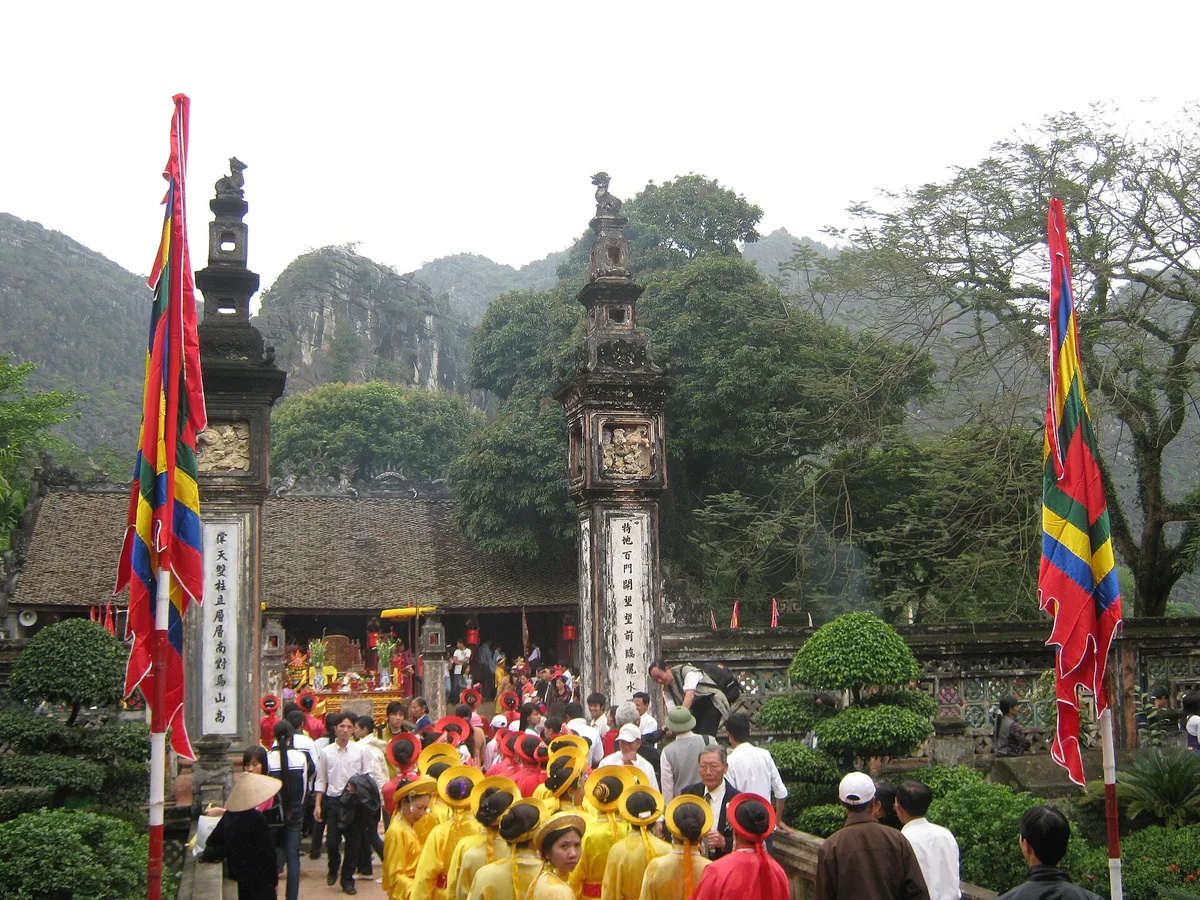
You feel it before you see it: the road narrows, rice paddies open up flat and green on both sides, and suddenly limestone karsts rise straight out of the earth like something drawn rather than formed. This is Hoa Lu, capital of Vietnam a thousand years before Hanoi took the title.
Why Hoa Lu matters
Short version: this was Vietnam’s first independent capital. Two 10th-century kings, Dinh Tien Hoang and Le Dai Hanh, ruled from here after centuries of Chinese domination ended.
The original citadel is mostly gone now, worn down by a millennium of monsoons. What you actually walk through are 17th-century temples rebuilt on the old foundations, plus scattered ramparts and tombs climbing the hillsides.
Getting there
Hoa Lu sits about 12km northwest of Ninh Binh city, roughly a 20-minute drive. Most visitors arrive by rented scooter, private car, or as part of a day tour bundled with Trang An or Tam Coc.
There’s no train or bus station nearby, so you’ll need your own wheels or a booked transfer. Parking is at a lot near the entrance, then it’s a short walk to the temple complex.
What to see once you’re inside
The site is compact, and you can cover the essentials in about an hour to ninety minutes.
- Dinh Tien Hoang Temple – the main shrine, with a stone dragon-carved staircase and worn courtyard flagstones
- Le Dai Hanh Temple – smaller, quieter, a short walk beyond
- Yen Ngua Mountain viewpoint – a steep climb (skip if it’s midday heat) for a full view of the valley
- Old citadel wall traces – low earthen mounds easy to miss if you don’t know to look
Inside the temples, dim light filters through wooden lattice screens onto lacquered altars and incense coils hanging from the rafters. Outside, the karst peaks frame every photo whether you plan it or not.

When to go
The site opens daily from 7am to 5pm, every day of the week. Spring (February–April) brings soft, hazy light and cooler air; summer gets hot and humid by mid-morning.
Weekends tend to draw noticeably more visitors than weekdays, particularly through the late morning and early afternoon. Weekday visits stay comfortably calm across the whole 7am–5pm window.
If you can only come on a weekend, arrive right at 7am and you’ll have the courtyards nearly to yourself for that first hour.
How to visit like a local
This is a well-visited, well-trodden stop on the Ninh Binh circuit, not a quiet find, so plan around the crowds rather than expecting to escape them.
- Best time: weekdays anytime, or weekends strictly between 7am and 8am
- Avoid: weekend late-morning and early-afternoon (9am–2pm), when tour groups peak
- Payment: small entrance and parking fees are typically paid in cash (Vietnamese dong); card machines are unreliable this far from the city
- Dress: cover shoulders and knees. These are active temples, not ruins for climbing on
- Etiquette: remove hats before entering temple interiors, and keep voices low near the altars
The mistake most first-timers make is treating Hoa Lu as a quick photo stop between bigger sights and rushing through in fifteen minutes. Slow down at Le Dai Hanh Temple instead, where the crowds thin out fastest and the carving detail rewards a closer look.
Bring water; there’s little shade between the parking area and the temple courtyards, and the walk up to Yen Ngua Mountain has none at all.
Nearby to pair with your visit
Hoa Lu sits close enough to Trang An and Tam Coc that most visitors combine all three in a single day. A boat ride through Trang An’s flooded caves, then Hoa Lu in the cooler late afternoon, is a natural sequence if you start early enough to beat the heat and the crowds on both ends.
Frequently asked questions
How long should I spend at Hoa Lu Ancient Capital?
Plan for 1 to 1.5 hours to see both main temples and the citadel remains; add 30–45 minutes if you climb to the Yen Ngua Mountain viewpoint.
What's the quietest time to visit?
Weekdays are calm all day (7am–5pm). On weekends, go right at opening, 7am–8am, before tour buses arrive between 9am and 2pm.
How do I get to Hoa Lu from Ninh Binh city?
It's about 12km northwest, roughly a 20-minute drive by scooter, private car, or organized day tour — there's no direct public bus or train.
Can I combine Hoa Lu with other Ninh Binh sights in one day?
Yes — it's commonly paired with Trang An or Tam Coc boat tours, both a short drive away, making for a full but manageable day trip.
Is there an entrance fee?
There's typically a modest entrance and parking fee payable in cash (Vietnamese dong); confirm the current amount locally as it can change.
Plan your trip to Ninh Binh
Some links above are affiliate links — if you book through them, Wander Atlas earns a small commission at no extra cost to you. It's how we keep every guide free.
Related guides
 attraction
 Bai Dinh Pagoda: Ninh Binh Travel Guide (4.8★)
 attraction
 Tam Coc - Bich Dong: Ninh Binh Travel Guide (4.5★)
 attraction
 Thong Nhat Park: Hanoi Travel Guide (4.3★)
 attraction