A coliseum that never got its roof
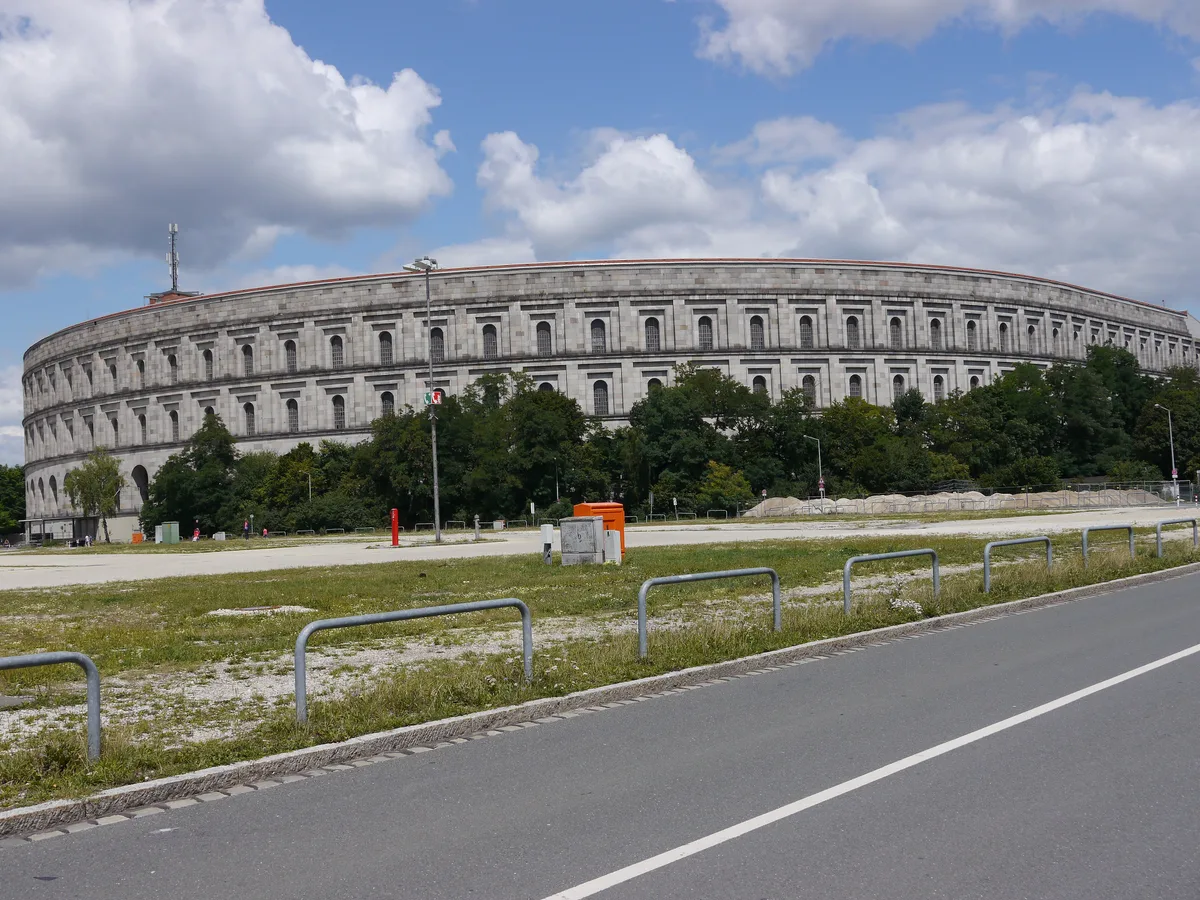
From the tram stop, the curved granite wall seems to go on and on. The Kongresshalle was designed by the architects Ludwig and Franz Ruff and openly modelled on Rome’s Colosseum. It was meant to seat around 50,000 Nazi Party delegates under a vast roof. Construction started in 1935 and stopped when the war came. The roof was never built.
What stands today is a horseshoe of arcaded stone with an open, grassy courtyard inside. Above the regular rows of windows, the facade simply ends. The unfinished top edge is the most honest thing about the building: you are looking at an ambition that collapsed.
The glass spear through the north wing
The Documentation Center Nazi Party Rally Grounds (Dokumentationszentrum Reichsparteitagsgelände) sits in the north wing. In 2001 the Austrian architect Günther Domenig drove a diagonal walkway of glass and steel straight through the old masonry. It is a deliberate act of vandalism against the building’s symmetry, and the most photographed angle on the site.
The museum covers the rallies, the propaganda behind them and their link to persecution and war. It has been going through a major redesign in recent years, with interim exhibitions while the work goes on. Check the official site to see what is open now.
Walking the rest of the grounds
The Kongresshalle is only one piece of the Reichsparteitagsgelände. Information panels along a signed loop let you read the landscape as you walk. The main stops:
- Dutzendteich lake: the Kongresshalle’s back wall faces the water, and that view shows its full size best.
- Große Straße (Great Road): a two-kilometre granite parade axis aimed at the old town’s castle.
- Zeppelin Tribune and Zeppelinfeld: the stand where Hitler spoke, now crumbling and partly fenced while it is being conserved.
- Märzfeld: the planned army parade ground, mostly built over, with only fragments left.
The full loop takes roughly an hour at a steady pace. It is flat, open and exposed, so dress for the weather.
Getting to Bayernstraße
The site is southeast of the centre, not within walking distance of the old town. Your options:
- Tram 8 to the Doku-Zentrum stop, which lets you off almost at the entrance.
- S-Bahn S2 to Nürnberg-Dutzendteich, then a walk of about 10 minutes past the lake.
- Bus 36 or 65, which also serve the area.
If you drive, the address is Bayernstraße 100. The surrounding Volkspark draws joggers and families, and on big event days the area around the nearby football stadium fills up.
Reading the site without performing for it
This is one of the most visited historical landmarks in Nuremberg. Locals treat it as a place of record rather than a ruin to pose on. A few things are worth knowing before you arrive:
- Nazi gestures and symbols are criminal offences in Germany. That includes joke photos on the Zeppelin Tribune. Police do act on it.
- The courtyard has a working life. The Nuremberg Symphony has its home in part of the complex, so some doors and areas are simply offices or rehearsal space.
- Take the audio guide or read the panels in order. The exhibition is built as a sequence, and skipping around loses the argument it makes.
- Card is widely accepted at the museum desk, but keep a little cash for the tram ticket machines in case one is card-shy.
- School groups are common on weekday mornings during term. If the halls are full, step outside and walk the grounds first, then come back.
German labels sit alongside English ones throughout, so you will not need a translator.
Pairing it with the trials courtroom
The Rally Grounds show how the regime presented itself. The other half of the story is across the city, at the Memorium Nuremberg Trials in the Palace of Justice on Fürther Straße. Courtroom 600 is where the leading Nazis were tried in 1945–46.
To get there, take the U1 to Bärenschanze. Doing both on the same day is tiring but coherent: the spectacle in the morning, the reckoning in the afternoon. If you only have time for one, the Kongresshalle and its grounds give you the scale. The courtroom gives you the consequences.
Frequently asked questions
How do I get to the Kongresshalle from Nuremberg Hauptbahnhof?
Take tram 8 to the Doku-Zentrum stop, right by the entrance. You can also take the S-Bahn S2 to Nürnberg-Dutzendteich and walk about 10 minutes past the lake.
How long should I spend there?
Allow 2–3 hours: one to two hours for the Documentation Center's exhibition, plus about an hour for the signed walk out to the Zeppelin Tribune and back.
Is the Documentation Center open during the renovation?
The museum in the north wing has been undergoing a major redesign, with interim exhibitions while the work goes on. Check the official Documentation Center site for what is open and for current hours before you travel.
Can I walk around the Rally Grounds outside museum hours?
Yes, the outdoor grounds around the Dutzendteich, the Great Road and the Zeppelin Tribune sit in public parkland with information panels. Parts of the Zeppelin Tribune may be fenced off for conservation.
What else is nearby?
The Zeppelinfeld and Zeppelin Tribune, the Große Straße and the Dutzendteich lake are all walkable from the Kongresshalle. Across town, the Memorium Nuremberg Trials (U1 to Bärenschanze) completes the story.
Plan your trip to Nuremberg
Germany eSIM & staying connected →
Some links above are affiliate links — if you book through them, Wander Atlas earns a small commission at no extra cost to you. It's how we keep every guide free.
Related guides
 attraction
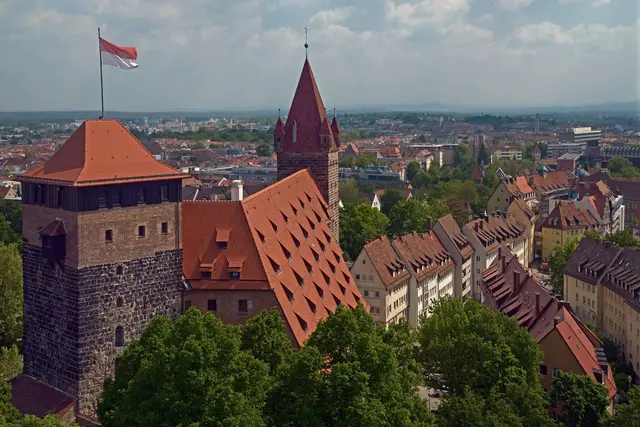
 Imperial Castle of Nuremberg: Travel Guide (4.6★)
 hidden gem
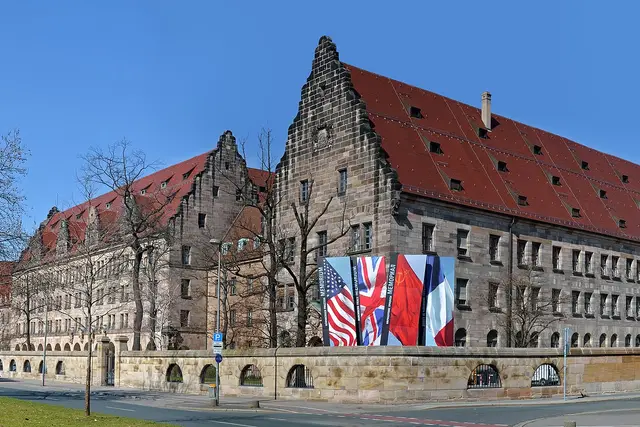
 Memorium Nuremberg Trials: Travel Guide (4.6★)
 attraction
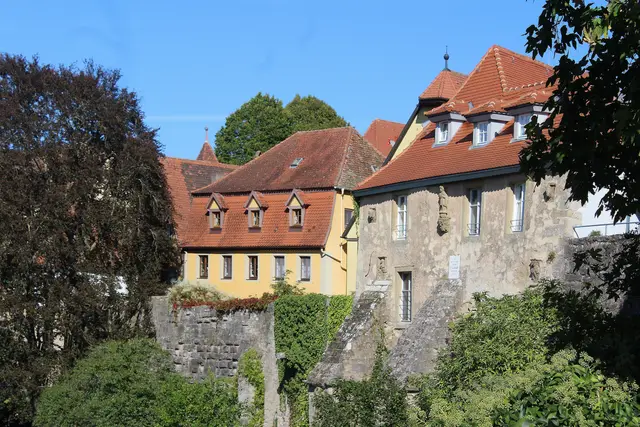
 Stadtmauer Rothenburg: Rothenburg ob der Tauber Travel Guide
 attraction