Quattro Canti: Palermo Travel Guide (4.7★)

✓ Facts verified via Google Places · Sep 13, 2026
At a glance
Live foot-traffic data via BestTime.app
How this guide is made
Produced with AI assistance and reviewed against live data sources. Facts such as hours, ratings, and location come from Google Places; images are licensed or public domain. Details can change — please verify before visiting. Editorial policy
Stand in the middle of Via Maqueda where it crosses Via Vittorio Emanuele and you are standing on the seam of Palermo itself. This intersection, officially Piazza Villena but known to everyone as Quattro Canti, the “Four Corners”, was cut through the medieval city in the late 1500s specifically to divide it into four administrative quarters: Kalsa, Albergheria, Capo and Vucciria. Every direction you turn, you’re looking down a different neighbourhood.
What you’re actually looking at
Each of the four corners is curved concave and stacked in three tiers of carved stone, so the whole intersection reads like an open-air stage set rather than a crossroads. The bottom tier on each corner holds a fountain with a reclining statue representing one of the four seasons. The middle tier has a Spanish viceroy from the era of Sicilian rule. The top tier holds a female saint, one of Palermo’s four patronesses: Christina, Ninfa, Oliva and Agata.
Look up before you look around. The detail is carved a full storey above street level, easy to miss if you’re only scanning shopfronts and traffic.
Why it sits where it does
The intersection was engineered under Spanish viceroy Vicenzo Vila, hence the piazza’s formal name, and finished around 1620 as part of a broader Baroque remodeling of the city’s spine. Via Maqueda itself was a new artery, sliced through older neighbourhoods to connect the port to the political centre. Quattro Canti was the ceremonial hinge where the new street met the old east-west route, and it was built to be seen from a moving carriage or a walking procession, not just admired from a fixed viewpoint.
That’s still true. It rewards a slow 360-degree turn on foot far more than a static photo from one corner.
The light-and-shadow trick
Because the four facades are identical in form and oriented to the compass points, sunlight sweeps around the piazza through the day, lighting one corner while the other three sit in shadow. Midday sun hits differently than late afternoon, and photographers who know this will circle the intersection two or three times over an hour rather than shoot once and move on. There’s no bad time of day for it exactly, but the raking light of early morning picks out the carving depth better than the flatter light of noon.

Getting there and getting your bearings
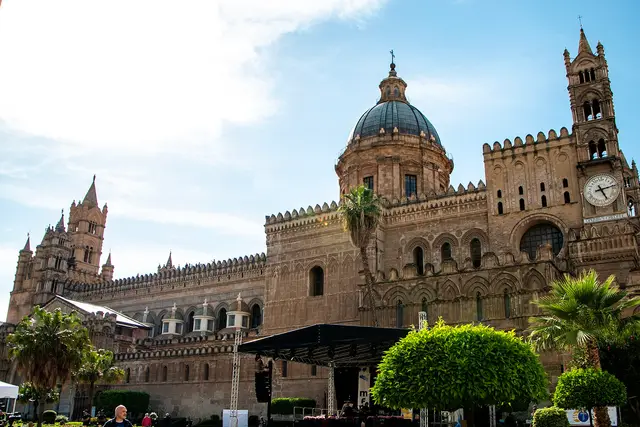
Quattro Canti sits in the historic centre, an easy walk from the Cattedrale di Palermo and a two-minute stroll from Piazza Pretoria, home of the famous “Fountain of Shame.”
- On foot: it’s roughly 10–15 minutes from Palermo Centrale train station down Via Maqueda.
- By bus: several AMAT city bus lines stop within a block on Via Vittorio Emanuele or Via Maqueda.
- Landmark to pair it with: Chiesa di San Giuseppe dei Teatini sits right on one corner, worth a quick look inside if the door is open.
There’s no admission and no gate, since it’s a functioning street intersection, so you can loop through it as many times as you like on the way to somewhere else.
Beating the crowds at a crossroads with no off-season
Quattro Canti never closes, but that also means it never truly empties out either; it’s one of the most visited single spots in Palermo’s old town. Weekend afternoons and evenings, roughly 11am to 11pm, are when foot traffic, tour groups and idling cars converge hardest, and crossing on foot starts to feel like a small negotiation.
The quiet window, on both weekdays and weekends, runs 7am to 9am. At that hour the shutters on the surrounding shops are still down, the statues get soft direct light, and you can stand in the centre of the crossing long enough to actually turn and read all four corners without being swept along by the crowd.
If you can only come once, come once early and once again after dark; the carvings floodlit at night have a completely different, flatter drama to them than the same stone at 7am.
Reading the corner you’re standing on
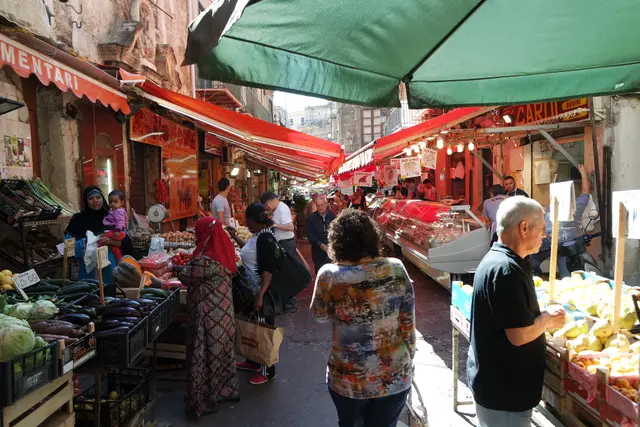
Locals still use the quarter names, Kalsa, Albergheria, Capo, Vucciria, as everyday shorthand for direction, the way a New Yorker says “uptown.” Ask which way the market is and a Palermitano is as likely to point toward “Vucciria” as to name a street.
There’s no queue system, no ticket booth and no real etiquette to learn here beyond ordinary street sense: mind the traffic, since cars and scooters still use this as a live intersection, and don’t stand mid-crossing for a photo if a Vespa is bearing down on you. Locals cut through fast and diagonally; visitors tend to circle slowly, which is fine, just keep to the outer edge of the crossing when you do.
Combine it with a proper walk, not just a photo stop
Because Quattro Canti has no set visit length, most people either rush it in ninety seconds or fold it into a longer loop. The better version is the loop: start at the Cattedrale, walk Via Vittorio Emanuele east to Quattro Canti, detour one block south to Piazza Pretoria and the cathedral-scale Baroque fountain there, then continue toward the Vucciria market for lunch. That whole stretch takes under an hour on foot and uses Quattro Canti as the hinge it was always designed to be.
Frequently asked questions
What exactly is Quattro Canti and where is it?
It's a Baroque octagonal intersection, officially Piazza Villena, where Palermo's two main historic streets, Via Maqueda and Via Vittorio Emanuele, cross in the old city centre. Each of its four curved corners has a fountain, a viceroy statue and a patron saint statue stacked in tiers.
Is there an entry fee or set opening hours?
No. It's an open street intersection with no gate or ticket, accessible 24 hours every day.
When is it quietest to visit?
Both weekdays and weekends, the calmest window is 7am to 9am, before shops open and crowds build. Try to avoid 11am to 11pm on weekends, when it's busiest.
How long should I spend here?
Ten to fifteen minutes covers a proper look at all four corners. Most visitors fold it into a longer walk toward Piazza Pretoria and the Cattedrale di Palermo, which are both within a couple minutes on foot.
What's nearby worth combining with a visit?
Piazza Pretoria and its large fountain are one block away, the Cattedrale di Palermo is a short walk west, and the Vucciria market quarter is a few minutes north for a follow-on lunch stop.
Plan your trip to Palermo
Some links above are affiliate links — if you book through them, Wander Atlas earns a small commission at no extra cost to you. It's how we keep every guide free.