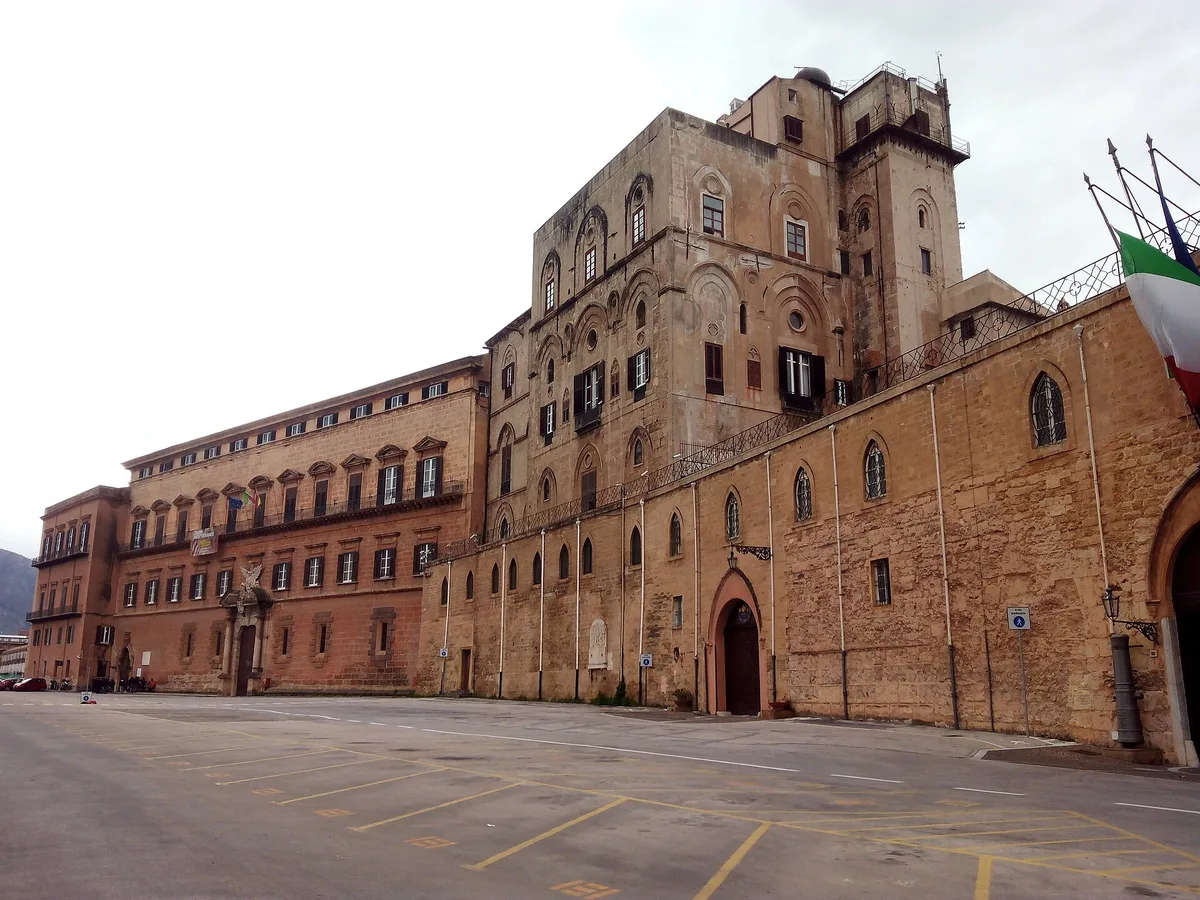
This is Sicily’s oldest royal residence, and also its seat of government today, which is why half the building is roped off behind metal detectors and the other half is covered floor to ceiling in Byzantine gold. The Sicilian Regional Assembly meets in rooms upstairs from a 12th-century chapel. Few palaces anywhere ask you to hold both facts in your head at once.
Getting your bearings on Piazza del Parlamento
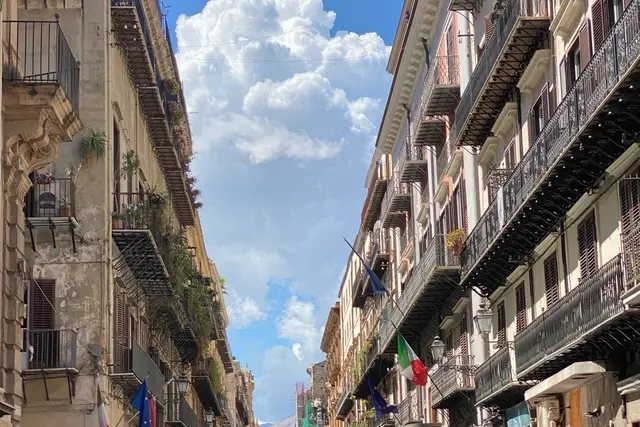
The palace fronts a wide square at the western end of Corso Vittorio Emanuele, Palermo’s old main street, just past the cathedral. The facade you see now is largely 17th and 18th century neoclassical work, cream-colored and formal, added over foundations that go back to the 9th century when Arab emirs first built a fortress here. Norman kings expanded it in the 12th century; Spanish viceroys used it after that. That layering is the whole point of the visit, not a footnote.
Entry is on the square itself, through a courtyard where the ticket line forms. Security screening is routine here because of the working parliament, so bags get checked and it moves a bit slower than a typical museum queue.
The Cappella Palatina, and why you came
The chapel is why the palace draws crowds who otherwise skip Sicilian government buildings. Commissioned by King Roger II around 1140, it packs three decorative traditions into one room: Byzantine mosaics on the walls and dome, a carved wooden muqarnas ceiling built by Arab craftsmen, and Norman-Romanesque architecture holding it all up.
The mosaics run wall to wall in gold ground, telling Old and New Testament scenes with a Christ Pantocrator staring down from the apse. Look up before you look around. The ceiling is a honeycomb of painted wooden cells, a technique imported from North Africa and found nowhere else in a Christian church at this scale.
Give the chapel itself 20 to 25 minutes minimum; it rewards slow looking more than most single rooms in Palermo.
The Royal Apartments upstairs
Beyond the chapel, a staircase leads to the Sala di Ruggero, a room with 12th-century mosaics of hunting scenes, lions, peacocks, and palm trees, entirely secular in subject where the chapel below is sacred. This is one of the few surviving Norman-era rooms outside the chapel itself.
Access to the Royal Apartments depends on parliamentary business. Because the Assembly still sits here, certain rooms close without notice on sitting days. If seeing the Sala di Ruggero matters to you, ask at the ticket desk when you arrive rather than assuming it’s included.

Working around the parliament’s schedule
Hours run 8:30am to 4:30pm Monday through Saturday, and only 8:30am to 1pm on Sunday, so a Sunday afternoon plan will find the doors shut. Build in roughly an hour for the chapel and apartments combined, more if you linger over the mosaics or catch a temporary exhibition in the palace’s other halls.
Because this is a functioning government building, not just a museum, expect occasional closures of specific rooms for official events. This isn’t a quirk to work around so much as a fact to accept: check the current situation at the ticket desk rather than planning around a fixed floor plan.
Beating the weekend crush
The palace is a well-visited stop on Palermo’s main tourist route, and it earns that popularity, so don’t expect to have the chapel to yourself. Weekend crowds build steadily and peak between 11am and noon; that hour is worth avoiding if you can help it.
Weekend mornings before 11am, or after roughly 2pm, run noticeably calmer, based on the palace’s own visitor patterns. Weekday visits spread the crowd out more evenly across the day. Either way, arriving close to the 8:30am opening gives you the best shot at photographing the mosaics without a shuffling line of tour groups between you and the apse.
Reading the muqarnas ceiling without a guide
Most visitors walk into the Cappella Palatina, photograph the gold walls, and walk out without ever tipping their head back far enough to register the ceiling properly. The wooden muqarnas panels are painted with hunting scenes, courtly figures, and Arabic inscriptions, hundreds of small individually carved cells fitted into a stalactite pattern. Bring or rent binoculars if the palace has any available that day, or simply plan to stand still under the center of the nave for a couple of minutes rather than passing straight through.
Photography is generally permitted without flash, though this can change with temporary exhibitions or events, so check signage at the entrance on the day.
Getting there and making a stop of it
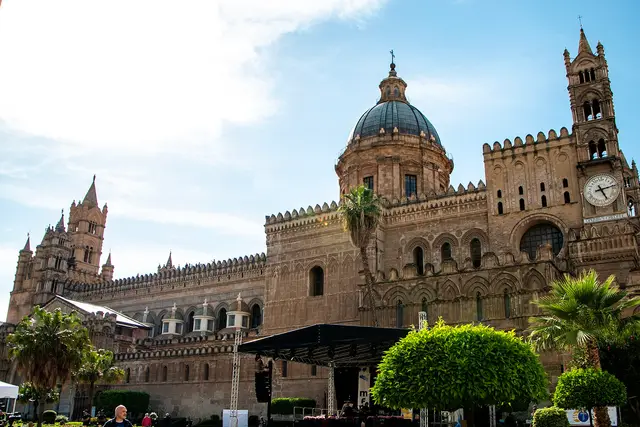
The palace sits at Piazza del Parlamento, 1, an easy 15 to 20 minute walk from the Quattro Canti crossroads down Corso Vittorio Emanuele, passing the cathedral (Cattedrale di Palermo) roughly halfway along. Buses serving Piazza Indipendenza stop close by if you’d rather not walk the whole Corso.
Pair the visit with the cathedral itself, a five-minute walk back east, or continue past the palace to the Porta Nuova, the 16th-century gate marking the old city’s western edge. Both fit naturally into the same morning as a route down toward the historic center.
Frequently asked questions
How much time should I budget for Palazzo dei Normanni?
Plan on about an hour total: 20-25 minutes for the Cappella Palatina alone, plus time for the Sala di Ruggero and any temporary exhibitions, if they're open that day.
What are the opening hours?
Monday to Saturday it's open 8:30am to 4:30pm; Sunday hours are shorter, 8:30am to 1pm only, so don't plan a Sunday afternoon visit.
When is it quietest?
On weekends, mornings from 9am to 2pm run calmer; try to avoid 11am to noon on Saturdays and Sundays, when crowds peak.
Can I always see the Royal Apartments and Sala di Ruggero?
Not guaranteed. The building still houses Sicily's regional parliament, so certain rooms close on sitting days without notice; ask at the ticket desk when you arrive.
How do I get there from central Palermo?
It's a 15-20 minute walk from Quattro Canti down Corso Vittorio Emanuele, passing Palermo Cathedral along the way; several buses also stop near Piazza Indipendenza close to the entrance.
Plan your trip to Palermo
Italy eSIM & staying connected →
Some links above are affiliate links — if you book through them, Wander Atlas earns a small commission at no extra cost to you. It's how we keep every guide free.