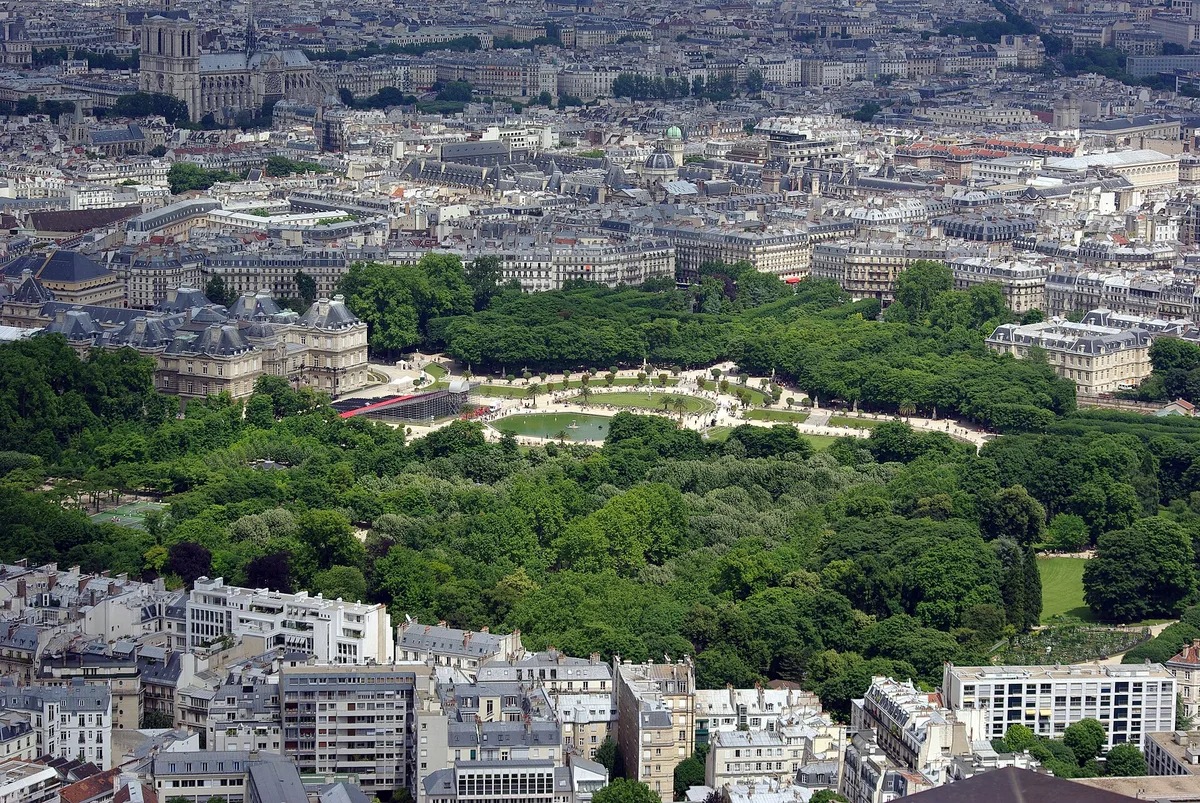
Sixty acres of formal French garden sit behind the Palais du Luxembourg, laid out in the 1610s for Marie de Medici and still run on the same geometric logic four centuries later. Straight gravel allées converge on a central octagonal basin. Chestnut and lime trees are pruned into pattern, not left to sprawl. It reads less like a park you wander into and more like a plan you walk through.
The garden belongs to the French Senate now, which is why it’s kept so precisely: raked paths, statues on plinths in strict rows, lawns you’re mostly asked to admire rather than sit on. That formality is the point. It’s the opposite of the looser, English-style Buttes-Chaumont across town.
Finding your way in
The garden has multiple gated entrances, and which one you use shapes your first impression.
- Rue de Médicis / Place Edmond Rostand (RER B, Luxembourg station) drops you right by the Medici Fountain, a shaded, ivy-hung basin that’s the most photographed corner of the park.
- Rue de Vaugirard, on the north side, runs along the Palais itself.
- Boulevard Saint-Michel entrances are closest if you’re walking down from the Sorbonne or the Panthéon.
All gates keep the same hours as the garden, roughly 7:30am to between 9:15 and 9:30pm depending on the season, and guards do walk through blowing whistles at closing time, so don’t cut it fine.
What’s actually inside
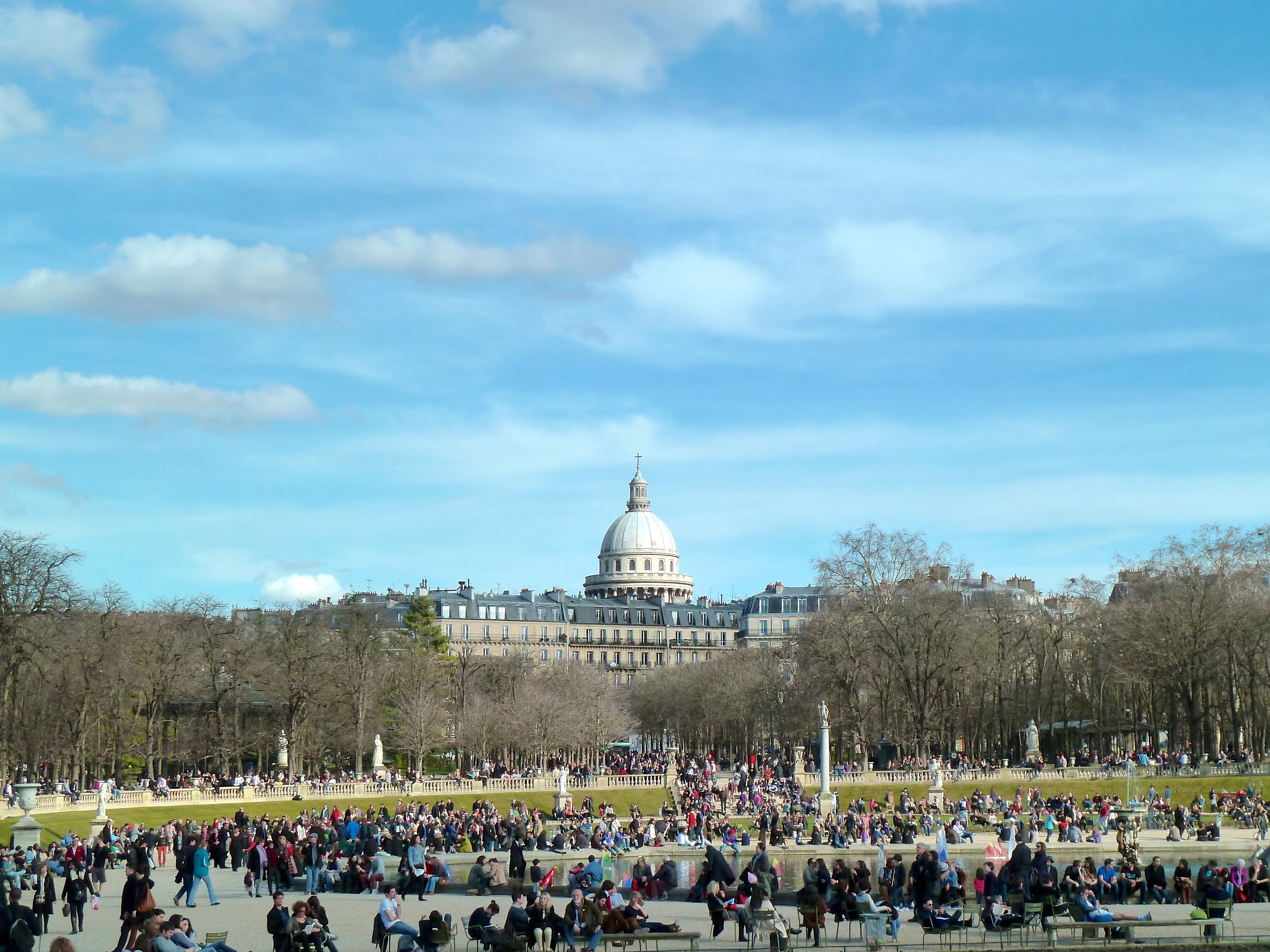
The octagonal Grand Bassin is the anchor: children rent small wooden sailboats and push them off with long sticks, a tradition that’s been running here for generations. Around it, more than a hundred statues watch from pedestals, including a ring of France’s queens and a scaled-down Statue of Liberty cast from Bartholdi’s original mold.
Tucked in the southwest corner, an orchard grows heirloom apple and pear varieties, and there are working beehives nearby that have produced honey since the 19th century. The Medici Fountain, on the eastern side, is Italian Baroque grafted onto a French garden, all dark water and moss under a canopy of plane trees.
Tennis courts, a puppet theatre (the Théâtre du Luxembourg), and a bandstand for free summer concerts round out the grounds. None of it is hidden; all of it rewards slowing down.
Claiming a chair
The park’s signature move is its green metal chairs, scattered loosely rather than bolted down, free to drag wherever the sun or shade suits you. Locals and tourists alike treat this as one of the only truly unstructured things you can do here.
- Pull a chair to the edge of the Grand Bassin for the classic view.
- Move one under the chestnut trees near the tennis courts if the day is hot.
- Expect them to be scarce on warm afternoons; this is a very popular garden, and prime chairs go fast.
Avoiding the crowds
Because Jardin du Luxembourg draws heavy foot traffic year-round, especially on weekend afternoons and any sunny day, timing matters more here than in quieter Paris parks.
Arrive at or near opening, 7:30am, and you’ll share the paths mostly with joggers and locals doing tai chi near the orchard. By midday, especially Saturday and Sunday, the main allées and the chairs around the basin fill up fast. If you can only come in the afternoon, the quieter northern paths near Rue de Vaugirard tend to hold fewer people than the Bassin side.
Eating and resting without leaving
There’s no need to exit for food. A handful of kiosks inside the gates sell coffee, crepes, and sandwiches, and there are proper cafe terraces near the tennis courts and by the main entrance on Boulevard Saint-Michel. Picnicking on the open lawns (rather than the ornamental ones roped off with signs) is allowed and common on warm days, so a baguette and cheese from a nearby rue de Vaugirard shop works just as well as a kiosk crepe.
Restrooms are marked and maintained near the main entrances; there’s usually a small fee, so keep a coin or two on hand.
Frequently asked questions
How do I get to Jardin du Luxembourg?
The closest stop is Luxembourg station on RER B, right at the Rue de Médicis entrance. Several Métro stations, including Saint-Sulpice (Line 4) and Odéon (Lines 4 and 10), are a 5-10 minute walk away.
Is Jardin du Luxembourg free to enter?
Yes, the garden itself is free and open to the public daily. Some individual attractions inside, like renting a toy sailboat for the pond or entering the puppet theatre, carry a small separate cost.
What time does the garden open and close?
It opens at 7:30am every day. Closing time shifts with the season, between 9:15pm and 9:30pm on weekdays in summer and slightly earlier, around 9:15pm, on Mondays, Fridays, weekends.
When is the best time to visit to avoid crowds?
Go right at opening, around 7:30am, before tour groups and weekend crowds arrive. This is a very popular garden, so afternoons, especially on sunny weekends, get busy fast.
How long should I plan to spend there?
A walking loop past the main statues, the Grand Bassin, and the Medici Fountain takes about an hour. Bring a book or claim a green chair and you can easily spend half a day.
Plan your trip to Paris
France eSIM & staying connected →
Some links above are affiliate links — if you book through them, Wander Atlas earns a small commission at no extra cost to you. It's how we keep every guide free.