Natural History Museum of the University of Pisa: Travel Guide
At a glance
Opening hours
- Monday: 9:00 AM – 7:00 PM
- Tuesday: 9:00 AM – 7:00 PM
- Wednesday: 9:00 AM – 7:00 PM
- Thursday: 9:00 AM – 7:00 PM
- Friday: 9:00 AM – 7:00 PM
- Saturday: 9:00 AM – 7:00 PM
- Sunday: 9:00 AM – 7:00 PM
How this guide is made
Produced with AI assistance and reviewed against live data sources. Facts such as hours, ratings, and location come from Google Places; images are licensed or public domain. Details can change — please verify before visiting. Editorial policy
Most people come to Pisa for the Leaning Tower and never make it the extra eight kilometres east to Calci, which is exactly why the Certosa’s courtyards feel so much bigger than the crowds inside them. The building itself is the first surprise: a working Carthusian monastery founded in 1366, its cloisters, monks’ cells and frescoed church still intact, now sharing the complex with one of Italy’s largest natural history collections.
You enter through the monastery’s grand baroque facade, past a formal garden laid out in geometric box hedges, before the route funnels you into room after room of taxidermy, minerals, fossils and skeletons assembled over more than four centuries by the Medici and Lorraine grand dukes.
The whale skeletons are the reason to go
Nothing prepares you for the cetacean gallery. It occupies what was once the monastery’s granary, a long vaulted hall now strung with the full skeletons of sperm whales, a fin whale and other cetaceans suspended at eye level and above.
This is reportedly the largest collection of its kind in Europe. Walk the length of it slowly; the scale only registers once you’re standing under a jawbone longer than you are tall.
- Sperm whale and fin whale skeletons, plus smaller dolphin and porpoise specimens
- Mounted in a former granary with high vaulted ceilings, so the acoustics carry
- Best photographed from the raised walkway at the far end, where you get the full line of skeletons in one frame

Beyond the whales: minerals, monsters and a monastery
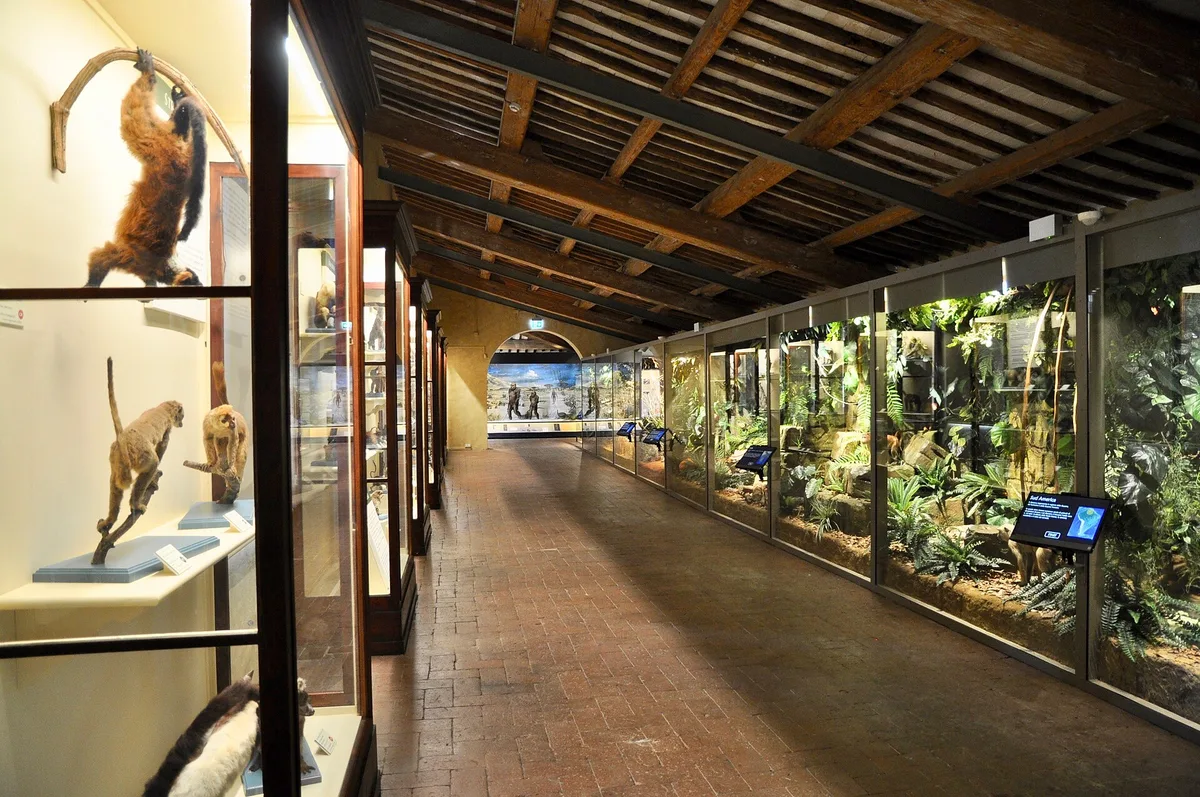
The museum’s older wings hold the Medici mineral and gem collection, cabinets of shells and corals, and a menagerie of taxidermied mammals and birds arranged in the old-fashioned diorama style rather than behind sterile modern glass.
One room is given over to the “monsters,” a 19th-century collection of preserved animal deformities that was considered cutting-edge biology in its day and now reads as genuinely strange. Don’t skip the aquarium section either, added more recently and stocked with live Mediterranean and tropical species, a good stop if you’re travelling with children who’ve had their fill of dead things upstairs.
Because the museum occupies the actual monastery, you also walk through cloisters, a chapter house and several monks’ cells with their original frescoes still on the walls. The scale of the complex, over 300 rooms in total though only a portion is open to visitors, means the building competes with its own contents for your attention.
Getting to Calci from Pisa
The Certosa sits at Via Roma 79 in Calci, a small town in the hills east of the city, and it’s not walkable from central Pisa.
- By car: roughly 20 minutes from Pisa, with free parking near the monastery gates
- By bus: CTT Nord buses run from Pisa to Calci; check current timetables before you go, as rural routes change
- By taxi: around 20 minutes, a reasonable option if you’re short on time or travelling in a group
There’s no train station in Calci itself, so this is a trip that needs either a car or a bit of bus-timetable patience.
Timing your visit
The museum opens at 9am and stays open until 7pm every day of the week, which is generous by Italian museum standards and gives you room to plan around tour groups rather than around closing time.
Because it’s a well-reviewed, well-known attraction rather than a quiet local secret, midday in high season can bring coach parties timed to arrive after the drive from Pisa’s tourist centre. Getting there close to 9am, or after 4pm when day-trippers have started heading back, tends to leave the whale hall and cloisters noticeably calmer.
Making the most of the visit
Wear shoes you can walk in for two hours; the stone floors and courtyards add up over 300-plus rooms, even if you only see a fraction of them.
Photography is generally fine without flash, which matters in the taxidermy rooms where flash would otherwise be tempting. Bring a light jacket even in summer: the older stone galleries, including the whale hall, stay noticeably cooler than the courtyards outside.
Pair the visit with a walk through Calci’s small town centre afterward, or continue into the Monti Pisani hills if you have a car and want to extend the day beyond the museum itself.
Frequently asked questions
How long should I spend at the Natural History Museum of the University of Pisa?
Plan on two to three hours to cover the whale skeleton hall, the mineral and taxidermy rooms, and at least part of the monastery cloisters and cells.
How do I get from Pisa to the museum in Calci?
It's about 20 minutes by car or taxi, or you can take a CTT Nord bus from Pisa; there's no train service to Calci, and free parking is available near the monastery.
When is the best time to visit to avoid crowds?
The museum is open 9am to 7pm daily. Arriving right at opening or after about 4pm generally avoids the coach tour groups that arrive mid-morning to early afternoon.
Is the museum suitable for children?
Yes, the aquarium section with live Mediterranean and tropical species is a strong draw for kids, alongside the dramatic scale of the whale skeletons.
What's nearby if I want to extend the trip?
Calci's small town centre is walkable from the monastery, and the Monti Pisani hills offer further walking or driving routes if you have your own transport.
Plan your trip to Pisa
Some links above are affiliate links — if you book through them, Wander Atlas earns a small commission at no extra cost to you. It's how we keep every guide free.