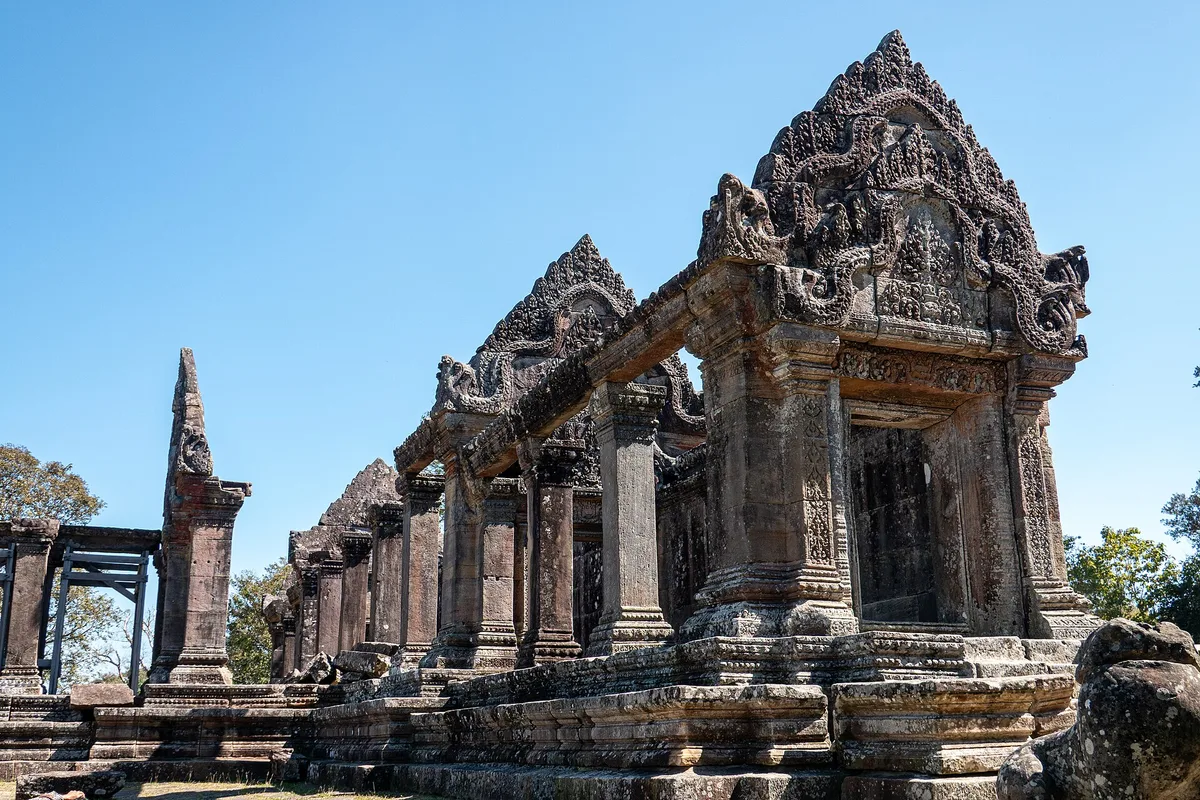
Preah Vihear doesn’t sit near anything. That’s the point. This 11th-century Hindu temple to Shiva was built along a natural ridge of the Dangrek Mountains, right on the border with Thailand, and the whole complex climbs nearly 800 meters up the escarpment before ending at a sanctuary that looks straight down a sheer cliff onto the Cambodian lowlands.
Poipet, where this guide is anchored, is actually a long way from the temple itself, sitting at the Thai border far to the west. There’s no shortcut here: reaching Preah Vihear from Poipet means a full day’s drive east across Cambodia, usually routed through Siem Reap or Anlong Veng, before turning north to the mountain.
Getting up the mountain
The temple itself sits at the top of a long, narrow spine of rock, and there is no way to see it without climbing that spine.
Visitors typically drive to a base area near Sra Em town, then transfer to local motodops or pickup trucks for the final steep ascent, since the road up is not always suitable for standard rental cars. It’s a slow, winding climb with switchbacks cut into the cliff face.
Give yourself at least half a day once you’re at the base: between the transfer, the walk through the complex, and the drive back down, this isn’t a stop you can rush.
Walking the causeway of the gods
Unlike temples built on a single flat plan, Preah Vihear unfolds along an axis nearly 800 meters long, rising through a sequence of gopuras (gateway towers) and courtyards.
You enter at the lowest point and climb steadily north to south, passing through five main gopura structures before reaching the central sanctuary at the summit.
- Naga staircase: the entrance stairway flanked by seven-headed serpent balustrades, a hallmark of Khmer temple design
- Gopura III and IV: carry some of the best-preserved lintel carvings, including scenes from Hindu mythology like the Churning of the Sea of Milk
- Central sanctuary: the final courtyard, perched directly on the cliff edge with views over the Cambodian plain hundreds of meters below
The carvings here rank among the finest surviving Angkorian-era stone work, partly because the site’s remoteness spared it from the heavier tourist wear seen at Angkor.
The border question nobody skips
This is the detail every visitor needs to know before showing up. Preah Vihear sits directly on the Cambodia-Thailand border, and the temple has been the subject of an international boundary dispute for decades, including a 1962 World Court ruling and a further 2013 clarification that confirmed Cambodian sovereignty over the site.
Access is exclusively from the Cambodian side; there is no functioning crossing from Thailand into the temple grounds for tourists. Border tensions have periodically closed the site altogether in past years, so confirming current access conditions before you set out isn’t optional, it’s essential.
Check with a local tour operator or the Cambodian ministry of tourism for the latest status, especially if you’re planning a trip with a tight schedule.
Reading the cliff-edge view
The reward for the climb is the view from the final courtyard, where the mountain simply stops and the land drops away toward the Cambodian plain.
On a clear dry-season day, you can see for many kilometers across flat farmland stretching toward Preah Vihear province and beyond. This vantage point is exactly why the site was chosen for a temple in the first place: it was meant to feel like standing at the edge of the world, a threshold between earth and the divine realm the temple was built to honor.
Bring water and a hat. There’s little shade along the exposed causeway sections, and the sun at this elevation is intense even in cooler months.
When to time your climb
The temple keeps consistent hours daily, from 8:30am to 4:30pm, which shapes how you should plan the day.
Arriving as close to opening as your travel schedule allows is the smart move here, both for cooler temperatures on the exposed stone causeway and for softer morning light on the carved lintels. By afternoon the climb back down can feel long if you’ve lingered at the summit past the early hours.
The dry season, from November through April, is the only realistic window for most travelers. The access road up the escarpment can become difficult or impassable during the rainy months, and low season haze often erases the cliff-edge view that makes the climb worth it.
Respecting a living sacred site
Preah Vihear is still an active place of Buddhist and Hindu-influenced reverence, not simply a ruin, so dress and behavior matter here the way they would at any working temple in Cambodia.
- Cover shoulders and knees; this is enforced more strictly here than at some Angkor sites given the sanctuary’s active religious use
- Remove shoes before entering any roofed sanctuary chamber
- Keep voices low near the central shrine, where local visitors often come to pray
- Expect a mix of Cambodian pilgrims and international visitors, since this remains a well-known landmark rather than an undiscovered spot
Because it draws steady visitor numbers and sits inside an active border zone, patience with checkpoints, permit checks, and the occasional queue for the pickup trucks at the base is part of the experience, not an inconvenience to route around.
Frequently asked questions
How do you get to Preah Vihear Temple from Poipet?
It's a full day's drive east across Cambodia, typically routed through Siem Reap or Anlong Veng, then north to Sra Em town at the base of the mountain before a final transfer up the escarpment.
What are the opening hours?
The temple is open daily from 8:30am to 4:30pm. Arrive as early as possible to beat the afternoon heat on the exposed causeway.
Is Preah Vihear accessible from Thailand?
No. Due to the ongoing border arrangement, access is exclusively from the Cambodian side. Check current conditions before traveling, as the site has periodically closed during border tensions.
How long does a visit take?
Plan for at least half a day once you reach the base near Sra Em, factoring in the truck transfer up the mountain, walking the roughly 800-meter causeway, and the descent.
When is the best time to visit?
The dry season, November through April, offers the clearest views and a passable access road. The rainy season can make the mountain road difficult and often obscures the cliff-edge views.
Plan your trip to Poipet
Cambodia eSIM & staying connected →
Some links above are affiliate links — if you book through them, Wander Atlas earns a small commission at no extra cost to you. It's how we keep every guide free.
Related guides
 attraction
 Banteay Srei Temple: Siem Reap Travel Guide (4.8★)
 attraction
 Pre Rup Temple: Siem Reap Travel Guide (4.7★)
 attraction
 Preah Khan Temple: Siem Reap Travel Guide (4.8★)
 attraction