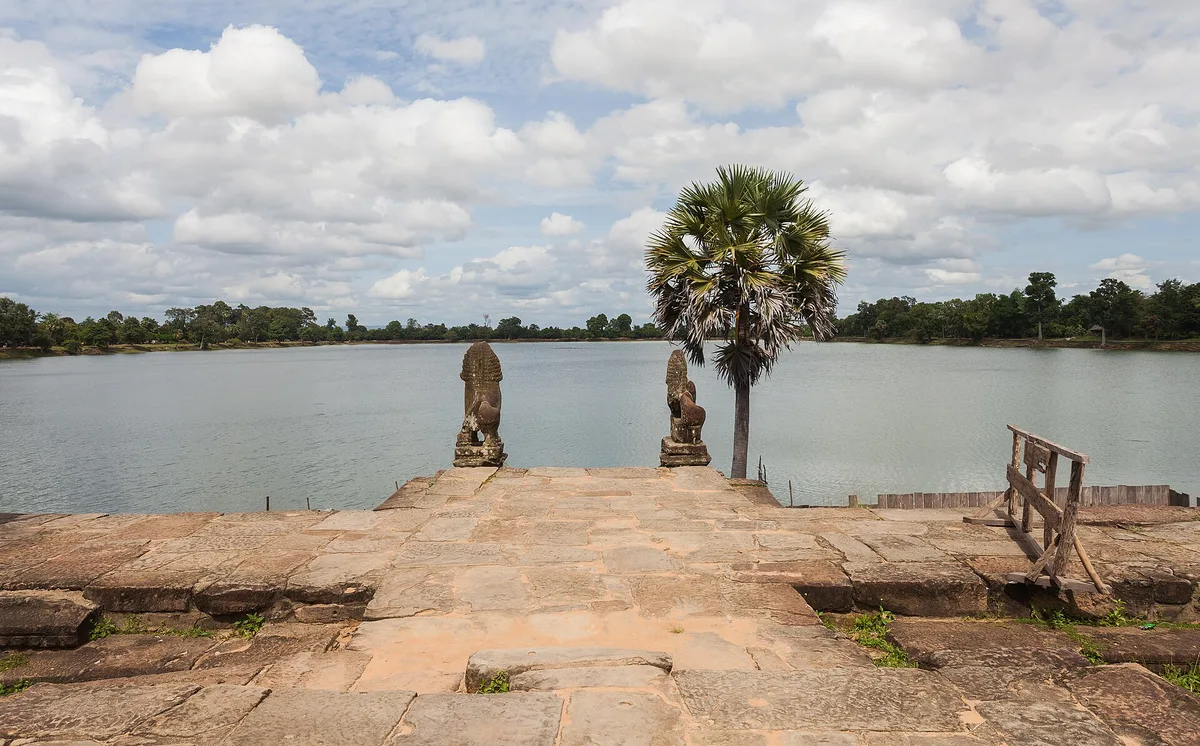
Most people rushing between Angkor Wat and Ta Prohm never turn off for Srah Srang, and that’s exactly why it’s worth the detour. This is a man-made reservoir, about 700 metres long, dug to supply water and mark royal ceremony.
You reach it via a sandstone landing terrace on the western bank, guarded by stone lions and a pair of naga serpents whose bodies form the balustrade. The steps lead straight down to the water’s edge, angled so that sunrise lands directly across the reservoir in front of you. Behind you, low sugar palms and dry dipterocarp forest ring the water on three sides.
The sunrise that isn’t Angkor Wat’s
Everyone with a 5am alarm in Siem Reap heads for the reflecting pools at Angkor Wat. Srah Srang gets a fraction of that crowd, even though the view across open water, framed by the naga terrace, is arguably calmer and easier to actually enjoy.
The sun comes up over the reservoir itself rather than behind a temple silhouette, so the payoff here is more about stillness and reflection on the water than a postcard shot of towers. Bring a flashlight or your phone light for the short walk from the road to the terrace; there’s no lighting installed.
Getting there and reading the site
Srah Srang sits inside the Angkor Archaeological Park, on the small road connecting Banteay Kdei and Pre Rup, east of the main Angkor Wat-Angkor Thom loop. Most visitors reach it by tuk-tuk or hired car as part of the “grand circuit,” often paired with Banteay Kdei directly across the road.
There’s no ticket booth here specifically; your standard Angkor Pass, checked at the park’s main entrances, covers it. A visit takes 20 to 30 minutes if you’re just here for the terrace and the view, longer if you sit and wait out a sunrise.

What you’re actually looking at
The reservoir was built in stages during the Angkor period, with its sandstone terrace added later, which is the era that gives it its current stone terrace. Historians believe it served both practical irrigation purposes and ceremonial ones, possibly used for royal bathing rituals or as a staging point for barges during festivals.
Unlike the moats around Angkor Wat or Angkor Thom, Srah Srang has no temple rising from its center. What you get instead is open water, sky, and one architecturally serious embarkation point. It rewards visitors who like ruins for their engineering and atmosphere rather than carved narrative panels.
Timing your visit around the park, not the crowds
Because Srah Srang opens at 5:00 AM and closes at 5:30 PM daily, sunrise is genuinely accessible here, not a special exception. Arriving right at opening gets you the terrace nearly empty, since most tour groups are funneled toward Angkor Wat or Sras Srang’s more famous neighbors first.
Midday sun flattens the reflection and brings heat with little shade around the water, so it’s a rougher window than dawn or the couple of hours before closing. Late afternoon, closer to 4 or 5pm, is a quieter second option if you can’t manage the early start.
Pairing it with Banteay Kdei
The practical move locals and drivers use is to combine the two sites in one stop. Banteay Kdei, the Buddhist monastery temple directly across the road, takes 30 to 45 minutes to explore and pairs naturally with a sunrise or late-afternoon look at Srah Srang.
- Ask your tuk-tuk driver for “Srah Srang and Banteay Kdei together,” it’s a standard combination on the grand circuit
- Wear sandals or shoes you don’t mind getting dusty; the terrace steps and shoreline are uneven sandstone
- Skip bottled drinks vendors expecting a crowd, there’s rarely one set up here, so carry your own water
- Respect the terrace itself; the naga balustrade is original stonework, not a modern replica for climbing on
Frequently asked questions
How do I get to Srah Srang from Siem Reap town?
It's inside the Angkor Archaeological Park, about a 20-25 minute drive from central Siem Reap. Most visitors go by tuk-tuk or hired car as part of the grand circuit route, often combined with Banteay Kdei just across the road.
Do I need a separate ticket for Srah Srang?
No, it's covered by the standard Angkor Pass checked at the park's main entrances. There's no dedicated ticket booth at the site itself.
What time should I go for sunrise?
The site opens at 5:00 AM daily, so arrive right at opening to catch the sunrise over the water with the fewest other visitors, well ahead of the crowds that head to Angkor Wat instead.
How long should I spend at Srah Srang?
Plan on 20 to 30 minutes for the terrace and reservoir view, or longer if you want to sit through sunrise. Pair it with Banteay Kdei across the road for a fuller stop of an hour or more.
Is Srah Srang worth visiting if I've already seen Angkor Wat's sunrise?
Yes, it offers a quieter, less crowded alternative sunrise spot with open water views rather than temple silhouettes, and it's still under-the-radar compared to the park's headline sites.
Plan your trip to Siem Reap
Cambodia eSIM & staying connected →
Some links above are affiliate links — if you book through them, Wander Atlas earns a small commission at no extra cost to you. It's how we keep every guide free.
Related guides
 attraction
 Ta Prohm Temple: Siem Reap Travel Guide (4.8★)
 attraction
 Pre Rup Temple: Siem Reap Travel Guide (4.7★)
 attraction
 Angkor Wat: Siem Reap Travel Guide (4.8★)
 attraction
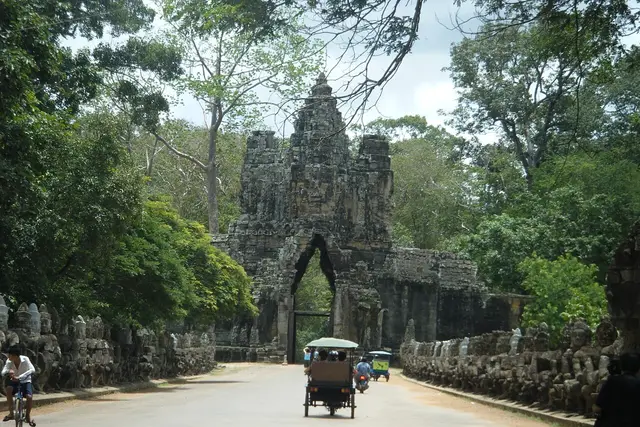
 South Gate Angkor Thom: Siem Reap Travel Guide (4.9★)
This spot is Day 1 of our Siem Reap 3-day itinerary