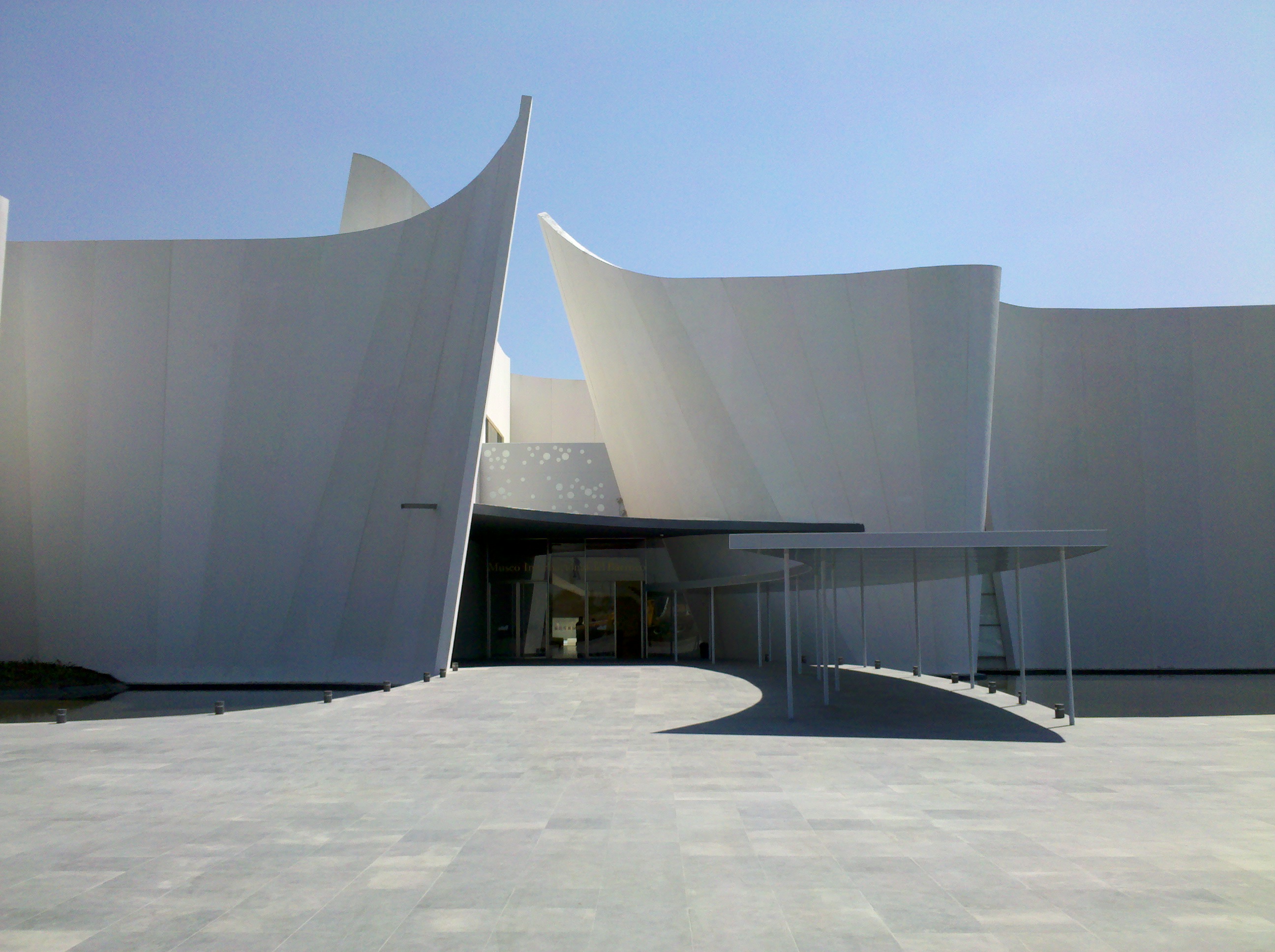
White walls, gold inside
The building looks nothing like what it holds. Toyo Ito, the Japanese architect, designed it as a run of tall white concrete panels that curve and lean, a bit like stiff sheets of paper stood on end. It opened in 2016, out among the glass towers and wide avenues of the Angelópolis district.
Inside, the walls stay pale and smooth. They’re the backdrop for the opposite style: gilded altarpieces, dark oil paintings, carved saints and heavy ornament. Between the gallery wings sits a central courtyard with a fountain and shallow water, where the white walls are mirrored back at you.
Moving through the galleries
The permanent collection treats the Baroque as a whole way of seeing the world. It covers far more than painting. The rooms work through themes, so you move from one art form to the next rather than through a straight timeline.
Expect these themes, roughly in this spirit:
- Painting and sculpture, the European and New Spain canvases most visitors come for
- Architecture, with models and projections explaining domes, facades and the Baroque obsession with drama
- Music and theatre, where listening stations and screens take over from objects
- Daily life and belief, covering how the style reached clothing, festivals and devotion
Audiovisual displays do a lot of the explaining. That suits travellers who don’t read much Spanish, because the images carry the story. Temporary exhibitions rotate through separate halls, so check the official site before you go if a particular show is the draw.
Timing your visit
The museum keeps a simple schedule. It’s open from 10am to 7pm, Tuesday through Sunday, and closed every Monday. That Monday closure catches people who plan a long weekend in Puebla, so put it on a Friday or Sunday instead.
Weekend afternoons are the time to avoid. Between 12pm and 6pm on Saturdays and Sundays the galleries fill with families and tour groups, and the screen-based rooms get crowded. If you can only come at the weekend, be at the door at 10am and you’ll have the first rooms before the midday rush builds. On a weekday the schedule simply has fewer visitors to absorb.
Give it two to three hours. The courtyard and a slow loop around the outside of the building are worth an extra half hour, especially in late-afternoon light on the white panels.

Reaching Angelópolis
This isn’t a walk from the Zócalo. The museum is in the Reserva Territorial Atlixcáyotl, the modern southwest zone that grew up along Vía Atlixcáyotl. The historic centre is roughly a 20 to 30 minute drive away, depending on traffic.
Most visitors take a taxi or a ride-hailing app, both widely used in Puebla. Give the driver the full address, Atlixcáyotl 2501, rather than just the museum name. The area is built around cars, with big roads and long blocks, so a ride is easier than piecing together buses.
The Estrella de Puebla observation wheel and the Angelópolis shopping area are close by. That makes it easy to add a meal or a ride on the wheel before heading back.
Making the most of the ticket desk and galleries
A few habits make the visit smoother:
- Check the current price at the ticket desk or official site. Admission policies, including any discount days, change, so confirm before you go.
- Pick up the floor plan. The building’s curved layout means galleries branch off the courtyard, and it’s easy to miss a whole wing.
- Start with the architecture rooms. They give you the vocabulary for everything else, and later for the churches downtown.
- Use a card or a mobile wallet for tickets. Keep some pesos for taxis and small purchases nearby, though.
- Treat the screens as part of the collection. The music and theatre sections only make sense if you stop and watch.
Weekend visitors should plan their day around the 12pm–6pm crush. Do the museum first thing, then spend the afternoon somewhere else.
Seeing the real thing downtown
Afterwards, go and see the Baroque where it was actually built. Puebla’s historic centre is a UNESCO World Heritage Site, and the museum reads like an introduction to it.
Head to the Capilla del Rosario inside the Templo de Santo Domingo. Its walls and vault are covered in gilded plaster, about as far as Mexican Baroque ornament goes. Puebla Cathedral on the Zócalo and the Biblioteca Palafoxiana, with its tiers of old wooden shelving, are a few blocks away. Seeing them on the same day as the museum works best, while the galleries are still fresh in your mind.
Frequently asked questions
When is the quietest time to visit the Museo Internacional del Barroco?
The busiest period is weekends between 12pm and 6pm, so avoid that window. If you must visit on a weekend, arrive when the doors open at 10am. Otherwise, a Tuesday-to-Friday visit avoids the weekend crowds altogether.
Is the museum open on Mondays?
No. It's closed on Mondays. It opens Tuesday through Sunday from 10am to 7pm.
How do I get there from Puebla's historic centre?
Take a taxi or a ride-hailing app to Atlixcáyotl 2501 in the Reserva Territorial Atlixcáyotl (Angelópolis area). The ride usually takes about 20 to 30 minutes, depending on traffic.
How long should I spend there?
Two to three hours covers the permanent galleries and the courtyard. Add more time if there's a temporary exhibition you want to see.
What else is nearby?
The Estrella de Puebla observation wheel and the Angelópolis shopping area are close. Downtown, the Capilla del Rosario, Puebla Cathedral and the Biblioteca Palafoxiana let you see real Baroque spaces after the museum.
Plan your trip to Puebla
Mexico eSIM & staying connected →
Some links above are affiliate links — if you book through them, Wander Atlas earns a small commission at no extra cost to you. It's how we keep every guide free.