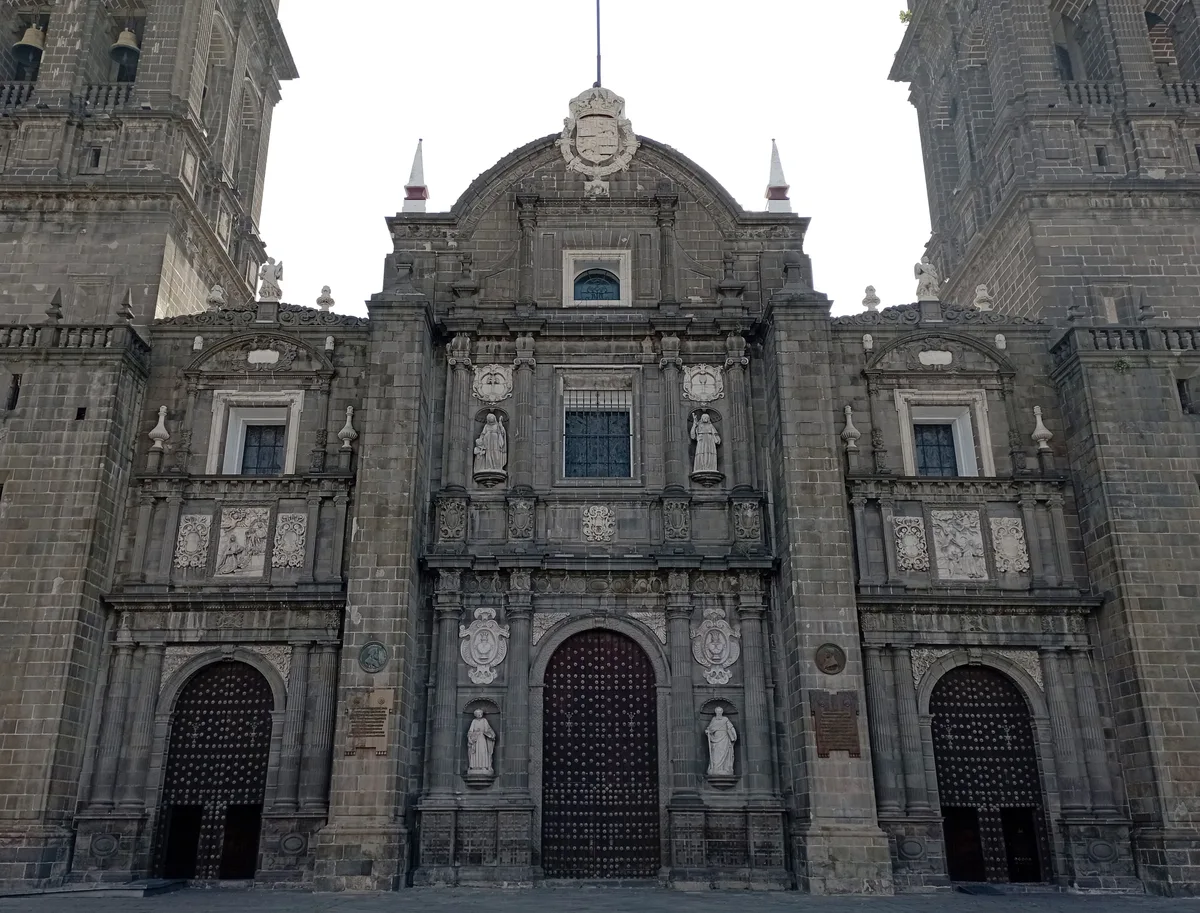
Two grey stone towers rise over the Zócalo, and they are visible from most of the centre’s straight colonial streets. They belong to the Basílica Catedral de Nuestra Señora de la Inmaculada Concepción, which everyone simply calls the Catedral de Puebla. It is one of the most-reviewed sights in the city and consistently well rated. Expect company.
A cathedral that took most of a century
Building began in the 1570s. The cathedral was consecrated in 1649 under Bishop Juan de Palafox y Mendoza, whose name you will keep seeing around the old town. That long timeline shows in the stonework. The exterior is sober, dark grey Renaissance masonry, and the interior goes the other way entirely: gold leaf, carved altarpieces and marble.
The building anchors the historic centre of Puebla, a UNESCO World Heritage Site since 1987. Its towers are among the tallest of any colonial church in Mexico. You can take that in from the square long before you reach the iron railings and the atrium gates.
Inside: chapels, onyx and the octagonal altar
Step through and the scale changes. A long central nave runs between rows of side chapels, each with its own altarpiece and its own small crowd of candles and votive offerings.
What to look for as you walk:
- The ciprés, the octagonal high altar under the crossing. It is a freestanding, many-columned structure finished in the early 19th century, designed by the neoclassical architect Manuel Tolsá.
- The Altar de los Reyes behind it in the apse, a towering gilded altarpiece and the most theatrical piece in the church.
- The choir stalls, with dense inlaid woodwork in the enclosed choir in the nave.
- The side chapels, where local families still come to pray. Keep your voice low and give them room.
Look up as well as around. The vaulted ceilings and the dome over the crossing are the reason the inside feels so much bigger than the square suggests.
Two towers and the angels of Puebla
The city’s full old name is Puebla de los Ángeles, and the cathedral carries a piece of that. A long-told local legend says the great bell in one of the towers was too heavy for the builders to raise. Angels, the story goes, hoisted it into place overnight.
Nobody asks you to believe it. But it explains the angel imagery you will find across the city, and why poblanos are so attached to these towers. They are lit after dark. Coming back to the Zócalo in the evening is the easiest way to see the façade looking its sharpest.

Timing your visit around the crowds
Our measured foot-traffic data is unusually clear here. The quietest window runs from 7am–11pm on weekdays and on weekends. That covers essentially the whole day, so the real deciding factor is which day you choose.
Weekends are the problem. From 8am–8pm on Saturdays and Sundays, the cathedral is at its busiest, with families, tour groups and Mass-goers all in the nave together. If you only have a weekend, try to avoid the middle of that window. A weekday visit gives you the chapels with far fewer people in your sightline.
No opening hours are confirmed for this guide. Check the parish notices or the official diocesan channels before you go, especially around Holy Week and other major feasts.
Behaving well during Mass
This is a working cathedral first and a monument second, and visitors who forget that stand out quickly. A few habits will keep you on the right side of the ushers:
- Check for a service before you wander. If Mass is under way, sit quietly at the back or come back later. Walking the side aisles taking photos during a service is the one thing that reliably gets you asked to stop.
- Dress with some modesty. Shoulders covered and no beachwear is the safe standard. Hats come off inside.
- Turn the flash off and keep your phone silent.
- Leave something in the donation boxes if you can. They fund upkeep of a very large, very old building.
- Don’t treat the side chapels as a backdrop. People kneeling there are praying, not part of the scenery.
In Spanish it is simply la Catedral, and anyone in the centre will point you to it.
Getting to the Zócalo
The cathedral sits on Calle 16 de Septiembre, facing the Zócalo, in the grid of streets that makes up the Centro Histórico. If you are staying anywhere in the old town, walk. Every street here leads back to the square eventually.
From Mexico City, long-distance buses run to Puebla’s CAPU terminal in roughly two hours, depending on traffic. From there, a taxi or ride-hail into the centre is the simplest option. Puebla’s own airport, Hermanos Serdán, is outside the city, so allow time for the transfer. Driving in the centre is slow and parking is tight, so leave the car at your hotel.
What sits around the square
The cathedral is the start of a very compact walk, so plan to keep going:
- Biblioteca Palafoxiana, just behind the cathedral. Bishop Palafox founded it, and it is often described as the first public library in the Americas, with a vaulted reading room lined with old shelving.
- Templo de Santo Domingo, a few blocks north along 5 de Mayo. Its Capilla del Rosario is covered almost entirely in gilded stucco.
- Callejón de los Sapos and the nearby Barrio del Artista, for antiques, Talavera pottery and painters’ studios.
- The arcades (portales) around the Zócalo, where you can sit with a coffee and look back at the façade.
Puebla is the home of mole poblano. In late summer it is also the place for chiles en nogada, so plan a meal near the square once you’ve seen the cathedral.
Frequently asked questions
When is the quietest time to visit Catedral de Puebla?
Measured foot-traffic data puts the quietest window at 7am–11pm on both weekdays and weekends. Weekends are busiest from 8am–8pm, so a weekday visit is the calmest option.
How long should I spend inside?
Around 45 minutes to an hour covers the nave, the octagonal high altar, the Altar de los Reyes and the side chapels. Allow longer if you also want to see the Biblioteca Palafoxiana next door.
Can I visit during Mass?
You can attend, but don't sightsee during a service. Sit quietly or come back later, and keep the flash off at all times. Opening and Mass times aren't confirmed here, so check parish notices before you go.
How do I get to the cathedral from Mexico City?
Take a long-distance bus to Puebla's CAPU terminal, which takes roughly two hours depending on traffic. Then take a taxi or ride-hail to the Zócalo in the Centro Histórico. The cathedral faces the square on Calle 16 de Septiembre.
What else is nearby?
The Biblioteca Palafoxiana is right behind the cathedral. The Templo de Santo Domingo and its Capilla del Rosario are a few blocks north on 5 de Mayo. Callejón de los Sapos and the Barrio del Artista are a short walk away.
Plan your trip to Puebla
Mexico eSIM & staying connected →
Some links above are affiliate links — if you book through them, Wander Atlas earns a small commission at no extra cost to you. It's how we keep every guide free.
Related guides
 attraction
 Museo Amparo: Puebla Travel Guide (4.8★)
 attraction
 Parque Ecológico: Puebla Travel Guide (4.6★)
 attraction
 Museo Internacional del Barroco: Puebla Travel Guide (4.7★)
 restaurant