Four buildings, one ticket
From Grande Allée, the museum looks like a stack of glass boxes. That’s the Pierre Lassonde Pavilion. Behind it, set back in the park, are two much older stone buildings. Visitors often expect one building and find a small campus instead.
There are three main pavilions, plus a central hall that ties them together:
- Pierre Lassonde Pavilion: the contemporary wing on the street, opened in 2016 and designed by OMA with Provencher_Roy. Its glass volumes are stacked and cantilevered one over the next.
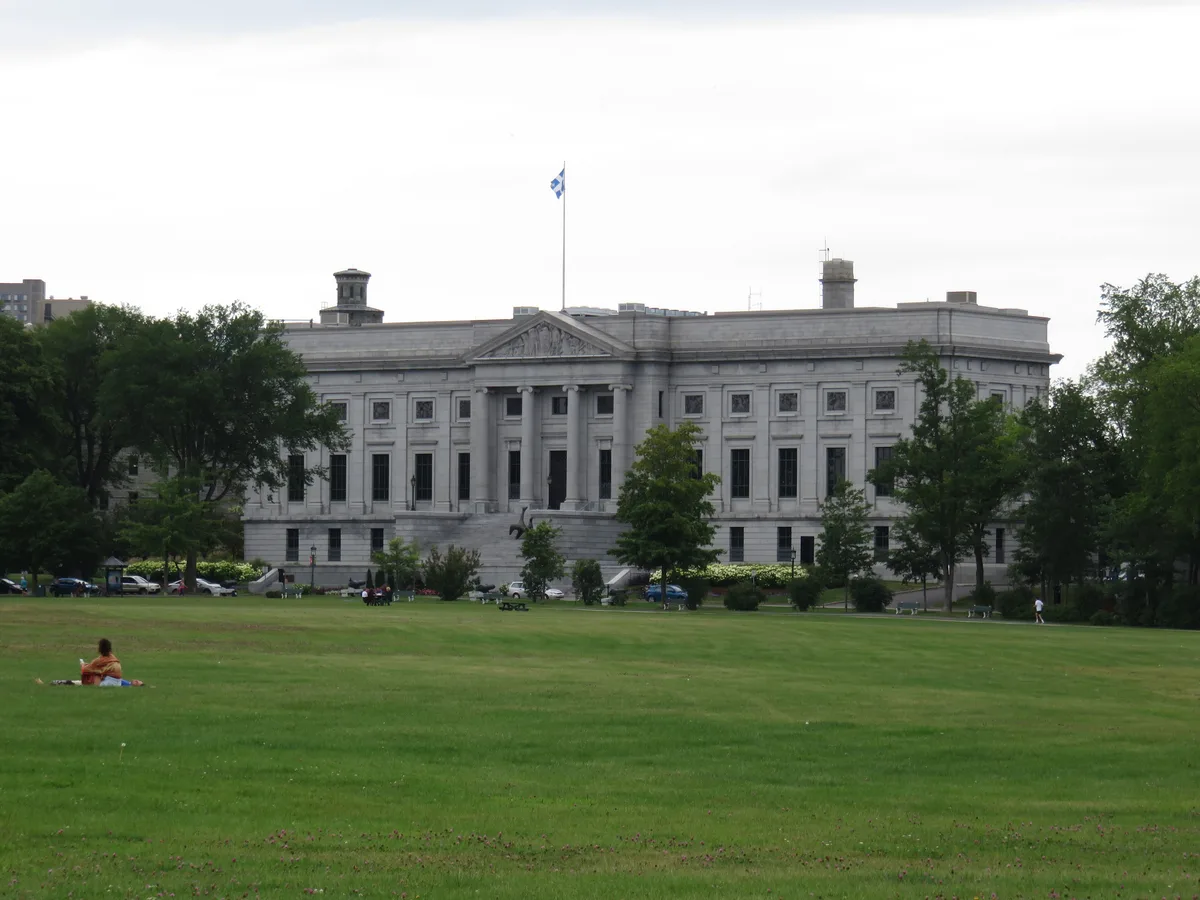
- Gérard Morisset Pavilion: the original 1933 museum, a neoclassical stone building facing the Plains of Abraham.
- Charles Baillairgé Pavilion: a 19th-century former prison, now gallery space.
Every wing is on the same visit. Plan two to three hours if you want to see all of them without hurrying.
The prison wing
Of the three buildings, this one has the oddest backstory. The Charles Baillairgé Pavilion was Quebec City’s jail for about a century before the museum took it over. A section of the old cells has been kept, so you can step out of a gallery and into a narrow cell corridor.
The building is named for its architect. It sits in the park beside the Morisset Pavilion, so from some of the windows you look straight out onto open lawn. The contrast between the bare corridor and the green outside is the reason to linger here.
What’s on the walls
The museum’s focus is Quebec art, from colonial-era religious painting up to the present. If you know little about Canadian art, this is one of the clearest places to start.
Names to look for:
- Alfred Pellan: bold, colourful modernism and a central figure in Quebec’s break with academic painting.
- Jean-Paul Riopelle: the abstract painter whose large late work L’Hommage à Rosa Luxemburg is one of the collection’s best-known pieces.
- Jean-Paul Lemieux: wide, empty landscapes and lone figures that look like a Quebec winter.
- Inuit art: a substantial collection of sculpture and prints.
Touring and temporary exhibitions take up much of the Lassonde Pavilion. Check the official site before you go to see what’s on, because the big shows change the feel of the whole visit.

Beating the weekend wave
Monday is the day that catches people out. At the moment the museum is closed on Mondays and opens 10am–5pm the rest of the week. Like most museums, it shifts its hours at certain times of year and around holidays, so confirm on the official site for the month you’re visiting.
Based on our crowd data, it’s quietest on weekdays between 10am and 11am. If you can, be at the door at opening on a Tuesday to Friday. You’ll get the Riopelle and Pellan rooms nearly to yourself for the first hour.
Avoid arriving between 11am and 5pm on a weekend, which covers almost the whole Saturday and Sunday opening day. That’s when ticket lines and the big temporary shows fill up. If a weekend is your only option, go straight to the most popular exhibition first and save the permanent collection for later.
Walking out along Grande Allée
The simplest way here is on foot. Leave the walled Old City through Porte Saint-Louis and follow Grande Allée west. You’ll pass the Hôtel du Parlement and then the terraces of bars and restaurants. Allow roughly 20 minutes at an easy pace.
The museum is at 179 Grande Allée Ouest, where the street meets Battlefields Park. RTC city buses run along Grande Allée and nearby René-Lévesque Boulevard. Check the RTC trip planner for the current route. In winter, the walk is cold but the sidewalks are cleared, and it’s still usually quicker than waiting for a bus.
Tickets, coats and a bonjour
Quebec City works in French first. Starting with a “Bonjour” at the ticket desk is polite, and staff will happily switch to English. Buying tickets online for a popular temporary exhibition saves you a spot in the weekend line. Cards are accepted almost everywhere in the city.
A few habits that make the visit easier:
- Check your coat. From November to April you’ll be wearing a heavy parka, and carrying it through the galleries gets old fast. Bulky bags usually go to the coat check too.
- Look for photo signs. Rules on photos can differ between the permanent collection and loaned exhibitions. The signs at each room entrance tell you, and flash is off-limits.
- Tip in the café, not at the desk. As anywhere in Quebec, table service gets around 15%. Admission desks don’t take tips.
When the galleries close
The museum’s back door opens onto the Plains of Abraham, the 1759 battlefield that is now the city’s big park. In summer people picnic and run on the lawns. In winter there’s cross-country skiing and sledding. One of the Martello towers, small round 19th-century defensive towers, stands a short walk away.
Between the museum and the Parliament is the Jardin Jeanne-d’Arc, a formal flower garden that’s at its best in mid-summer. For food, walk a few minutes north to Avenue Cartier in Montcalm. It’s a lively strip of cafés, bakeries and the Halles Cartier market, and it suits a late lunch after a morning in the museum.
Frequently asked questions
When is the quietest time to visit the Musée national des beaux-arts du Québec?
On weekdays between 10am and 11am, right after opening. Avoid weekends between 11am and 5pm, when it's busiest.
Is the museum open on Mondays?
Not at the moment. It's currently closed on Mondays and opens 10am–5pm Tuesday to Sunday. Hours shift around holidays and certain seasons, so check the official site for the month you're visiting.
How do I get there from Old Quebec?
Leave the walled city through Porte Saint-Louis and walk west along Grande Allée past the Parliament building. It takes about 20 minutes. RTC buses also run along Grande Allée and René-Lévesque Boulevard.
How long should I spend at the museum?
Two to three hours lets you cover the Lassonde, Morisset and Baillairgé pavilions, including the preserved prison cells and a major temporary exhibition.
What is there to do nearby?
The Plains of Abraham and a Martello tower are right behind the museum. The Jardin Jeanne-d'Arc is a few minutes' walk east, and Avenue Cartier, with its cafés and the Halles Cartier market, is a short walk north.
Plan your trip to Quebec City
Canada eSIM & staying connected →
Some links above are affiliate links — if you book through them, Wander Atlas earns a small commission at no extra cost to you. It's how we keep every guide free.
Related guides
 attraction
Fairmont Le Château Frontenac: Quebec City Travel Guide
 attraction
Place Royale: Quebec City Travel Guide (4.7★)
 attraction
Vieux-Port de Montréal: Montreal Travel Guide (4.7★)
 attraction