
Where Quebec Began
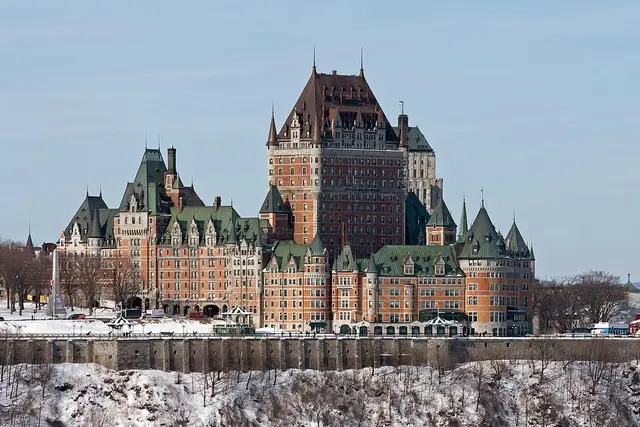
Look up from the square and the cliff fills the sky. The Château Frontenac sits on the rock above you, and Place Royale lies at its foot, almost at river level. This is where Samuel de Champlain built his first fortified Habitation in 1608, the settlement that grew into Quebec City.
The square is small enough to cross in under a minute. Steep-roofed stone houses with tall chimneys and dormer windows surround it on all sides. The ground is cobblestone, and a bronze bust of Louis XIV stands on a pedestal in the middle. The far end is closed off by a modest stone church with a single white-capped belfry.
The whole of Old Québec has been a UNESCO World Heritage Site since 1985. Few corners of it look this much like 17th-century New France. Most of the buildings you see were restored or rebuilt in the second half of the 20th century, following the old foundations and the French colonial style.
A Church Named for Two Sieges
That church is Notre-Dame-des-Victoires. Construction began in 1688, and it is often described as the oldest stone church in North America. It stands on the site of Champlain’s Habitation.
The name tells you about its early years. The church was first dedicated as Notre-Dame-de-la-Victoire after the city held off the English fleet under William Phips in 1690. In 1711 a second English fleet, under Admiral Walker, was wrecked in a storm on the St. Lawrence before it could attack. After that the name went plural.
British bombardment in 1759 left the church a shell, and it was rebuilt afterwards. Inside, look up: a model ship hangs from the nave ceiling, a votive offering that was common in seafaring parishes. It is still a working parish church, so visiting hours depend on services. Check the parish listing before you plan around going inside.
Reading the Square
Spend ten minutes looking at the details. They’re most of what makes the square worth the visit.
- The Louis XIV bust. It’s a bronze copy of the king. A bust of Louis XIV was first set up here in the 1680s, and the square took the name “Place Royale” from it.
- The rooftops. Count the firewalls between houses and the thick chimney stacks. They were a building response to the fires that repeatedly burned through the early Lower Town.
- The Fresque des Québécois. It’s around the corner where Rue Notre-Dame meets Côte de la Montagne. This trompe-l’œil mural covers the whole side of a building and shows figures from Quebec’s history along with the city’s seasons.
- The shopfronts. Cafés and boutiques fill the ground floors around the edges, so you can sit and look at the square rather than just walk through it.
Plan on 30–45 minutes for the square, the church exterior and the mural. Allow more if you go inside the church or stay for a coffee.

Getting Down from Upper Town
Place Royale is in Lower Town, so getting there means a drop down the cliff. You have three options.
- The Funiculaire du Vieux-Québec. It runs from Terrasse Dufferin, beside the Château Frontenac, down to Rue du Petit-Champlain. From the bottom it’s a short walk to the square.
- L’Escalier Casse-Cou (Breakneck Stairs). This steep flight drops from Côte de la Montagne into the top of Quartier Petit Champlain. In ice or snow, hold the rail and take it slowly.
- Côte de la Montagne on foot. The winding street goes down from near the Porte Prescott area and comes out close to the mural.
If you’re coming from the river side, the square is a few minutes’ walk from the Québec–Lévis ferry terminal and the Old Port.
Beating the Weekend Crush
The square never closes, so the timing is up to you. On weekends it’s busiest from 11am to 8pm. Tour groups and walkers from Petit Champlain fill the cobbles then, and you’ll have trouble getting a clear photo of the church.
The quietest weekend windows are 7am–8am and 10pm–11pm. Early morning gives you low light on the stone façades and mostly empty cafés. Late evening has the square lit and almost silent. We don’t have equivalent weekday figures, but avoiding that long weekend middle stretch is the clearest win.
Manners on the Cobblestones
This square is lived in and prayed in, not just photographed. A few habits make you a better guest.
- Start in French. A simple “Bonjour” before anything else is the local norm. Staff in Old Québec usually switch to English without fuss once you’ve greeted them.
- Tip at the café table. Quebec follows North American tipping, and 15–20% at table-service spots is expected. Card terminals usually prompt you for it, and cards and tap payments are widely accepted.
- Mind the church. If a mass, wedding or funeral is on, wait outside or stand quietly at the back. Hats off, voices down, and no flash.
- Don’t block the doorways. The house fronts open straight onto the square, so when you’re framing a shot, step to the side rather than standing in a shop entrance.
- Watch your footing. The cobbles are uneven all year and slick from late autumn into spring. Wear grippy soles here, not smooth fashion shoes.
Around the Corner
Place Royale works best as one stop on a Lower Town loop. Step out of the square and Rue du Petit-Champlain begins almost immediately. It’s a narrow pedestrian street of boutiques that runs under the cliff toward the funicular.
The Musée de la civilisation is a few minutes north, toward the Old Port, if you want the longer story of Quebec in a museum. For the best view back at the Château Frontenac and the cliff, cross to Lévis on the ferry and look back from the water. Then go up by funicular to Terrasse Dufferin. From there you can look down at the steep roofs you’ve just walked among.
Frequently asked questions
When is the quietest time to visit Place Royale?
On weekends it's quietest 7am–8am and 10pm–11pm. Avoid 11am–8pm on weekends, when it's at its busiest.
How do I get to Place Royale from the Château Frontenac?
Take the Funiculaire du Vieux-Québec down from Terrasse Dufferin to Rue du Petit-Champlain, then walk a few minutes to the square. You can also walk down the Breakneck Stairs (Escalier Casse-Cou) or Côte de la Montagne.
Can I go inside Notre-Dame-des-Victoires?
It's an active parish church, so access depends on services. Check the parish's current visiting times before you go, and keep quiet if a mass or ceremony is on.
How long should I spend at Place Royale?
Allow 30–45 minutes for the square, the church exterior and the Fresque des Québécois mural. Allow longer if you go into the church or combine it with Quartier Petit Champlain.
Is Place Royale open at night?
Yes. It's a public square and it's currently listed as open 24 hours. The 10pm–11pm window on weekends is one of its quietest times.
Plan your trip to Quebec City
Canada eSIM & staying connected →
Some links above are affiliate links — if you book through them, Wander Atlas earns a small commission at no extra cost to you. It's how we keep every guide free.
Related guides
 attraction
Fairmont Le Château Frontenac: Quebec City Travel Guide
 attraction
Vieux-Port de Montréal: Montreal Travel Guide (4.7★)
 attraction
Notre-Dame Basilica of Montreal: Travel Guide (4.7★)
 attraction