
A market named after a ghost rider
The name comes from a legend. The Reiterle (“little rider”) is an old Franconian figure tied to the winter season: a horseman said to carry the souls of the dead across the sky during the dark weeks of the year. Over time, the spirit became a bringer of gifts. A costumed Reiterle on horseback is still part of the market’s tradition.
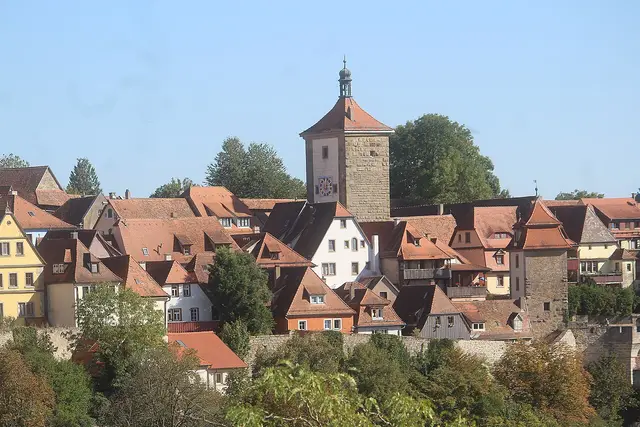
The market itself is centuries old, and its setting has barely changed. You stand on cobbles below the Renaissance town hall. Around you are steep half-timbered gables, the Gothic towers of St. Jakob and a ring of medieval walls you can still walk along. For 2026, the stalls stay up from November 20 to December 23.
Where the stalls stand
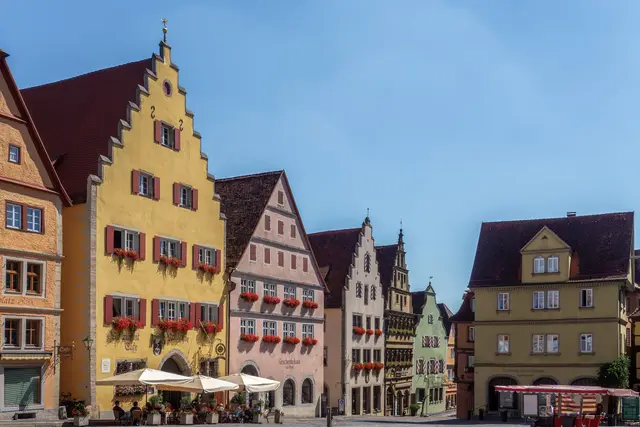
Everything is held inside the old town. The main cluster fills the Marktplatz. From there, rows of wooden huts spill into the Kirchplatz in front of St. Jakob and down toward the Grüner Markt.
On the square’s north side is the Ratstrinkstube, whose clock windows open on the hour. Two figures appear and replay the Meistertrunk, the legend of a mayor who saved the town by downing a huge tankard of wine. Around the market, a few landmarks are worth a look:
- Herrngasse, the wide street running south toward the castle garden
- Käthe Wohlfahrt’s Christmas Village and the German Christmas Museum, both near the square and open well beyond the market season
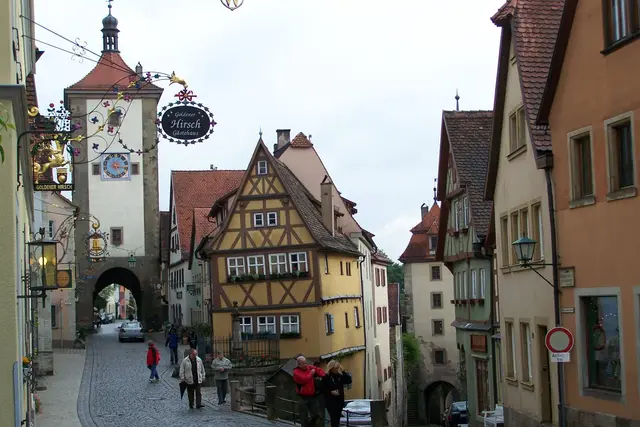
- Plönlein, the much-photographed fork in the road with its yellow half-timbered house, a few minutes’ walk south
- St. Jakob’s Church, home to Tilman Riemenschneider’s carved Holy Blood Altarpiece
What fills the mugs and the paper bags
The menu follows Franconian tradition, so expect hearty and sweet. Food comes in paper trays and on small plates. Drinks arrive in ceramic mugs that carry a deposit. Most people treat the stalls as a progression:
- Glühwein, the mulled wine. In this wine region, a white version sometimes sits beside the red.
- Fränkische Bratwurst, served in a bread roll with mustard
- Schneeballen, Rothenburg’s own “snowballs”: strips of shortcrust pastry balled up, fried and dusted with sugar or dipped in chocolate
- Lebkuchen, the spiced gingerbread of nearby Nuremberg
- Kinderpunsch, a non-alcoholic punch for children and drivers
The craft stalls sell carved wooden figures, glass ornaments, candles and the other decorations the town is known for.
Walking in through the gates
This is a small town at the end of a branch line. Trains reach Rothenburg ob der Tauber station by changing at Steinach (bei Rothenburg), on the line between Würzburg and Ansbach. From the station, it is roughly a 15-minute walk east to the Rödertor gate, then straight down Rödergasse to the Marktplatz.
Drivers find the old town closed to most traffic. The numbered car parks (P1–P5) sit just outside the walls, within walking distance of the gates. Many visitors on Germany’s Romantic Road tour arrive by coach as a day trip from Munich, Frankfurt or Würzburg.
Doing the Reiterlesmarkt the Franconian way
Getting in costs nothing: no ticket, no gate, no queue. The town’s tourism office, Rothenburg Tourismus Service, publishes the season’s dates and daily opening times on its official site.
- The mug deposit. Your first Glühwein comes with a Pfand on the mug. Hand the mug back at any stall from the same vendor and the deposit comes back. Or keep it, since the mugs carry the market’s design and many people take one home as a souvenir.
- Cash at the huts. Many small stalls still prefer coins and notes, though card readers are becoming more common. There are cash machines near the square.
- Ordering. A short “Einen Glühwein, bitte” works everywhere. Stallholders deal with international visitors all season and switch to English easily.
- Timing. Most day-trip coaches leave the town before evening. That is why many overnight guests save their main market stroll for after dark, when the huts are lit and the square holds mostly the people staying in town.
- Space. The lanes are narrow. Locals stand to the side with their mugs rather than in the walkway.
After the stalls close
Rothenburg rewards an overnight stay. Several guesthouses and hotels sit inside the walls, and many visitors book a room for at least one night of the market season. The long-running Night Watchman tour starts from the Marktplatz. A guide in medieval costume carries a lantern and halberd and tells the town’s stories in English.
Before dark, you can climb onto the covered walkway of the town wall for views over the rooftops. You can also walk through the Burggarten to the edge of the Tauber valley. In winter the valley falls away below in brown fields and bare trees, and the old town’s towers rise behind you.
Frequently asked questions
When is the Rothenburg Reiterlesmarkt in 2026?
It runs from November 20 to December 23, 2026. Rothenburg Tourismus Service publishes the daily opening times on its official site.
Do you need tickets for the Reiterlesmarkt?
No. It is an open-air market across the Marktplatz and the lanes around St. Jakob's Church, and you walk in freely. You only pay for food, drinks and the deposit on your mug.
How do you get to the market by train?
Take a train to Rothenburg ob der Tauber station, changing at Steinach (bei Rothenburg) on the Würzburg–Ansbach line. From the station it is about a 15-minute walk through the Rödertor gate to the Marktplatz.
Where do you park for the Christmas market?
The old town is closed to most traffic. Drivers use the numbered car parks P1–P5 outside the walls and walk in through the nearest gate.
How long do people spend at the market?
Day-trippers usually spend two to four hours on the market, the Christmas Museum and Plönlein. Many visitors stay overnight to see the square lit up and to join the Night Watchman tour.
Plan your trip to Rothenburg ob der Tauber
Germany eSIM & staying connected →
Some links above are affiliate links — if you book through them, Wander Atlas earns a small commission at no extra cost to you. It's how we keep every guide free.
Related guides
 hidden gem
Altstadt Rothenburg: Rothenburg ob der Tauber Travel Guide
 hidden gem
Marktplatz: Rothenburg ob der Tauber Travel Guide (4.8★)
 attraction
Plönlein: Rothenburg ob der Tauber Travel Guide (4.7★)
 attraction