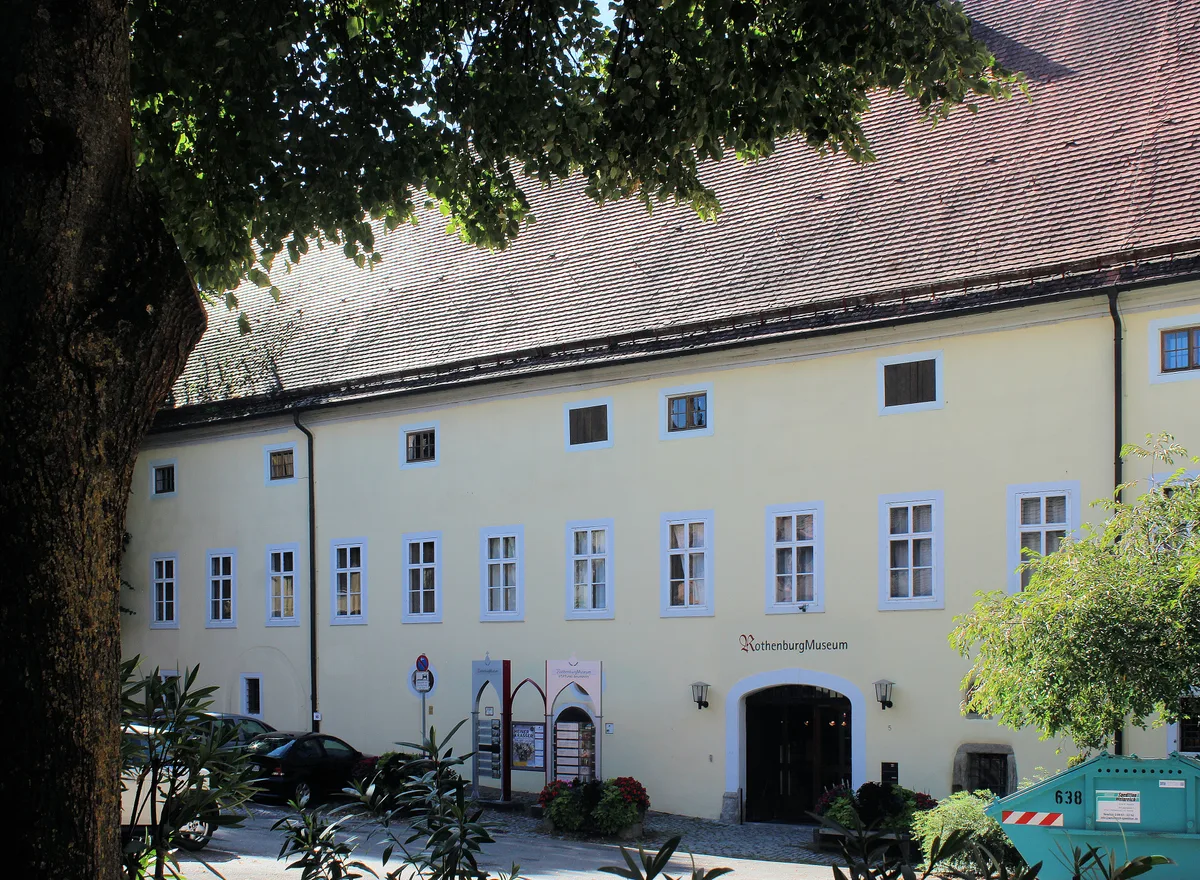
A convent behind St. Jakob
Most visitors walk straight past this place. They are on their way from the Marktplatz to the Plönlein, and the low convent buildings tucked behind St. Jakob’s church never catch their eye. Inside, though, is the story of how a free imperial city actually worked: who ate where, who fought, who prayed and who governed.
The building was a Dominican convent, founded in the 13th century. It became the town museum long after the nuns had gone. You still move through cloister-like passages and thick-walled rooms. The structure is as much on show as anything in a display case.
What to look for inside
Start with the convent kitchen. It is one of the oldest surviving convent kitchens in Germany, with a huge open hearth and a smoke hood that takes up most of the room. Standing in it, you can picture the scale of cooking for a whole religious community.
Then head for the collection’s best-known pieces:
- The Rothenburg Passion: twelve painted panels by Martinus Schwarz from 1494. They show the story of Christ’s suffering in sharp late-Gothic detail.
- The Meistertrunk tankard: the vessel linked to the 1631 legend. In the story, former mayor Nusch drained more than three litres of wine in one go and saved the town from Tilly’s army.
- Arms and armour: swords, helmets and firearms from the centuries when the walls you walked in on were actually defended.
- Jewish history: objects and gravestones from Rothenburg’s medieval Jewish community, once home to the scholar Rabbi Meir ben Baruch.
Timing your visit
Plan on 1.5–2 hours to see it properly. Add more if you read every caption on the Passion panels. At the moment the museum opens 10am–6pm every day of the week. Like most German museums, its hours change through the year and it may close on some holidays, so check the official website for this month’s times.
The old town fills up as the tour coaches arrive from mid-morning onwards. A museum visit fits well into the middle of the day, when the Marktplatz and Plönlein are at their most crowded. You get the town’s history under a roof while the photo spots clear a little. Then go back out in the late afternoon, when the light on the half-timbered houses softens.
Moving through the rooms
Here is how to get the most from the visit. Buy your ticket at the desk at the entrance; the current price is posted there and on the museum’s website. Card payment is widely accepted in Rothenburg, but some smaller places still prefer cash. Carry a few euros for the lockers if you are walking around with a daypack.
Ask at the desk whether an English guide or text is available. Many labels are in German, and the Passion panels and Meistertrunk story make much more sense with the context. Keep your voice down in the smaller rooms; they echo. If there is a photography rule, it will be marked, so check before raising your phone at the panels.
On the way out, cross the small square to St. Jakob’s church. Its Holy Blood Altar by Tilman Riemenschneider is a strong pairing with the Passion panels. You will have seen two very different responses to the same subject within a few minutes’ walk.
Getting to Klosterhof 5
Rothenburg ob der Tauber station is on a short branch line from Steinach, where you change from the regional trains. From the station, walk through the Rödertor into the walled town and on to the Marktplatz. It takes about 15–20 minutes. The museum is just north-west of the square, behind St. Jakob.
Driving visitors should use the signed car parks outside the walls. Traffic inside the old town is restricted. Walking in on foot from any gate takes 10–15 minutes and passes through cobbled lanes you would want to see anyway.
Nearby, within the walls
The museum makes a good anchor for an afternoon on the western side of the old town:
- St. Jakob’s church: next door, with the Riemenschneider altar.
- Marktplatz and Town Hall: a few minutes south-east. The Ratstrinkstube clock re-enacts the Meistertrunk, so you can see the tankard first and then the show.
- Medieval Crime and Justice Museum: on Burggasse, a short walk south.
- Burggarten: the castle garden on the spur above the Tauber valley, good for a quiet walk at the end of the day.
Frequently asked questions
How long should I spend at the Rothenburg Museum?
Allow 1.5–2 hours. That covers the convent kitchen, the Rothenburg Passion panels, the Meistertrunk tankard and the arms collection without rushing.
What are the opening hours?
At the moment it is open 10am–6pm every day. Hours change with the season and on holidays, so check the museum's official website before you visit.
How do I get there from Rothenburg station?
Walk through the Rödertor into the old town and on to the Marktplatz, about 15–20 minutes. The museum is at Klosterhof 5, just behind St. Jakob's church.
Is it busy?
It is generally quieter than the town's main sights. Many visitors pass it on their way between the Marktplatz and the Plönlein, so it makes a calm stop when the streets are crowded at midday.
What is near the museum?
St. Jakob's church with Riemenschneider's Holy Blood Altar is next door. The Marktplatz, Town Hall, Medieval Crime and Justice Museum and Burggarten are all within a short walk.
Plan your trip to Rothenburg ob der Tauber
Germany eSIM & staying connected →
Some links above are affiliate links — if you book through them, Wander Atlas earns a small commission at no extra cost to you. It's how we keep every guide free.
Related guides
 attraction
 Stadtmauer Rothenburg: Rothenburg ob der Tauber Travel Guide
 hidden gem
 Marktplatz: Rothenburg ob der Tauber Travel Guide (4.8★)
 attraction
 Imperial Castle of Nuremberg: Travel Guide (4.6★)
 attraction