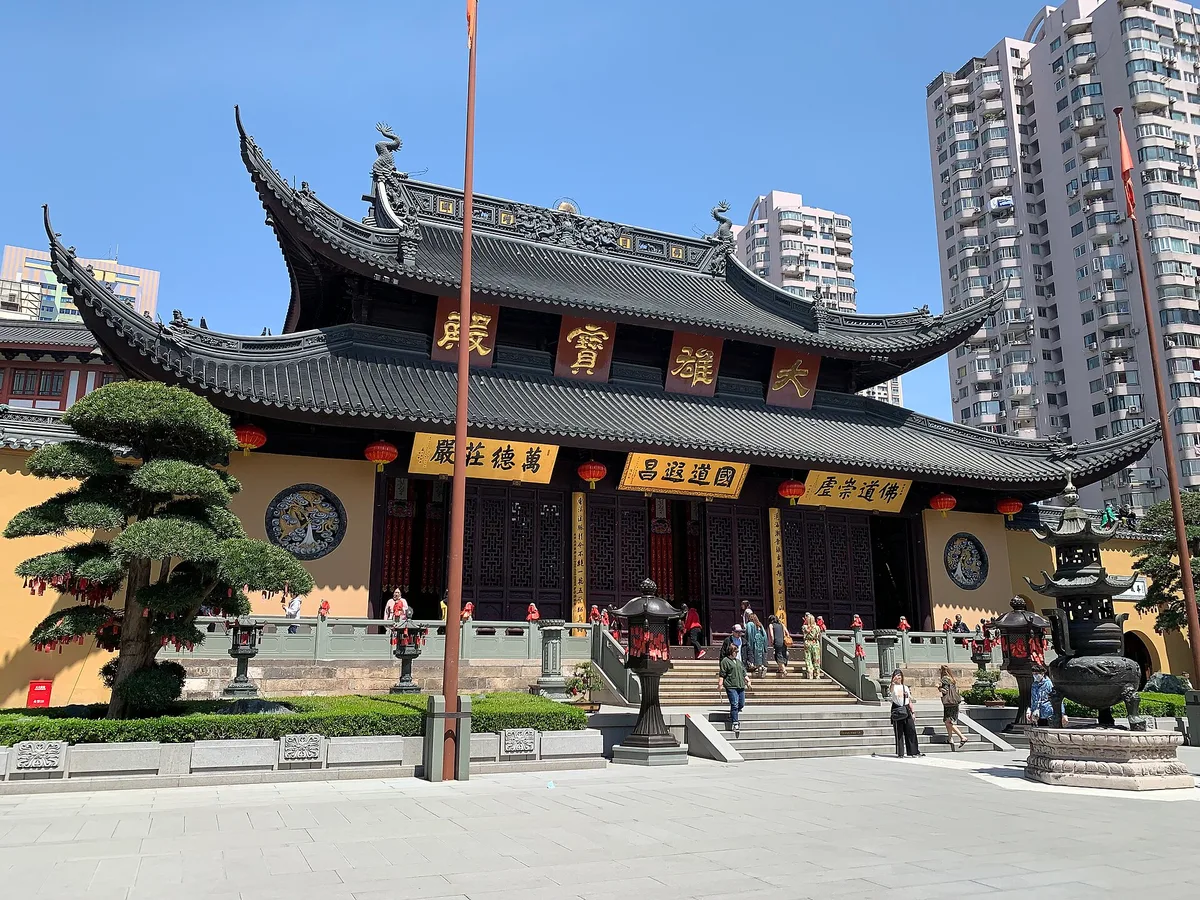
Most visitors expect a quiet backstreet shrine and instead find a full working monastery: shaved-headed monks crossing courtyards, incense smoke curling out of a bronze cauldron, chanting drifting from the main hall. This is still an active place of worship, not a roped-off relic, and that changes how you should move through it.
The temple takes its name from two Burmese white jade statues brought to Shanghai by the monk Huigen in the 1880s. The larger, a seated Buddha nearly two meters tall, sits upstairs in its own hall and is the reason most people come. A smaller reclining jade Buddha, carved from a single block, rests in a separate room nearby. Photography of both is generally not allowed, so look rather than shoot.
Finding your way through the halls
Walk in through the main gate on An Yuan Lu and you move through a sequence of courtyards, each opening onto a hall dedicated to different figures: the Heavenly Kings, Sakyamuni, then the Grand Hall with its rows of arhat statues. The jade Buddhas are held in halls toward the back, up a short staircase, slightly separate from the main flow.
Don’t rush the sequence. The layout follows a traditional Chinese Buddhist temple plan, oldest and most ceremonial halls set deepest, and walking it in order gives the visit some shape instead of feeling like a scavenger hunt for the jade statues.
Why it stays off most itineraries
Shanghai’s headline stops are the Bund and Yu Garden, so this temple, tucked into a residential stretch of Jing’an/Putuo away from the river, doesn’t make every first-timer’s list. That works in your favor: courtyards here rarely feel crowded even when the temple is clearly active and well-used by regular worshippers.
Come on a weekday morning shortly after opening if you want the halls closest to empty. Weekends and the first and fifteenth days of the lunar calendar bring noticeably more worshippers, since those dates carry religious significance for regular temple-goers.

Burning incense without getting it wrong
Incense sticks are sold near the entrance, usually in bundles of three. The custom is to light three sticks, hold them upright at chest height, bow once toward each of the cardinal directions, then plant them in the sand-filled burners in the courtyard rather than inside the halls themselves.
- Buy incense from the temple stalls, not from touts outside the gate
- Dress modestly: shoulders and knees covered
- Keep voices low inside the halls; monks are often mid-chant
- Step over threshold boards at hall entrances rather than on them, an old superstition still widely observed
- Move clockwise through the courtyards, following the direction most worshippers take
Nobody will scold a tourist for missing these details, but following them makes you far less conspicuous and shows basic respect in a space that’s still doing its actual job as a monastery.
The vegetarian restaurant worth staying for
Attached to the temple grounds is a vegetarian restaurant serving Buddhist-style dishes, mock meats built from tofu, mushroom, and wheat gluten shaped and seasoned to resemble duck or pork. It’s a low-key way to extend the visit by half an hour and taste something specific to temple cuisine rather than grabbing a coffee and moving on.
Meals here run mid-range for Shanghai, not cheap street food but far from a splurge. It gets busiest around the standard lunch window, so arriving a little before noon or well after 1pm means a shorter wait for a table.
Getting there and planning your visit
The temple sits at 170 An Yuan Lu, and the nearest metro stop is Jiangning Road on Line 13, followed by a short walk. Taxis and ride-hailing apps know the temple by name, which is often the simplest route if you’re coming from downtown.
Set aside 60 to 90 minutes: enough time to move through the courtyards without rushing, see both jade Buddhas, and stop at the vegetarian restaurant before heading out. Confirm current opening hours and any admission fee before you go, since both can shift with little notice at active religious sites.
Frequently asked questions
Where exactly is Jade Buddha Temple located?
It's at 170 An Yuan Lu, in the Jing'an/Putuo area of Shanghai, a short walk from Jiangning Road station on metro Line 13.
How much time should I plan for a visit?
Budget 60 to 90 minutes to see the main halls and both jade Buddha statues, longer if you stop to eat at the on-site vegetarian restaurant.
Can I take photos of the jade Buddha statues?
Photography is generally restricted inside the halls housing the jade statues, so plan to view rather than photograph them.
When is the best time to visit to avoid crowds?
Weekday mornings shortly after opening tend to be calmest. Weekends and the 1st and 15th days of the lunar month draw more worshippers and are busier.
Is there somewhere to eat nearby?
The temple has its own vegetarian restaurant serving Buddhist-style mock-meat dishes; going just before noon or after 1pm usually means a shorter wait.
Plan your trip to Shanghai
China eSIM & staying connected →
Some links above are affiliate links — if you book through them, Wander Atlas earns a small commission at no extra cost to you. It's how we keep every guide free.