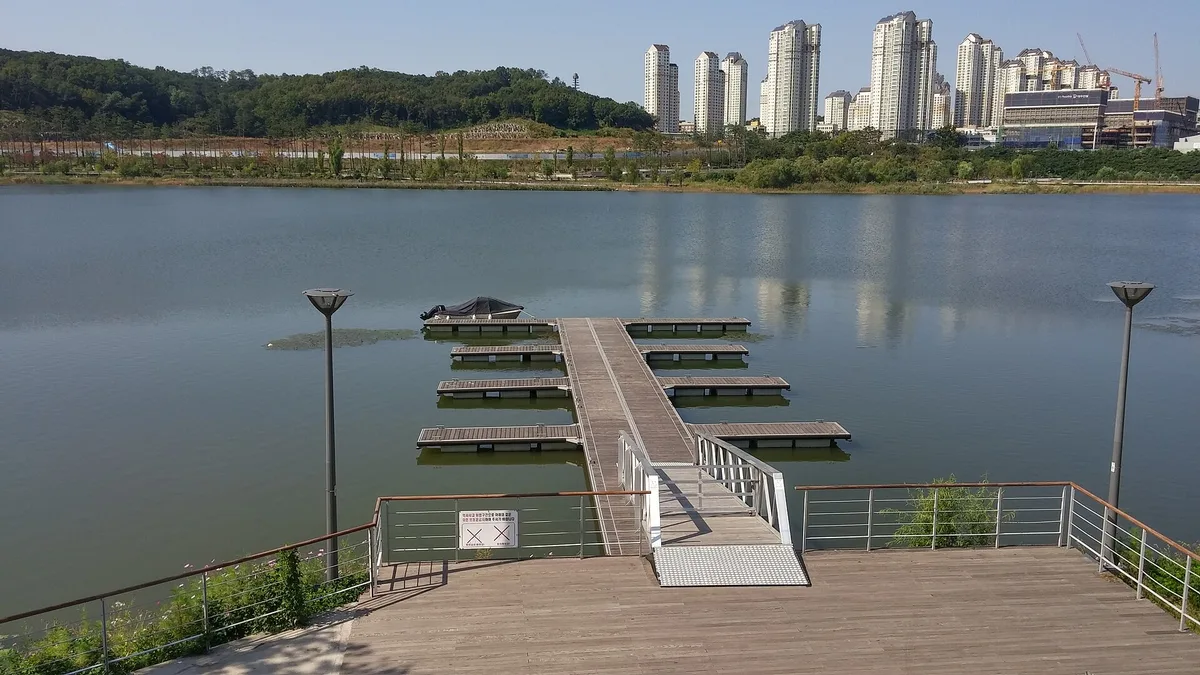
Gwanggyo Lake Park sits in the middle of one of Suwon’s newest districts, and it shows: glass apartment towers and office blocks rise directly behind the treeline, framing the water like a backdrop nobody quite expects in a Korean park. The park itself is built around two reservoirs, Woncheon-ho and Sinsan-ho, joined by a long pedestrian bridge and wrapped almost entirely in a wooden boardwalk.
You come here for the contrast: still water, reed beds, herons picking through the shallows, and skyscrapers glowing behind them once the sun starts to drop. It reads as one of the more photogenic public spaces in Gyeonggi-do, which is part of why it draws such steady crowds.
Getting oriented on the lake loop
The full loop around both reservoirs runs roughly 9km, mostly flat, mostly boardwalk or paved path. Most visitors don’t walk the whole thing.
A shorter loop around just Sinsan-ho, the smaller southern lake, takes about 40 minutes and covers the park’s best-known views, including the fountain plaza and the suspension bridge connecting the two lakes. If you have a full afternoon, continue north around Woncheon-ho, where the crowds thin and the path slips into pine forest.
Benches and shaded pavilions appear every few hundred meters, so there’s no need to plan rest stops in advance.
The rock-climbing structure and outdoor stage
Near the park’s central plaza stands a tall artificial climbing structure, a local landmark you’ll spot from across the water before you reach it. It’s used for organized climbing sessions and occasional public events rather than casual walk-up use, so treat it as a photo point unless you see it explicitly open.
Close by is an outdoor stage that hosts weekend performances and seasonal festivals, from busking to larger municipal events timed around cherry blossom season and the autumn foliage. Check what’s scheduled before you go; a concert night changes the whole feel of the plaza.
The water feature everyone photographs at dusk
The park’s musical fountain, set in the plaza between the two lakes, is the single most-photographed spot here. It runs choreographed jets timed to music in the evenings during warmer months, drawing families and couples who claim the surrounding steps well before the show starts.
Arrive 20 to 30 minutes early if you want a seat close to the water. The reflected skyline behind the fountain, especially once the office towers light up, is the shot most visitors come away with.
Spring and autumn: the park’s two peak seasons
Gwanggyo Lake Park has a real cherry blossom stretch along its western paths in early April, and a similarly strong maple and ginkgo turn in late October and into November. Both seasons pull noticeably larger weekend crowds than the rest of the year.
If your trip lines up with either window, a weekday visit or an early arrival will matter more than usual. Outside these two peaks, the park is calmer and the lakeside paths feel closer to a genuine neighbourhood green space than a destination in themselves.
How to visit like a local
Gwanggyo Lake Park is a very popular spot with residents of the surrounding Gwanggyo district, so it draws heavy weekend footfall rather than functioning as any kind of hidden find. Plan around that rather than expecting solitude.
- Weekend evenings, especially after dinner and around fountain-show times, are the busiest window; a weekday morning or midday visit is far calmer.
- The park is free and open 24 hours, so an early walk before the day heats up, or a quiet post-sunset loop, both work well and avoid the thickest crowds.
- Cyclists and joggers use the boardwalk constantly; keep to one side and stay aware, especially near the bridge connecting the two lakes.
- There’s no single ticket gate or entrance fee here, so there’s nothing to book in advance. Just pick an access point near your subway exit.
- Bring your own snacks or a coffee; convenience stores sit near the main plaza entrances, but there’s no dense food strip inside the park itself.
The mistake most first-time visitors make is treating this as a quick 20-minute detour. The park rewards slower movement, whether that’s the full 9km loop or simply picking one bench by Sinsan-ho and staying there as the light changes.
Getting there and practicalities
The park sits in Yeongtong-gu, on the eastern edge of central Suwon, easily reached from Gwanggyo Jungang Station on the Suin-Bundang Line; several exits lead directly toward the lake’s plaza side. It’s also a short taxi ride from Suwon Station if you’re coming from central Suwon or Seoul via the Bundang Line or KTX.
There’s no admission fee and no closing time, since the park operates 24 hours every day of the week. That said, most amenities like the fountain show and rock-climbing sessions run on their own daytime and evening schedules, so treat the round-the-clock access as freedom to walk, not a guarantee that every feature is running whenever you arrive.
Parking exists near the plaza and municipal buildings ringing the park, though on festival weekends it fills fast; public transit is the more reliable option if you’re visiting during cherry blossom or autumn foliage season.
Frequently asked questions
How do I get to Gwanggyo Lake Park from central Suwon?
Take the Suin-Bundang Line to Gwanggyo Jungang Station; several exits lead directly to the lake's plaza side. It's also a short taxi ride from Suwon Station.
Is there an entrance fee?
No, the park is free to enter and open 24 hours every day, so there's no ticket to book in advance.
When is the quietest time to visit?
Weekday mornings are calmest. Weekend evenings, especially around fountain-show times, draw the heaviest crowds, so avoid those if you want space on the boardwalk.
How long should I plan to spend here?
Budget 40 minutes for a loop around just the smaller Sinsan-ho lake, or two to three hours for the fuller loop including Woncheon-ho and the surrounding forest paths.
What's the best season to visit?
Early April for cherry blossoms along the western paths, or late October into November for maple and ginkgo colour. Both are peak weekend crowd times, so a weekday visit helps.
Plan your trip to Suwon
South Korea eSIM & staying connected →
Some links above are affiliate links — if you book through them, Wander Atlas earns a small commission at no extra cost to you. It's how we keep every guide free.