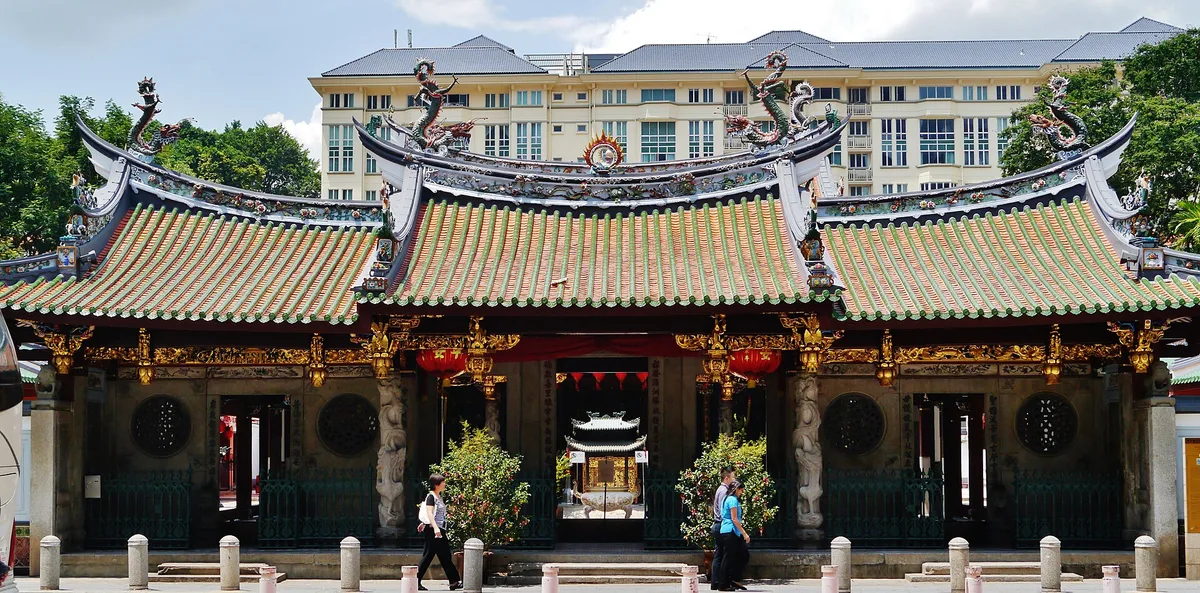
Telok Ayer Street runs along what used to be Singapore’s shoreline, back before land reclamation pushed the sea nearly a kilometre away. Thian Hock Keng stands exactly where Hokkien immigrants once stepped off their junks and walked straight to the Goddess of the Sea to give thanks for surviving the crossing. That’s the whole reason it’s here: this patch of ground was the first solid land many of them touched.
A temple built without a single nail
The current building dates to the 1840s, replacing a smaller joss house on the same spot. Craftsmen and materials came from southern China: granite pillars, timber beams, and roof tiles shipped over as ballast, then assembled by local masons and carpenters without using nails.
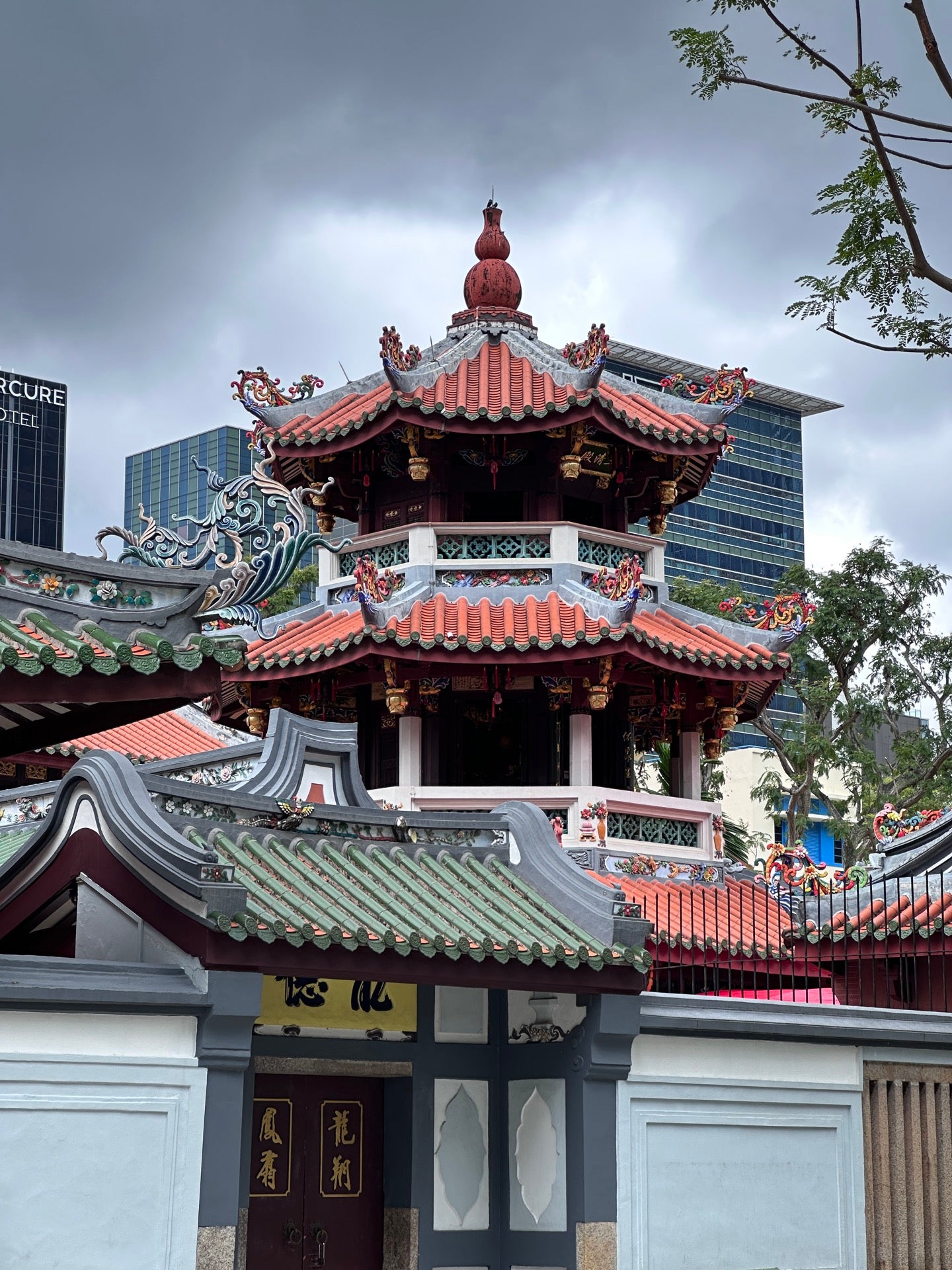
Look up at the roof ridges and you’ll see pairs of dragons flanking a flaming pearl, plus phoenixes and other guardian figures in ceramic shard-work called jian nian. The main hall is dedicated to Mazu, Goddess of the Sea; side halls hold Guan Yin and other deities brought over by different clan groups.
Reading the courtyard like a ledger
Walk the entrance courtyard slowly and you’re reading a piece of trading history. Stone tablets and inscribed plaques record donations from 19th-century Hokkien merchants who funded construction and later restorations.
Tan Tock Seng, the philanthropist whose name now sits on one of Singapore’s major hospitals, was among the early patrons. The temple was gazetted a National Monument in 1973 and underwent a major restoration in the 2000s that won a UNESCO Asia-Pacific heritage award for how faithfully it preserved original techniques.
Getting there and getting in
The temple sits at 158 Telok Ayer Street, in the Chinatown/CBD fringe rather than Tiong Bahru itself, so don’t let the regional tag mislead your route planning.
- Nearest stations: Telok Ayer MRT (Downtown Line) and Tanjong Pagar MRT (East-West Line), both roughly a 5–8 minute walk
- Hours: daily, 7:30am–5:00pm
- Entry: free, though a small donation box sits near the entrance
- Time needed: 20–30 minutes for the main halls, longer if you linger over the inscriptions
Because it closes at 5pm sharp, this isn’t a place to slot in after a late dinner nearby; plan it as a daytime stop, ideally paired with a walk down the rest of Telok Ayer Street.
Picking your window
This is a well-known stop on Chinatown heritage trails, so tour groups do pass through, especially on weekends. Crowd patterns here are fairly predictable.
- Weekdays: quiet fairly evenly from 8am to 5pm
- Weekends before 9am: the calmest slot all week
- Weekends 9am–5pm: the busiest stretch, when coach groups tend to arrive
If you want the courtyard to yourself for photos of the roof dragons, an early weekend morning or almost any weekday works better than a Saturday afternoon.
The incense ritual at the entrance
Regular worshippers follow a set sequence here that’s worth understanding even if you’re only observing. They light joss sticks at the outdoor urn first, bow three times facing the main hall, then move inside to place incense at each deity’s altar in turn, starting with Mazu.
Visitors are welcome to watch from the sides of the courtyard without joining in. If you do want to light incense yourself, follow the same order rather than skipping straight to a favourite altar, since the sequence matters more here than which deity you’re addressing.
Moving quietly through a working temple
This is an active place of worship, not a museum, and that shapes how you should behave inside it.
- Keep voices low, especially near the main altar where people are praying
- Dress modestly: shoulders and knees covered is the safe standard
- Photography is generally fine in the courtyard and halls, but avoid pointing a camera directly at someone mid-prayer
- Remove hats before entering the main hall
- There’s no strict shoe-removal rule here as there is at some Hindu or Buddhist sites, but check for any posted signs at the entrance
Because the temple sees a steady flow of visitors alongside worshippers, staff are used to tourists and won’t mind quiet observation, but treating it as a functioning religious space rather than a photo backdrop goes a long way.
Beyond the main hall
Telok Ayer Street itself rewards a slow walk in either direction from the temple. Al-Abrar Mosque and Nagore Dargah sit within a few minutes on foot, a reminder that this street was historically shared by Hokkien, Tamil Muslim, and other immigrant communities who all landed near the same stretch of former shoreline.
A small heritage exhibit inside part of the Thian Hock Keng compound outlines the temple’s restoration and the Hokkien clan history behind it, worth the extra ten minutes if you’re already inside. From here it’s an easy walk back toward Tanjong Pagar’s food streets or onward into the rest of Chinatown.
Frequently asked questions
Is Thian Hock Keng actually in Tiong Bahru?
No. It's on Telok Ayer Street near the Chinatown/Tanjong Pagar CBD fringe, roughly a 15–20 minute walk or one MRT stop from central Tiong Bahru. The regional listing groups it broadly, but plan your route via Telok Ayer or Tanjong Pagar MRT, not Tiong Bahru MRT.
What are the opening hours and is there an entry fee?
The temple is open daily from 7:30am to 5:00pm, and entry is free. A donation box near the entrance is optional.
When is the quietest time to visit?
Weekends before 9am are the calmest window. On weekdays it stays fairly quiet throughout the day; the busiest stretch is weekends from 9am to 5pm, when tour groups tend to arrive.
How long should I plan for a visit?
Most visitors spend 20–30 minutes seeing the main halls and courtyard. Add another 10–15 minutes if you want to read the heritage inscriptions or check the small exhibit inside the compound.
What's nearby if I want to extend the trip?
Al-Abrar Mosque and Nagore Dargah are both a few minutes' walk along the same street. Tanjong Pagar's food and drink strip is a short walk away for a meal afterward.
Plan your trip to Tiong Bahru
Singapore eSIM & staying connected →
Some links above are affiliate links — if you book through them, Wander Atlas earns a small commission at no extra cost to you. It's how we keep every guide free.
Related guides
 attraction
 HortPark: Tiong Bahru Travel Guide (4.5★)
 restaurant
 Tiong Bahru Market: Where to Eat (4.3★)
 attraction
 Sri Mariamman Temple: Singapore Travel Guide (4.5★)
 attraction