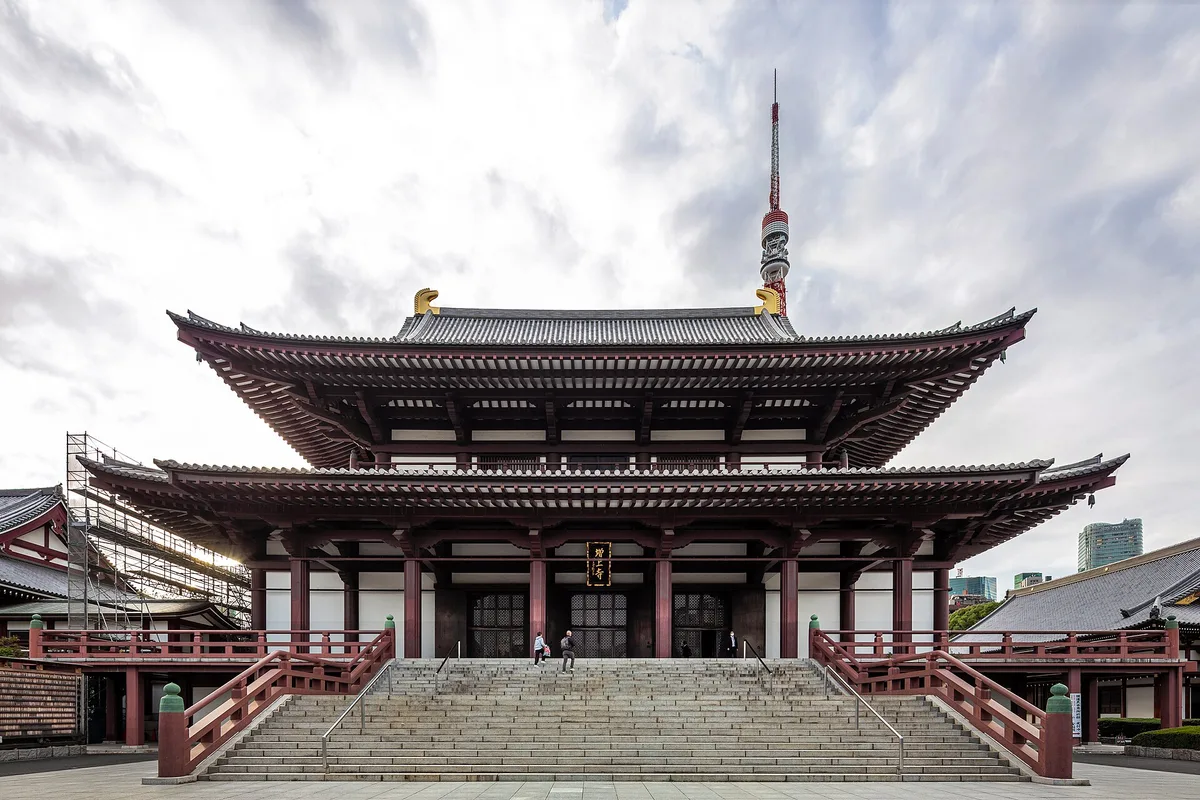
Walk south from Onarimon or Shibakoen subway stations and Zojo-ji arrives as a change of scale: a two-story wooden gate, black-lacquered and heavy-beamed, standing directly in the shot line of Tokyo Tower’s red-and-white lattice. That gate, the Sanmon, dates to 1622 and is one of the oldest wooden structures left in central Tokyo, having survived the 1945 firebombing that destroyed most of the rest of the compound.
Zojo-ji has been the head temple of the Jodo-shu (Pure Land) sect since the 1590s, when it was moved here to serve as the funerary temple of the Tokugawa shogunate. Six Tokugawa shoguns are buried on the grounds, in a mausoleum area that’s more modest today than its Edo-period original but still marked by carved stone lanterns and gates salvaged from the old complex.
The Sanmon and the Daiden
Start at the Sanmon gate and pass straight through it; this is the formal entrance and most people photograph it from the street side, tower rising behind.
Beyond the gate the Daiden (main hall) sits on raised ground, a 1970s concrete rebuild that replaces the hall lost to wartime bombing. It’s plainer than the Sanmon but functional: this is where the sect’s daily services actually happen, and visitors are welcome to step up, bow, and drop a coin in the offering box.
- Sanmon gate: 1622, one of Tokyo’s oldest wooden buildings
- Daiden: a 20th-century concrete rebuild, the temple’s main hall
- Ankokuden: a smaller side hall holding a black-painted image of Amida Buddha said to have belonged to Tokugawa Ieyasu
Senzu Kannon and the rows of jizo
Off to one side of the main hall, a section called Koshoji holds the temple’s most photographed corner: hundreds of small stone jizo statues arranged in tight rows, many wearing knitted caps and bibs left by parents. These figures, known as Senzu Kannon or sometimes described as memorials for miscarried and stillborn children, stand alongside spinning pinwheels that catch whatever wind comes through the compound.
It’s a quiet, slightly sobering stop, and locals treat it with visible restraint. Keep voices down here even if the rest of your visit has been casual.
Reading the Tokugawa mausoleum
The shogun mausoleum, Tokugawa Reidaien, sits east of the main hall and is far smaller than it was before 1945; most of the original gilded structures burned or were dismantled after the war. What remains is a cluster of stone gates and lantern rows, plus the graves themselves, generally viewable from outside a fence rather than walked through freely.
Check current access before planning around this specifically, since public entry to the inner mausoleum area has varied over the years and isn’t always open the same way as the rest of the grounds.

Getting the Tokyo Tower shot without the crowd in it
The single most-repeated photo from Zojo-ji lines the Sanmon gate up with Tokyo Tower directly behind it, taken from the street just south of the gate, near the pedestrian crossing on the temple’s east side. On weekends this spot gets a steady rotation of visitors doing the same shot between 11am and 4pm, so you’ll wait your turn.
Arriving at 9am, right at opening, on a weekday or weekend both give you a genuinely quiet stretch, per the temple’s own visitor patterns: 9am-10am is the calmest window either day. After that the compound fills steadily until early afternoon.
If you only have one photo stop in Tokyo for this exact composition, treat sunrise-to-mid-morning as your window rather than midday.
Moving through the grounds respectfully
Zojo-ji is a working temple, not a museum, and the etiquette is closer to a Buddhist hall than a shrine.
- Bow slightly before and after approaching the Daiden’s offering box
- A small coin toss (any denomination) followed by a quiet bow is standard; no clapping, that’s shrine etiquette, not temple
- Photography is generally fine in the outdoor compound but be more careful and quieter directly around the jizo rows and the mausoleum fence
- No entry fee to walk the main grounds, though specific sub-halls or treasure displays have occasionally charged small entry fees in the past, so check signage on the day
Most visitors spend more time here than they expect, not because there’s a lot to see room by room, but because the combination of the gate, the tower behind it, and the jizo rows makes people slow down and look twice.
Getting there and timing your visit
Zojo-ji sits in Shibakoen, Minato City, a short walk from either Onarimon Station or Shibakoen Station on the Toei subway lines, and also walkable from Tokyo Tower itself if you’re already in that area.
- Hours: daily, 9:00am to 5:00pm, no variation by day of the week
- Quietest times: 9am-10am on both weekdays and weekends
- Busiest stretch: 11am-4pm on weekends, worth avoiding if you want the gate to yourself
- Suggested visit length: 45 minutes for the main compound, up to 90 minutes if you’re photographing thoroughly or sitting with the jizo rows
Given how consistently well-reviewed the temple is and its position as one of the most visited Buddhist sites in the city, don’t expect true solitude at any hour. The early window is a relative quiet, not an empty one.
Pair the visit with Shiba Park, which wraps around part of the temple grounds and gives a second angle on the Sanmon-and-tower composition, or continue on to Tokyo Tower itself, a five-to-ten minute walk north.
Frequently asked questions
How do I get to Zojo-ji?
Take the Toei subway to Onarimon Station or Shibakoen Station, both a short walk from the compound. It's also an easy 5-10 minute walk from Tokyo Tower if you're combining the two.
Is there an entrance fee?
Walking the main outdoor grounds, including the Sanmon gate, Daiden hall exterior, and jizo rows, is free. Some sub-halls or special displays have occasionally charged small fees, so check posted signage on the day.
When is the quietest time to visit?
Both weekdays and weekends are calmest between 9am and 10am, right at opening. Weekends get busy from 11am to 4pm, which is worth avoiding if you want a clear shot of the Sanmon gate against Tokyo Tower.
How long should I plan for the visit?
Most people need 45 minutes to walk the main compound. Budget up to 90 minutes if you want to photograph the gate thoroughly or spend time at the jizo statues in Koshoji.
What's nearby?
Shiba Park surrounds part of the temple grounds and offers another angle on the gate-and-tower view. Tokyo Tower itself is a short walk north.
Plan your trip to Tokyo
Japan eSIM & staying connected →
Some links above are affiliate links — if you book through them, Wander Atlas earns a small commission at no extra cost to you. It's how we keep every guide free.
Related guides


This spot is Day 1 of our Tokyo 5-day itinerary