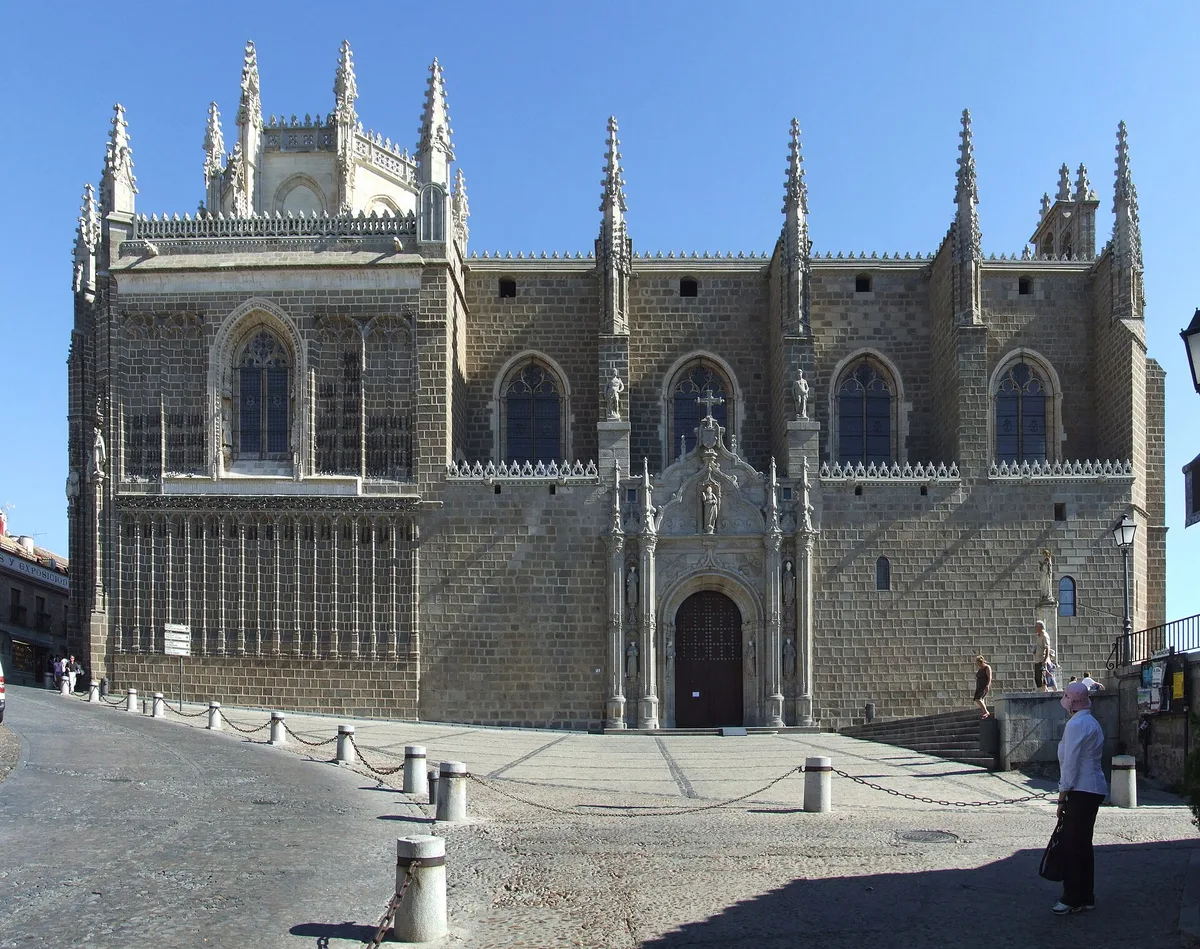
You smell the stone before you see the detail, that cool, mineral hush of old limestone that hangs in the narrow streets of Toledo’s former Jewish quarter. Then the facade opens up above you, and you understand why this church stopped being just a building and became a monument.
Isabella and Ferdinand commissioned San Juan de los Reyes in the late 15th century to mark a military victory and to serve, eventually, as their burial place. Plans changed and they ended up in Granada instead, but the monastery they left behind is arguably the finer building. It’s Gothic-Flemish architecture at its most theatrical, dense with heraldic eagles, pomegranates, and the yoke-and-arrow emblems of the Catholic Monarchs.
The cloister is the reason to come
Skip past the church interior quickly if you’re short on time. The real spectacle is outside, in the two-tiered cloister.
The lower level is stone, heavy and Gothic. The upper level turns to wood, lighter and almost domestic in feel, with a carved artesonado ceiling running its full length. Walk it slowly. Gargoyles peer down from the cornices in shapes you won’t expect in a religious building, monkeys, dogs, a few figures that look frankly obscene, put there by stonemasons having a private joke five centuries ago.
The chains on the facade
Before you go in, look up at the exterior wall facing the Tagus gorge. Rows of rusted iron chains and shackles hang there, taken from Christian prisoners freed from Moorish captivity during the Reconquista. They were bolted to the church as a public trophy and have stayed put ever since, one of the more visceral pieces of medieval propaganda still on display anywhere in Spain.

Getting there
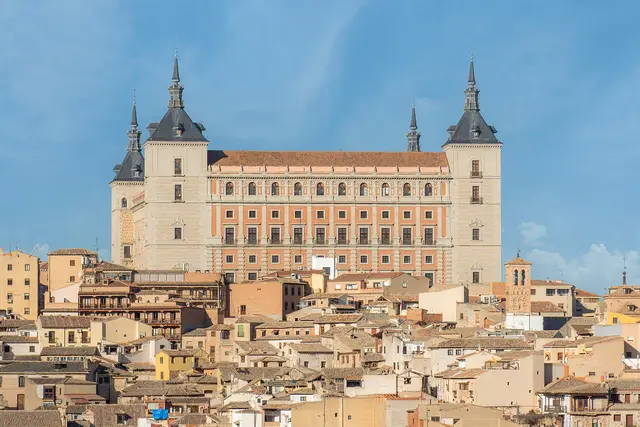
The monastery sits on Calle de los Reyes Católicos, inside the old town, an easy 5-minute walk from the Sinagoga de Santa María la Blanca and about 10 minutes from the Alcázar. Toledo’s old town is steep and mostly pedestrian, so plan on cobblestones and some uphill walking whichever direction you approach from. If you’re coming from Toledo’s train station, a taxi or the local bus into the old town saves a long uphill haul; from the central Plaza de Zocodover, it’s a walkable 10–15 minutes downhill through the Judería.
When to go
The monastery opens daily at 10am and closes at 6:45pm, with no midday closure, which makes it easy to slot into a walking day through the old town. Measured foot-traffic data shows the calmest window is 10am to 11am on weekdays. Arrive right at opening and you’ll often have the upper cloister nearly to yourself. Weekends are a different story: crowds build steadily from noon and stay heavy until closing, so if you’re visiting on a Saturday or Sunday, try to arrive before noon.
Plan on 45 minutes to an hour inside, more if you want to sit with the cloister ceiling for a while or read the informational panels on the building’s history.
How to visit like a local
This is one of Toledo’s most visited sites, so timing matters more than any insider trick.
- Go at opening on a weekday, ideally 10–11am, for a near-empty cloister
- Buy your ticket on-site or online in advance during peak season, lines form fast once tour groups arrive after 11am
- Wear low-noise shoes; the wooden upper cloister amplifies footsteps and it’s still an active Franciscan community, not just a museum piece
- Photography is generally fine in the cloister but be discreet and quiet in the church nave, where visitors are usually praying
- Check official hours before you go, especially around religious holidays, when access can shift
Combine it with a walk to the nearby Puente de San Martín, the medieval bridge just below the monastery, for the classic postcard view back up at the church rising above the gorge. A good way to close out the visit without doubling back through the crowds.
Frequently asked questions
What are the opening hours?
Daily, 10:00am to 6:45pm, with no midday closure. Confirm before visiting around holidays, as hours can shift.
When is the quietest time to visit?
Weekdays between 10am and 11am, right at opening. Weekends stay busy from noon until closing, so aim for a morning visit if you go on a Saturday or Sunday.
How long should I plan to spend there?
Around 45 minutes to an hour is enough to see the church and cloister properly; add extra time if you want to linger over the carved ceiling or facade details.
How do I get there?
It's in Toledo's old town on Calle de los Reyes Católicos, a 5-minute walk from the Santa María la Blanca synagogue and about 10 minutes from the Alcázar. From Plaza de Zocodover it's a 10–15 minute walk downhill through the Judería.
What's nearby worth combining with the visit?
The Puente de San Martín, a medieval bridge just below the monastery, offers a classic view back up at the facade, and the old Jewish quarter's synagogues are a short walk away.
Plan your trip to Toledo
Some links above are affiliate links — if you book through them, Wander Atlas earns a small commission at no extra cost to you. It's how we keep every guide free.