A temple built on the edge
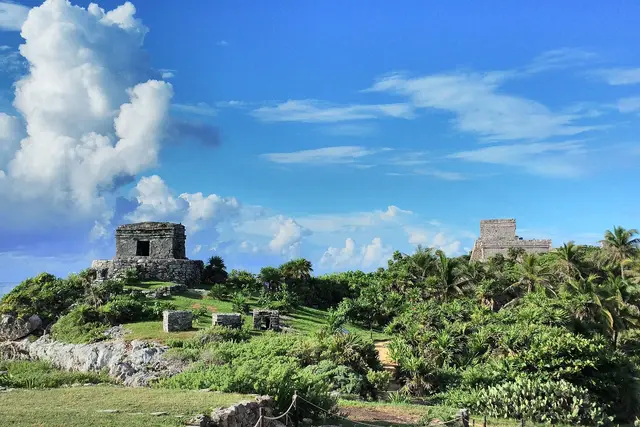
El Castillo stands at the top of a limestone cliff. Behind it the Caribbean runs turquoise over a reef, and in front of it a flat green lawn spreads out with smaller grey-stone temples scattered across it. This is the tallest structure in Tulum, the Postclassic Maya port its builders called Zamá.
The city was still lived in when Juan de Grijalva’s Spanish expedition sailed past in 1518. Many archaeologists read El Castillo as a beacon. Fires or markers on top are thought to have guided traders’ canoes through a gap in the reef to the cove below. Look for the serpent-column doorway at the summit; it faces inland, toward the old city.
Getting into the walled zone
The site sits on the coast road in the Zona Hotelera, a short taxi or bike ride north of Tulum town. Your car or taxi drops you at the parking and visitor area. A paved path of roughly a kilometre then leads to the ancient wall, and many visitors take the small trolley instead of walking it.
Tulum is walled on three sides, with the sea on the fourth. You enter through narrow, low gateways in that stone wall. Walk the marked loop and you reach El Castillo last, as the ground rises toward the cliff.

What to see around El Castillo
The site is compact, so the loop around El Castillo is short. Stops worth slowing down for:
- Temple of the Frescoes: faded Maya murals behind a colonnade, with carved faces on the corners.
- Temple of the Descending God: an upside-down figure carved over the doorway, right beside El Castillo.
- Temple of the Wind: a small shrine on a separate headland, best photographed from the north end of the cliff path.
- The cove beach: a wooden staircase drops to the sand below El Castillo when the stairs are open, so bring a swimsuit.
Iguanas sun themselves on almost every wall, and ropes keep visitors off the structures.
Doing El Castillo right
Climbing is forbidden. El Castillo has been roped off for years to protect it, so the classic photo is taken from the lawn or the northern cliff edge, looking back at the temple against the sea. Stay behind the ropes, because site custodians do call people back.
There is very little shade inside the walls. Bring water, a hat and reef-safe sunscreen if you plan to swim. Arriving right at the 9:00 AM opening usually puts you ahead of the tour groups from Cancún and Playa del Carmen, who tend to arrive later in the morning.
Gates shut at 5:00 PM every day, and the long approach walk eats into a late start. Do not arrive after about 3:00 PM. Entry prices are posted at the ticket booth and on Mexico’s INAH website. Drones need a permit, so leave yours in the car.
Frequently asked questions
What are El Castillo's opening hours?
The Tulum archaeological zone, El Castillo included, is open every day from 9:00 AM to 5:00 PM.
Can you climb El Castillo in Tulum?
No. The temple is roped off to protect it, so you view and photograph it from the lawn and the cliff path.
How long should I spend at El Castillo and the ruins?
Allow 1.5 to 2 hours for the walled site, plus extra if the beach stairs are open and you want a swim.
How do I get to El Castillo from Tulum town?
Take a short taxi or bike ride north along the coast road into the Zona Hotelera. From the parking area, walk the path of roughly a kilometre to the wall or ride the trolley.
What is the best time of day to visit?
Arrive at the 9:00 AM opening. It is cooler, and you usually get ahead of the day-trip coaches from Cancún and Playa del Carmen.
Plan your trip to Tulum
Mexico eSIM & staying connected →
Some links above are affiliate links — if you book through them, Wander Atlas earns a small commission at no extra cost to you. It's how we keep every guide free.