Down the spiral shaft
The descent sets the tone. A spiral staircase winds around a round shaft cut straight down into the limestone. Mourners are thought to have lowered bodies on ropes through the open centre while they walked the steps around it.
The name means “mound of shards.” It comes from the broken pottery that once covered the hill. The complex dates to the 2nd century AD and was used for generations, with the graves of the Antonine period among its burials. It was rediscovered in 1900, and the usual story is that a donkey cart fell through the ground.
What the rock holds
Below ground, the rooms branch off a central rotunda. Look for:
- The triclinium: a banquet hall with stone benches carved into the walls. Relatives held funeral meals here.
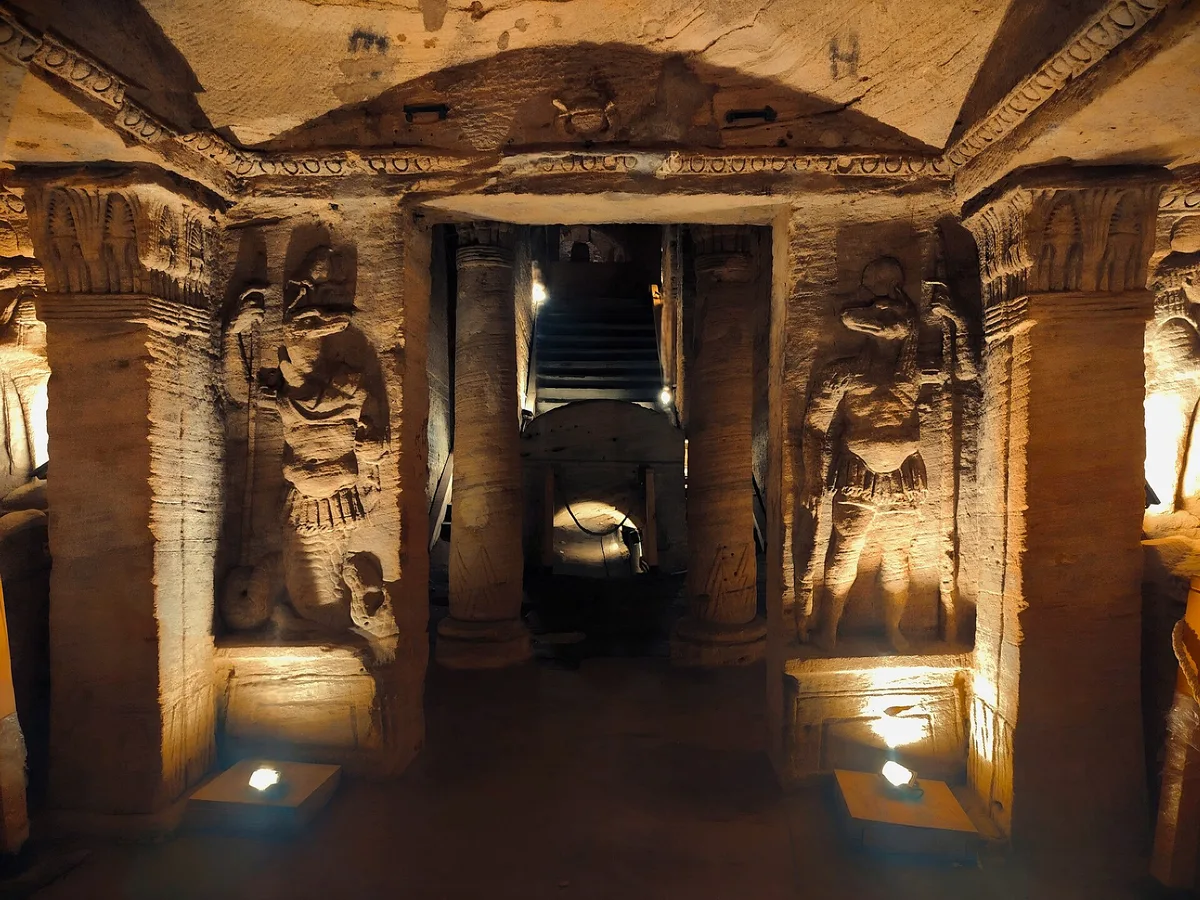
- The main tomb chamber: this is the reason people come. Anubis guards the doorway dressed as a Roman legionary, and serpents wearing the double crown of Egypt coil beneath Medusa heads.
- Sarcophagi niches: reliefs show Egyptian funeral scenes, but the carving style is Greco-Roman.
- The Hall of Caracalla: a separate group of tombs where bones of both horses and men were found. It is often linked to Caracalla’s massacre in Alexandria in 215 AD.
The lowest level sits in groundwater and is closed to visitors. The air down there stays humid all year, and the steps can be slick.

Reaching Karmouz
The catacombs lie southwest of the modern centre, away from the Corniche. A taxi, Uber or Careem from Raml Station or the seafront is the easiest way. Tell the driver “Kom el Shoqafa” or “Amoud el Sawari” (Pompey’s Pillar). The two sites are close enough to walk between, so plan them as one stop.
An hour covers the catacombs well. Add another 45 minutes for the Serapeum hill and Pompey’s Pillar. Wear shoes with grip for the damp stairs.
Getting the most from the ticket window and the guards
- Pay at the gate: the current price is posted at the ticket window. Carry Egyptian pounds in small notes, since card machines are not something to count on.
- Check camera rules at the gate: photography rules for the burial chambers have changed over the years.
- Guards offering a “special look”: a guard may wave you toward a niche or point out a carving with a torch. He will expect a small tip in cash afterwards. Accept or decline politely, and decide before you follow him.
- Timing: at the moment the site opens 9am–4pm every day, but antiquities sites change their hours through the year and close on some holidays. Check the Ministry of Tourism and Antiquities listing for this month. Arrive by early afternoon so you are not rushed out at closing.
- Beat the groups: this is one of Alexandria’s best-known sites, and many visitors come as part of Cairo day trips. Arriving right at opening usually puts you underground before the coaches arrive.
Combine it with the Roman Amphitheatre at Kom el Dikka and the Bibliotheca Alexandrina, a short taxi ride north, and you have a full day of Greco-Roman Alexandria.
Frequently asked questions
Where exactly are the Catacombs of Kom el Shoqafa?
They are in the Karmouz area southwest of central Alexandria, a short walk from Pompey's Pillar. The easiest way there is a taxi, Uber or Careem from Raml Station or the Corniche.
What are the opening hours?
At the moment it opens 9am–4pm every day of the week. Hours at Egyptian antiquities sites shift through the year and on holidays, so check the official listing before you go.
How long should I spend there?
About an hour inside the catacombs. Allow another 45 minutes if you add Pompey's Pillar and the Serapeum next door.
What is the highlight inside?
The main tomb chamber. Anubis appears there in Roman military dress, and serpents wearing Egyptian crowns are carved beneath Medusa heads, a clear mix of Egyptian and Greco-Roman art.
Is it difficult to visit?
You have to go down a spiral staircase into humid, sometimes slippery chambers. Wear shoes with grip. The lowest, flooded level is closed.
Plan your trip to Alexandria
Egypt eSIM & staying connected →
Some links above are affiliate links — if you book through them, Wander Atlas earns a small commission at no extra cost to you. It's how we keep every guide free.
Related guides
 hidden gem
Kom el Dikka: Alexandria Travel Guide (4.3★)
 attraction
Serapeum of Alexandria: Travel Guide (4.3★)
 attraction
Alexandria National Museum: Travel Guide (4.4★)
 attraction