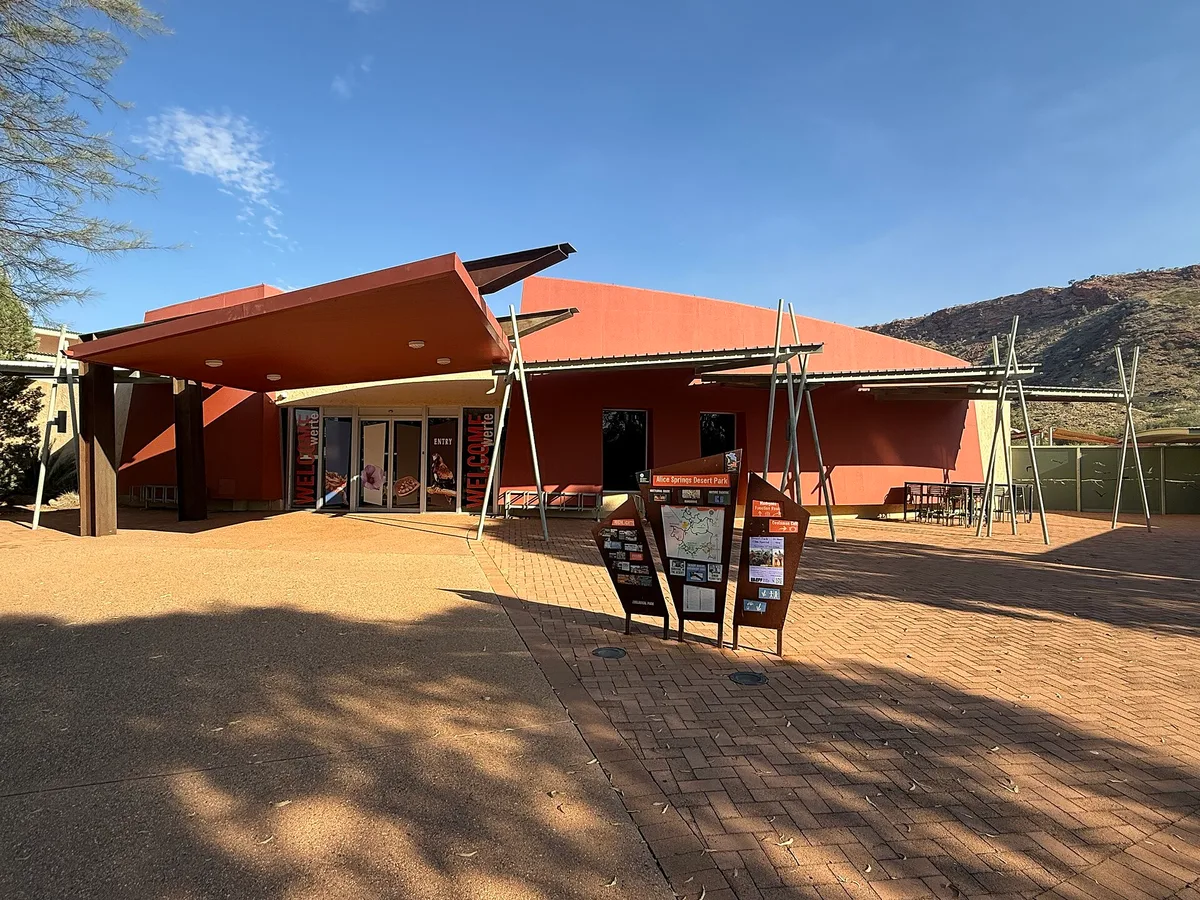
Red ground, ranges behind
The ranges are what you see first, and they stay in view the whole time. Alice Springs Desert Park is built right against the northern face of the West MacDonnell Ranges, known in Arrernte as Tjoritja. The red quartzite ridge fills the skyline behind every enclosure.
What you get is Central Australia packed into a single walk. A sealed path loops through recreated desert habitats, with aviaries, walk-through enclosures and interpretive shelters along the way. It reads less like a zoo and more like a field guide you can stroll through.
Three habitats on one loop
The park is laid out as a sequence of landscapes. Each one has its own plants, birds and animals:
- Desert Rivers: river red gums, a dry sandy creek bed and the waterbirds that gather wherever water collects in the Centre.
- Sand Country: spinifex and red dune country, home to the small, hard-to-spot animals of the open desert.
- Woodland: mulga and open woodland, with kangaroos and walk-through bird aviaries.
The signs explain how Arrernte people have used these plants for food, medicine and tools. They are worth stopping for. Once you know what you’re looking at, the scrub outside town looks different.
The Nocturnal House and the bird show
Come in from the glare and your eyes need a minute. The Nocturnal House keeps its lighting reversed, so desert animals that only come out after dark are awake while you visit. Bilbies are the usual headline. Walk slowly along the glass and give each enclosure time, because movement is easy to miss at first.
The other big draw is the free-flying birds of prey presentation at the Nature Theatre. Raptors such as kites and wedge-tailed eagles fly low over an open-air amphitheatre with the ranges behind them. Session times change, so check the board at the entrance before you set off. Then build your loop around them.
Beating the heat on Larapinta Drive
Most of the walk is in the open. At the moment the park opens at 7:30am and closes at 6pm, every day of the week. Opening hours can shift through the year and over holidays, so check the official site for this month’s times.
- Go early: birds are most active in the cool morning, and from late spring to early autumn the afternoon sun is punishing.
- Bring water and a hat: the loop takes a couple of hours on foot with little shade between shelters.
- Allow 3–4 hours: enough for the full loop, the Nocturnal House and one presentation without rushing.
Winter mornings in the Centre can be close to freezing, so a layer for the first hour is worth carrying.
Walking the park the way it’s meant to be walked
There are no shortcuts on this site. It rewards slowing down: stand still at an aviary for a few minutes and birds that hid when you arrived start moving again. Keep your voice low in the Nocturnal House, and never use a camera flash against the glass.
Sit in on a ranger talk if one is running. They often cover bush foods and Arrernte knowledge of Country, and that context is what makes the habitats make sense. Don’t touch or pick the plants. Some are culturally significant and all are part of a managed display. Entry prices are posted at the ticket counter and on the official website, which also lists guided experiences.
Getting there from town
It’s an easy, flat trip from the centre of Alice Springs. Drive west out of town on Larapinta Drive, the same road that continues out to the West MacDonnell Ranges, and the park entrance is on your right after roughly 7 km. There’s parking at the visitor centre.
Without a car, many visitors cycle. A sealed shared path runs alongside Larapinta Drive from town, with the ranges ahead the whole way. If you ride, start early: the path has little shade and the return trip in the afternoon heat is tougher.
The park also works as an introduction before you head further into the West MacDonnells. Simpsons Gap and Standley Chasm are on the same road west. After a morning learning the plants and animals here, you’ll recognise far more of what you see out there.
Frequently asked questions
How far is Alice Springs Desert Park from the town centre?
About 7 km west along Larapinta Drive. It's a short drive, and a sealed shared path alongside the road makes it a popular bike ride from town.
How long should I spend at Alice Springs Desert Park?
Plan 3–4 hours. That covers the walking loop through the Desert Rivers, Sand Country and Woodland habitats, the Nocturnal House and at least one presentation.
What time does Alice Springs Desert Park open?
At the moment it's open 7:30am to 6pm every day. Hours can change with the season and on holidays, so check the official website before you go.
What is the best time of day to visit?
Early morning. Birds are more active in the cool hours and the loop is mostly unshaded, so arriving near opening avoids the worst of the heat, especially from late spring to early autumn.
What can I see nearby after the Desert Park?
Keep driving west on Larapinta Drive into the West MacDonnell Ranges (Tjoritja), where Simpsons Gap and Standley Chasm are both on the same route.
Plan your trip to Alice Springs
Australia eSIM & staying connected →
Some links above are affiliate links — if you book through them, Wander Atlas earns a small commission at no extra cost to you. It's how we keep every guide free.
Related guides
 attraction
 ANZAC Hill: Alice Springs Travel Guide (4.6★)
 attraction
 National Road Transport Museum and Hall of Fame: Alice Springs Travel Guide
 hidden gem
 Alice Springs Telegraph Station Historical Reserve: Travel Guide
 attraction