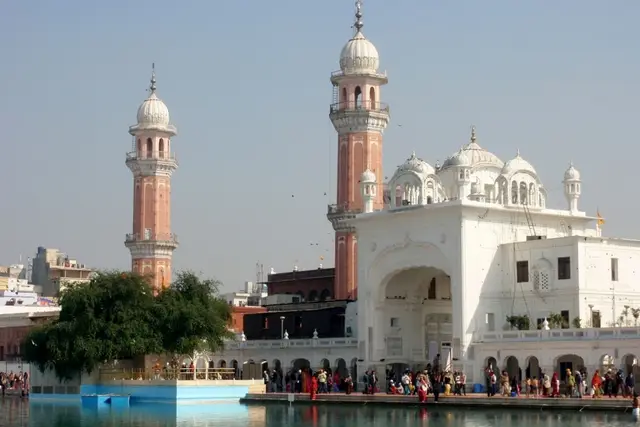
The dome comes into view before the gate does, a soft gold blur above the rooftops of Katra Ahluwalia, reflected upside-down in a rectangular pool so still it looks poured rather than filled. You leave your shoes at the counter, wade through an ankle-deep water trough at the entrance, and step onto marble that’s already warm or cold depending on the hour. Nobody rushes you. That’s the first thing you notice.
Why it holds you
This is the spiritual center for Sikhs worldwide, and the architecture explains why photographs never quite capture it. The shrine itself sits on a platform in the middle of the Amrit Sarovar, the sacred pool that gives Amritsar its name, connected to the walkway by a single causeway.
Above the white marble base rises a dome sheathed in real gold leaf, catching light differently at sunrise, noon, and dusk. Inside, ragis sing hymns from the Guru Granth Sahib continuously, the sound carried out over loudspeakers across the whole complex.
Getting there and getting in
The complex sits in Amritsar’s old city, walkable from most budget and mid-range hotels clustered nearby. Auto-rickshaws know it simply as “Golden Temple” or “Darbar Sahib”, no address needed.
It’s open 24 hours, every day, with no entry fee. Security checks are routine: bags get scanned, and men and women pass through separate lines before the main gate.

What to actually do once inside
Walk the full marble parikrama, the circular path that rings the sarovar, before joining the queue for the inner sanctum. The line to enter the shrine itself can take anywhere from twenty minutes to over an hour, moving slowly across the causeway.
Don’t skip these while you’re there:
- Akal Takht, the seat of Sikh temporal authority, just north of the causeway entrance
- Central Sikh Museum, upstairs near the clock tower entrance, covering Sikh history and the Partition era
- Guru Ka Langar, the free community kitchen feeding tens of thousands daily, regardless of religion
- Night viewing, the palanquin carrying the Guru Granth Sahib returns after the shrine closes for the night, a ceremony called Sukhasan worth timing your visit around
The langar hall alone deserves an hour. You sit cross-legged on long mats, volunteers ladle dal and roti onto your steel tray, and thousands of strangers eat in silence together. It’s one of the largest free kitchens on earth, running nonstop.
When to go
Because it’s open around the clock, timing is really about crowd avoidance, not access. The quietest window is 7am–8am on weekdays, when the marble is cool underfoot and the singing feels almost private.
Weekends shift entirely. Try not to arrive between 6pm and 11pm on a Saturday or Sunday, when the complex fills with domestic tourists and pilgrims and the queue for the inner sanctum stretches longest.
Early morning also catches the Palki Sahib procession, when the holy scripture is carried to the shrine at dawn, a genuinely moving thing to witness if you can manage the wake-up.
How to visit like a local
This is one of the most-visited religious sites in India, so treat crowd-avoidance as the main strategy rather than expecting solitude. Go at 7am on a weekday if you want the calmest experience the site offers.
A few things regulars always do:
- Cover your head with a scarf or bandana, cloths are handed out free near the entrance if you forget one
- Wear loose pants or a long skirt; shorts aren’t allowed
- Wash your feet in the water channel at the entrance without being told twice
- Join the langar queue and actually eat, declining feels more awkward than accepting
- Photograph the exterior and pool freely, but don’t photograph inside the inner sanctum
The single mistake first-timers make is treating it purely as a photo stop and rushing the causeway queue. Slow down, walk the full parikrama first, and let the hymns set the pace instead of your itinerary.
Frequently asked questions
What time is quietest to visit?
Weekdays between 7am and 8am see the fewest crowds — the complex is open 24 hours, so early morning gives you cooler marble and shorter queues before tour groups arrive.
Is there an entry fee?
No, entry is completely free, as is the langar (community meal) served continuously in the dining hall.
How long should I plan for a visit?
Budget at least 2-3 hours to walk the parikrama, queue for the inner sanctum, and eat at the langar — longer if you want to catch the dawn or night ceremonies.
What should I wear and bring?
Cover your head (scarves are provided free if needed), wear modest clothing that covers knees, and go barefoot inside — leave shoes at the free counters near each entrance.
When should I avoid going?
Skip 6pm to 11pm on weekends, when domestic tourist numbers peak and the queue to enter the inner shrine grows considerably longer.
Plan your trip to Amritsar
Some links above are affiliate links — if you book through them, Wander Atlas earns a small commission at no extra cost to you. It's how we keep every guide free.