A city with a roof over its pavements
Bologna has covered its sidewalks for eight centuries. Roughly 62 km of porticoes run through the city, about 40 km of them inside the old centre. You can cross most of the historic core in a downpour and barely get wet.
In 2021 UNESCO added twelve stretches of them to the World Heritage List. That status still hasn’t turned them into a sight people queue for. Most visitors walk under them without looking up, which is the whole reason to slow down.
Starting at Piazza Cavour
The listed address puts you on Piazza Cavour. It’s a small, formal square with a garden in the middle and palazzi on every side. The arcades around it are some of the grandest in the city, with painted and decorated vaults that reward anyone who tips their head back.
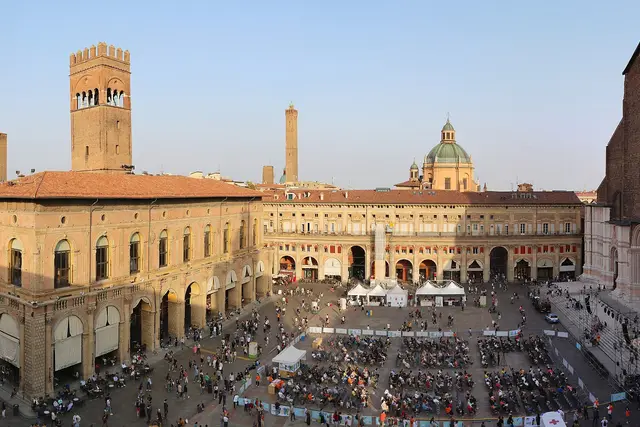
From here, Via Farini leads west under continuous arches toward Piazza Galvani and the Archiginnasio. The Archiginnasio was the old university seat, and its long portico is known as the Pavaglione. Piazza Maggiore and the Basilica di San Petronio are about five minutes further north.
Reading the arches
The porticoes started as a housing fix. Medieval Bologna was packed with students, and owners built out over the street on upper floors to gain rooms. A city statute of 1288 made porticoes compulsory on new buildings. It also fixed a minimum height tall enough for a rider on horseback to pass underneath.
That rule explains the variety you’ll see. The styles range widely:
- Casa Isolani, Strada Maggiore: a rare surviving medieval portico held up by tall oak beams, with the second floor projecting above it.
- Portico dei Servi, Strada Maggiore: slender columns and wide arches in front of the church of Santa Maria dei Servi.
- Via Zamboni: the university quarter, with its arcades lined by faculty buildings and student cafés.
- Via Saragozza: the start of the San Luca route. The arches get plainer and more residential the further you walk.

The long walk to San Luca
The Portico di San Luca is the longest in the world. It runs about 3.8 km from Porta Saragozza to the Sanctuary of the Madonna di San Luca on Colle della Guardia, under 666 arches. The flat first stretch ends at the Arco del Meloncello. After that, the path climbs steadily on steps and ramps.
It takes most people around an hour going up. Wear shoes with grip, because the stone gets slick after rain. Bring water, since shelter from the rain doesn’t mean shelter from summer heat. From the top you get views over the hills and the plain.
Sharing the arcades with Bologna
These are working streets, and the arches are how people get around the city. A few habits make walking them easier:
- Keep right and keep moving. The narrower porticoes on Via dell’Indipendenza and Strada Maggiore are commuter routes. If you want a photo of the vaults, step in beside a column.
- Café tables belong to the café. Many bars set seating out under the arches. Sit down there and you’ll be served table service, which usually costs more than standing at the counter inside.
- Look for the numbers. Along the San Luca route, the arches and the small shrines between them are numbered, so you can keep track of your progress.
- Cover up for the sanctuary. San Luca is an active church. Bring something for your shoulders if you plan to go in.
- Go early or late. The porticoes never close, so the empty early morning and the lamplit evening are both open to you. In the centre, arriving before the shops open usually means clear arches for photos.
Planning your time
Nothing needs booking and there’s nothing to buy. Two hours is enough to link Piazza Cavour, the Archiginnasio, Strada Maggiore and Via Zamboni on foot. Add half a day for San Luca.
From Bologna Centrale station, walk south along Via dell’Indipendenza. You’re under porticoes almost the whole way to Piazza Maggiore, and it’s a good introduction before you head to Piazza Cavour.
Rainy days and the hot middle of summer suit the porticoes best, because that’s what they were built for. On a wet afternoon you can still spend hours walking the city while other visitors are stuck indoors.
Frequently asked questions
Where do the Portici di Bologna start?
There's no single entrance, because the porticoes line streets across the whole centre. Piazza Cavour, a few minutes' walk south of Piazza Maggiore, is a good place to start. From there, Via Farini leads toward the Archiginnasio.
Are the porticoes open at night?
Yes. They are public streets, open 24 hours every day, and the central stretches are lit after dark.
How long does the walk to San Luca take?
The portico runs about 3.8 km from Porta Saragozza to the sanctuary, under 666 arches. Most people take around an hour going up, and the steepest part begins after the Arco del Meloncello.
How much time should I set aside?
Two hours covers the main central porticoes, including Piazza Cavour, the Archiginnasio, Strada Maggiore and Via Zamboni. Allow half a day if you add San Luca.
Why are the porticoes UNESCO-listed?
UNESCO listed twelve stretches in 2021 because Bologna's porticoes are unusual for their length, their continuity and their age. They have been required on new buildings since a city statute of 1288.
Plan your trip to Bologna
Some links above are affiliate links — if you book through them, Wander Atlas earns a small commission at no extra cost to you. It's how we keep every guide free.