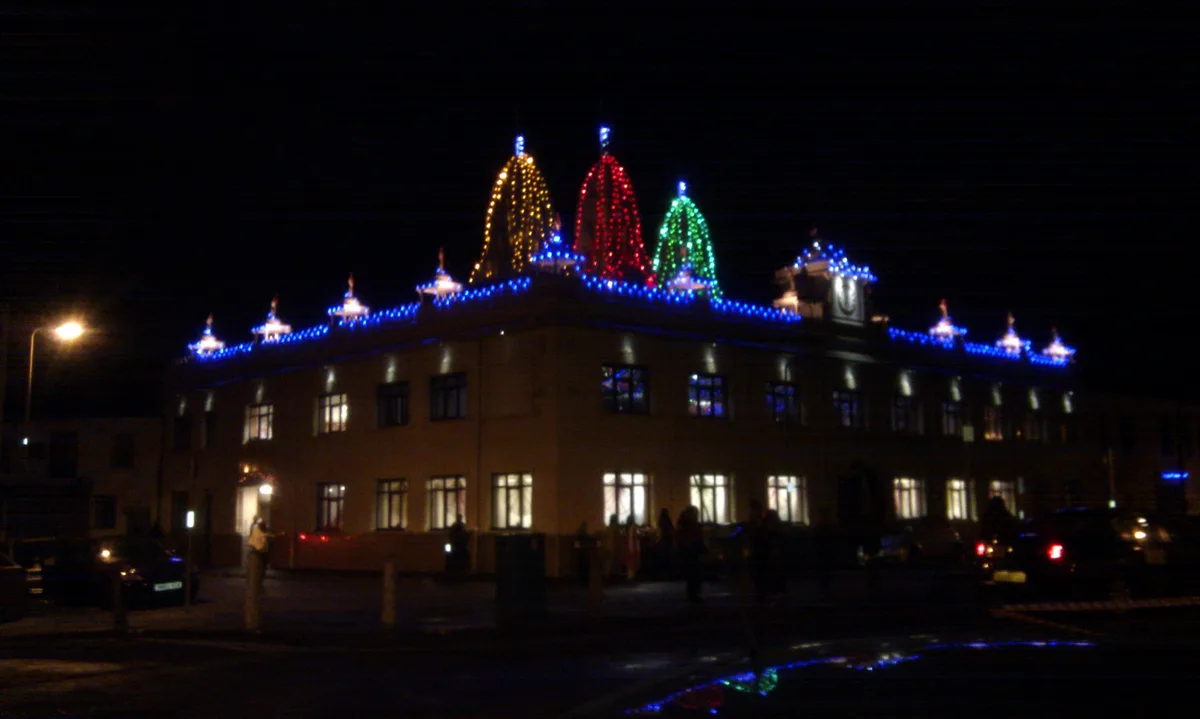
A mandir on a Cardiff side street
Merches Place doesn’t look like the kind of street where you’d find a temple. This is south Cardiff’s grid of Victorian terraces, between the River Taff and the railway, where corner shops and front doors line up close together. A Hindu mandir at number 4 is one of the quieter places of worship in the city.
That low profile is a good thing for a visitor. It gets far fewer people than Cardiff’s castle-and-stadium circuit, and it works as a living temple first. You come here to see daily worship as it actually happens, not a staged show. Visitors who come with respect consistently rate it well.
Two doors a day: the darshan windows
The thing to plan around is the schedule. The temple doesn’t stay open all day. It opens twice and closes in between, a pattern common across Swaminarayan temples, where the day follows the rhythm of the deities’ worship.
At the moment the hours are:
- Every morning: 6:30–9:00am
- Monday to Friday evenings: 4:00–7:00pm
- Saturday and Sunday evenings: 4:00–6:45pm, a quarter-hour earlier
Between 9am and 4pm the doors are shut, so a lunchtime visit will leave you standing outside. Temple hours often move around festivals and special events, so check the temple’s own notices before you make a trip just for it.
What the morning and evening bring
The two windows feel different. Early mornings in Swaminarayan temples usually start with the first prayers of the day, when the shrine is opened and the deities are greeted. It suits early risers and anyone heading on to a full day in the city centre.
The evening window is more practical for most travellers. It fits after a day at Cardiff Castle or the Bay, and it is when people who work during the day tend to come. Arti, the ritual waving of lamps in front of the deities with singing, is part of temple practice. Exact arti times aren’t published here, so ask at the door if you want to see it.
Getting to Merches Place
You can walk there from the city centre. From Cardiff Central station, head south and west towards Penarth Road and Clare Road. Merches Place sits in the streets in between, roughly 10–15 minutes on foot.
- By train: Cardiff Central is the main station. Grangetown station, on the Penarth and Barry lines, is the other option if you’re coming from the south.
- By bus: plenty of routes run along Penarth Road and Clare Road from the city centre.
- By car: these are tight residential terraces, so street parking is limited. Walking or the bus is usually less hassle.
Use the postcode CF11 6RD in your maps app. The street is short and easy to walk straight past.
Shoes off at the door: temple manners
The etiquette is simple, and it matters more here than speed.
- Shoes: take them off before you go into the prayer hall and leave them where everyone else has.
- Dress: cover your shoulders and knees. Loose, modest clothing is easiest when sitting on the floor.
- Feet: don’t point the soles of your feet at the shrine when you sit down.
- Photos: ask before you take any, especially of the shrine or of people praying. Many temples restrict photography inside.
- Quiet: keep your phone on silent and talk softly during worship.
You may be offered prasad, a small portion of blessed food. Take it with your right hand and eat it there or keep it; don’t throw it away. A donation box is normal in Hindu temples, and giving is entirely up to you. If you’re unsure about anything, ask a volunteer or a regular. Respectful questions from visitors are generally welcome.
Festival days in the Gujarati calendar
Like most Swaminarayan temples, the community here follows a festival calendar with Gujarati roots. The big dates usually bring more people, food and decoration than an ordinary weekday.
- Diwali and the Hindu New Year that follows, often marked with Annakut, an offering of many vegetarian dishes set out before the deities
- Swaminarayan Jayanti, which falls on the same day as Ram Navami in spring
- Janmashtami, Krishna’s birthday, in late summer
These are the most atmospheric times to go but also the busiest. Programmes can run outside the normal hours, so check locally before you go.
Around Grangetown and the Taff
The temple fits easily into a walk around south Cardiff. The River Taff is a few streets away, and the Taff Trail follows its banks north towards Bute Park and Cardiff Castle, or south towards Cardiff Bay.
Across the river, the Principality Stadium is only a short walk away. On match days the whole area fills up early, so a visit during the morning window helps you avoid the crowds. Grange Gardens, a small Victorian park in Grangetown, is a good place to sit for a while after an evening visit. Penarth Road and Clare Road have corner shops and takeaways if you need food afterwards.
Frequently asked questions
What are the opening hours of Shree Swaminarayan Temple Cardiff?
At the moment it opens 6:30–9:00am every day, then 4:00–7:00pm Monday to Friday and 4:00–6:45pm on Saturday and Sunday. It is closed between 9am and 4pm. Hours can change around festivals, so check the temple's notices before you go.
How do I get to the temple from Cardiff Central?
It's about a 10–15 minute walk south-west of Cardiff Central, towards Penarth Road and Clare Road. Search for 4 Merches Place, CF11 6RD. Grangetown station and buses along Penarth Road are other options.
What should I wear and how should I behave?
Wear modest clothing that covers your shoulders and knees, and take your shoes off before going into the prayer hall. Keep quiet during worship, don't point your feet at the shrine, and ask before taking any photos.
How long should I spend there?
For most visitors 30–45 minutes is enough to take off your shoes, see the shrine and sit quietly for a while. Allow more time on festival days, when there's more going on.
What else is nearby?
The River Taff and the Taff Trail are a few streets away, the Principality Stadium is just across the river, and Grange Gardens is in Grangetown. Cardiff Castle and Bute Park are a longer walk north along the river.
Plan your trip to Cardiff
United Kingdom eSIM & staying connected →
Some links above are affiliate links — if you book through them, Wander Atlas earns a small commission at no extra cost to you. It's how we keep every guide free.