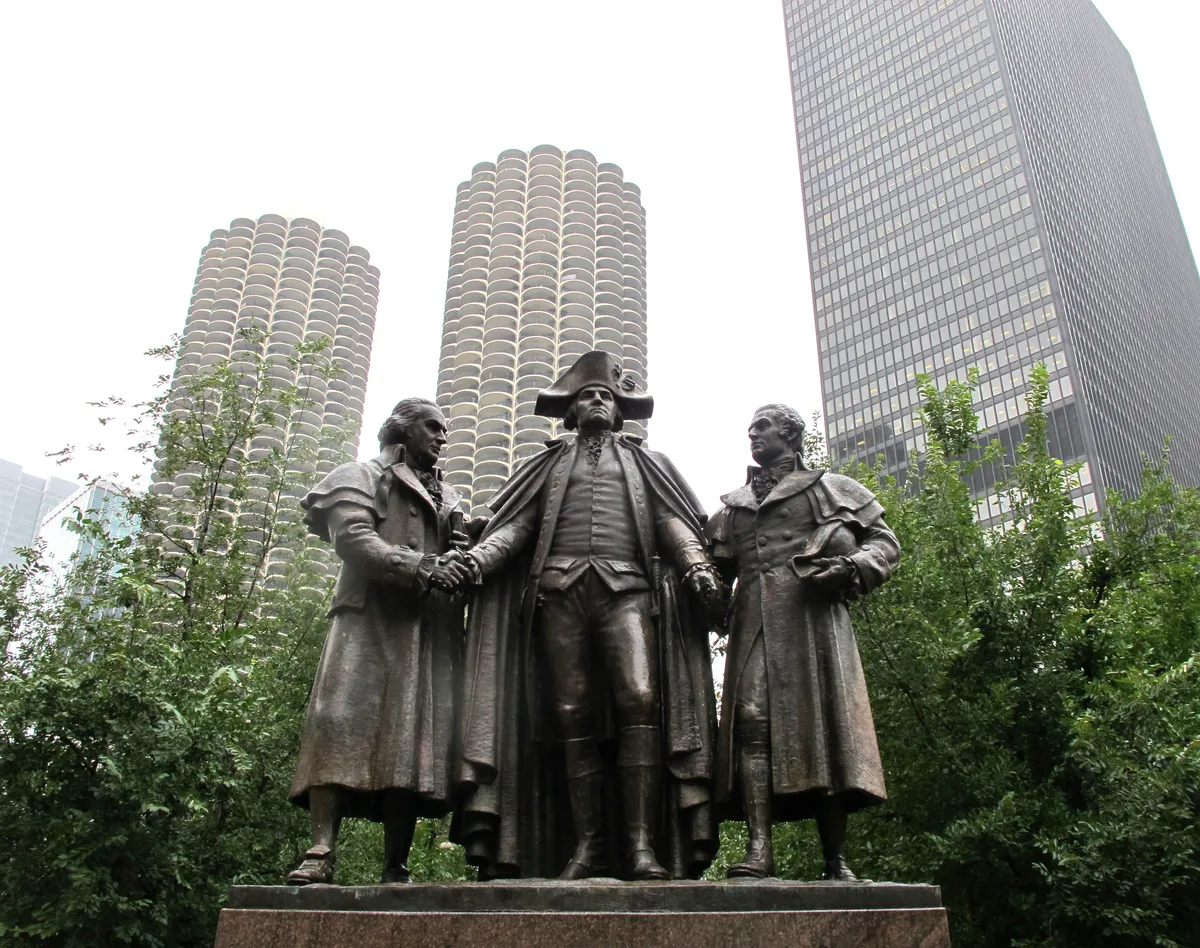
Three men on a granite block
Washington is in the middle, holding hands with two men. The bronze trio stands on a granite pedestal where Wacker Drive meets Wabash Avenue. Traffic loops around it, and the green steel of the Wabash Avenue Bridge rises just to the north.
Most people crossing the bridge on their way to Michigan Avenue walk straight past it. That’s what makes it a good stop. It’s a serious piece of civic sculpture on one of downtown’s busiest corners, and you’ll usually have the plinth mostly to yourself.
Who’s standing beside Washington
Washington’s companions are Robert Morris and Haym Salomon. Morris was a Philadelphia merchant, signed the Declaration of Independence and became Superintendent of Finance. Salomon was a Polish-born Jewish broker who raised money for the Continental cause and died poor soon after the war.
Lorado Taft, Chicago’s best-known sculptor of his day, designed the group. He died in 1936 with the work unfinished. His associate Leonard Crunelle completed it, and it was dedicated in December 1941, the 150th anniversary of the Bill of Rights.
The square has its own name for a reason. It honours Captain Nathan Heald, who commanded Fort Dearborn in 1812. The fort stood about a block east, near Michigan Avenue and Wacker, so this is one of the oldest patches of the city.
Walk around to the back
Most visitors photograph the front and move on. The better reason to stop is on the rear of the pedestal. It carries a passage from Washington’s 1790 letter to the Hebrew Congregation in Newport, Rhode Island.
That’s the letter declaring that the United States “gives to bigotry no sanction, to persecution no assistance.” Read it slowly. The monument opened as the United States entered the Second World War, and that context explains the choice of text better than any plaque could.
Getting to Wacker and Wabash
The monument is on the Loop side of the river, a short walk from several train lines.
- State/Lake station (Brown, Green, Orange, Pink and Purple Lines): walk north on State or Wabash to the river, about five minutes.
- Lake station (Red Line): same direction, a few minutes more.
- From the Magnificent Mile: cross the Wabash Avenue Bridge southbound. The monument is waiting at the foot of it.
- From the Riverwalk: take the stairs up to street level near Wabash.
Wacker Drive is double-decked here. Stay on upper Wacker, the street level with sidewalks. Lower Wacker is a service road underneath, and map apps sometimes route walkers down there by mistake.
Visiting a statue on a busy corner
It’s an open public monument, so there’s no gate, ticket or queue. It sits on a traffic island ringed by crossings, so use the signalled crosswalks on Wacker and Wabash. Cutting across between turning cars is the easy mistake to make here.
Some habits make the visit go better:
- Go early or late in the day. Early morning and early evening avoid the lunchtime office crowds, and low sun lights the bronze faces from the side.
- Step back to the bridge approach to fit the whole group and pedestal into one frame.
- Don’t climb the pedestal. Chicagoans treat public sculpture as part of the street, not a prop.
- Bring a phone for reading. The inscriptions sit at pedestal height and are easier to take in if you photograph them and zoom in.
Stitching it into a river walk
Treat the monument as one stop on a loop along the river. Everything below is within a ten-minute walk:
- Chicago Riverwalk, directly below: waterside paths, cafés and the embarkation points for river tours.
- Chicago Architecture Center at 111 East Wacker, a block east, where the architecture boat tours are based.
- Wrigley Building and the Michigan Avenue Bridge, a block east, with the Fort Dearborn outline marked in the pavement nearby.
- 35 East Wacker, the domed Jewelers Building, just west along Wacker.
- Trump International Hotel & Tower, straight across the river, the tall glass building that fills the view north.
Pause at the monument, cross the Wabash bridge, then walk back along the Riverwalk. You’ll see the statue from two levels in under an hour. You’ll also pass one of the few places in the city where the Revolution, Fort Dearborn and the modern skyline all fit in one view.
Frequently asked questions
Where exactly is the Heald Square Monument?
It's at East Wacker Drive and North Wabash Avenue in the Loop, on the south side of the Chicago River at the foot of the Wabash Avenue Bridge. Stay on upper Wacker, the street level. Lower Wacker runs underneath.
What's the nearest L station?
State/Lake (Brown, Green, Orange, Pink and Purple Lines) is about a five-minute walk south. Lake station on the Red Line is a few minutes further.
How long should I spend there?
15 to 20 minutes covers the front, the Washington letter on the rear of the pedestal and a few photos. Pair it with the Riverwalk or the Chicago Architecture Center for a longer outing.
Who does the statue show?
George Washington with Robert Morris and Haym Salomon, two of the main financiers of the American Revolution. Lorado Taft designed it, Leonard Crunelle finished it, and it was dedicated in 1941.
What else is nearby?
The Chicago Riverwalk is directly below. The Chicago Architecture Center, the Wrigley Building, the Michigan Avenue Bridge and 35 East Wacker are all within a few blocks.
Plan your trip to Chicago
Some links above are affiliate links — if you book through them, Wander Atlas earns a small commission at no extra cost to you. It's how we keep every guide free.