
Sixteen arches across the Guadalquivir
Stone arches carry you over the Guadalquivir. The bridge was first built in the early 1st century BCE, when Córdoba was a Roman provincial capital. Almost every century since has patched it, and much of what stands today is medieval Moorish and later rebuilding on the Roman line.
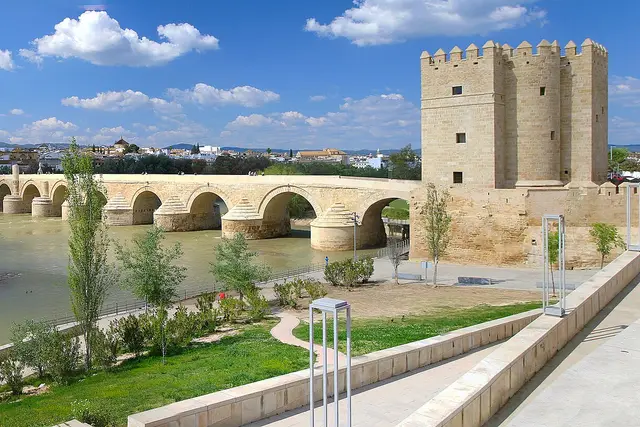
The deck is pedestrian-only and runs about 250 metres. At the north end the Renaissance gate, the Puerta del Puente, frames the Mezquita-Catedral’s walls. At the south end the fortified Torre de la Calahorra guards the Campo de la Verdad side. Most people cross it in ten minutes. Allow 30–45 if you stop for the views.
What you see from the deck
Halfway across, a stone statue of the Archangel Raphael, Córdoba’s guardian, stands on the parapet. Candles and flowers usually sit at its base. Look down and the riverbed opens into the Sotos de la Albolafia, a protected stretch of reeds, islets and birdlife.
- Molino de la Albolafia: the restored waterwheel by the north bank, a reminder of the river’s Moorish mills.
- Mezquita-Catedral skyline: the cathedral tower rises above the mosque roof. It looks best from the Calahorra end, looking back north.
- Triunfo de San Rafael: the tall baroque monument just beside the Puerta del Puente.
- Torre de la Calahorra: houses a museum on life in al-Andalus, with rooftop views back over the bridge.
Television fans may recognise the crossing as the Long Bridge of Volantis from Game of Thrones.
Crossing at the right hour
Come early. The bridge is quietest from 7am to 9am every day of the week. At that hour the low light falls across the arches and you can photograph the parapet without strangers in the frame.
Try not to arrive between 12pm and 10pm on weekends. That is when tour groups, street musicians and evening strollers fill the deck, so getting a clear photo means waiting. In summer, Córdoba’s midday heat is a second reason to cross early. The stone deck has almost no shade.
Walking it the Cordobés way
People in Córdoba walk the bridge as part of the old town, not as a stop to tick off. A good loop links it with the Mezquita-Catedral and the Alcázar de los Reyes Cristianos, both a few minutes’ walk from the north end.
- At the San Rafael statue: people light candles here as an act of devotion. Keep your voice down and step aside rather than posing against the shrine.
- For the classic view: cross to the south bank and walk a little way along the riverside. The full run of arches with the Mezquita behind is clearest from there.
- Buskers and vendors: musicians play for tips, so give coins if you stop to listen. Keep your bag zipped in the weekend crowds.
- After dark: the Mezquita walls and the arches are floodlit, and the bridge stays open to walkers.
The bridge is at Av. del Alcázar, s/n, in the Sur district. The city’s taxis and buses stop along the Ronda de Isasa and the riverside avenue at the north end. On foot, it is about 15 minutes from Plaza de las Tendillas through the Judería.
Frequently asked questions
When is the quietest time to visit the Roman Bridge of Córdoba?
7am–9am, both on weekdays and at weekends. Avoid weekends from 12pm to 10pm, when it is usually at its busiest.
Is the Roman Bridge open at night?
Google currently lists it as open 24 hours. It is a pedestrian bridge, and in the evening the arches and the Mezquita-Catedral walls are floodlit.
How long does it take to walk across?
The bridge is about 250 metres long, so crossing takes around ten minutes. Allow 30–45 minutes to stop at the San Rafael statue and look at the views from both banks.
What is near the Roman Bridge?
The Puerta del Puente, the Triunfo de San Rafael and the Mezquita-Catedral are at the north end, with the Alcázar de los Reyes Cristianos close by. The Torre de la Calahorra and its museum of al-Andalus stand at the south end.
Where is the best photo spot?
Go to the south bank near the Torre de la Calahorra and look back north. From there the full run of arches lines up with the Mezquita-Catedral behind.
Plan your trip to Cordoba
Spain eSIM & staying connected →
Some links above are affiliate links — if you book through them, Wander Atlas earns a small commission at no extra cost to you. It's how we keep every guide free.
Related guides
 attraction
Torre de la Calahorra: Cordoba Travel Guide (4.5★)
 attraction
Templo Romano: Cordoba Travel Guide (4.2★)
 attraction
Palacio de Viana: Cordoba Travel Guide (4.5★)
 hidden gem