
An iron pavilion beside the gardens
Mercado Victoria sits on a gravel promenade. Plane trees and the formal beds of the Jardines de la Victoria surround a 19th-century pavilion of wrought iron and glass. It began life as a caseta, one of the temporary halls built for the city’s fair. Today it houses a food hall.
Inside is a single open hall with counters around the edges and shared tables in the middle. Each stand does its own thing. One slices cured ham, another fries fish, another pours wine by the glass. You walk the loop, point at what you want and build a meal from several counters.
This isn’t somewhere to go looking for a quiet local secret. It’s one of the most-reviewed food spots in Córdoba, and the regular price level is mid-range. It works best as a grazing stop between sights, or as a late base when the rest of the old town has closed its kitchens.
What to put on your tray
The hall’s specialities are Andalusian tapas and fortified wines. Córdoba has its own versions of both, so start with the city’s classics:
- Salmorejo: a thick, chilled tomato and bread cream topped with chopped egg and ham. It comes from Córdoba.
- Flamenquín: pork rolled around ham, breaded and fried, usually cut into thick slices.
- Rabo de toro: oxtail slow-braised in red wine, a Cordoban standard.
- Jamón and cheese boards: shared plates that suit the deli counters.
- Montilla-Moriles wines: dry fino and sweet Pedro Ximénez from the province, poured the way sherry is.
What each stand offers changes over time, so walk the full circuit before you commit. Ordering small portions from three or four counters beats one big plate from the first stand you pass.

Ordering counter by counter
Every stand runs its own till. You order and pay at each counter, and nobody brings a single bill to your table. Pay as you collect. In a group, it’s faster to split up, with one person on drinks and another on food.
Seating is shared and first come, first served. Nobody seats you. Claim a free stretch of table, leave a jacket or bag on it, and send someone to fetch the food. Asking “¿Está libre?” before sitting at a half-empty table is normal and polite.
Cards are widely accepted in Spanish food halls. Tipping is modest in Spain and entirely optional at a counter. Rounding up or leaving small coins is plenty. A few words help: una copa de fino (a glass of fino), media ración (half portion), para compartir (to share).
Choosing when to go
The doors open at 9am every day. It closes at 1am from Sunday to Thursday, except Monday, when it stays open until 2am. On Fridays and Saturdays it also runs until 2am.
Córdoba keeps Spanish hours. Lunch starts around 2pm and dinner rarely before 9pm. The hall fills around those windows, and on weekend evenings you’ll likely be hunting for a seat. Mid-morning or late afternoon usually gives you more room, simply because most people aren’t eating then.
In high summer the city gets very hot in the afternoon. A cold salmorejo and a glass of fino under cover, then a walk through the gardens once the heat drops, fits the way the city already moves.
Getting there and walking on
The market is on Paseo de la Victoria, on the western side of the historic centre. Córdoba’s main railway station, where the AVE high-speed trains stop, is roughly a 15-minute walk north. The bus station sits beside it.
It’s an easy place to start or finish a day in the old town. Close by on foot:
- Jardines de la Victoria: the gardens right outside, good for a shady stroll.
- Puerta de Almodóvar: the medieval gate into the Judería, a few minutes south.
- The Judería: the old Jewish quarter’s lanes, with the Synagogue and the Calleja de las Flores.
- Mezquita-Catedral: about 15 minutes’ walk through the Judería.
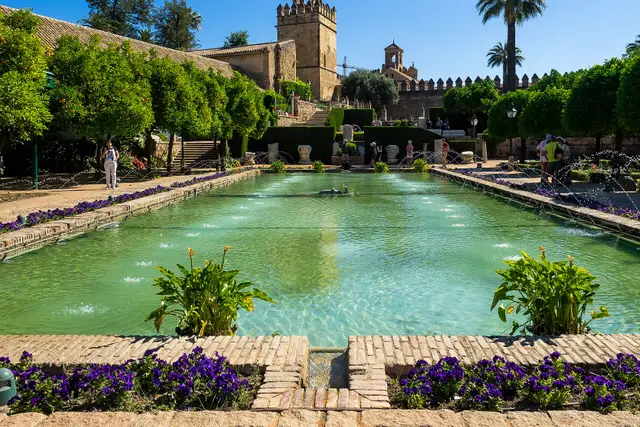
- Alcázar de los Reyes Cristianos: south towards the river, with its terraced gardens.
A good loop is the Mezquita in the morning, lunch back at the market, then the Alcázar gardens later in the day. Late hours also make it a reliable dinner fallback after a flamenco show in the old town.
Frequently asked questions
Where exactly is Mercado Victoria in Córdoba?
It's on Paseo de la Victoria in the Centro district (postcode 14004), next to the Jardines de la Victoria on the western edge of the historic centre. The Puerta de Almodóvar and the Judería are a short walk south.
What are the opening hours?
It opens at 9am every day. It closes at 1am Tuesday to Thursday and on Sunday, and at 2am on Monday, Friday and Saturday.
How does ordering work?
Each stand is separate. You order and pay at every counter you use, then carry your food to the shared tables in the middle. Seating is first come, first served.
How long should I spend there?
An hour is enough for a few tapas and a drink. Allow longer at dinner on weekends, when finding a seat can take time.
How far is it from the Mezquita and the train station?
The Mezquita-Catedral is about 15 minutes' walk through the Judería. Córdoba's main railway and bus stations are roughly 15 minutes' walk north.
Plan your trip to Cordoba
Some links above are affiliate links — if you book through them, Wander Atlas earns a small commission at no extra cost to you. It's how we keep every guide free.
Related guides
 hidden gem
 Alcázar de los Reyes Cristianos: Cordoba Travel Guide (4.5★)
 attraction
 Templo Romano: Cordoba Travel Guide (4.2★)
 attraction
 Torre de la Calahorra: Cordoba Travel Guide (4.5★)
 hidden gem