A 1930s villa on a hill of pines
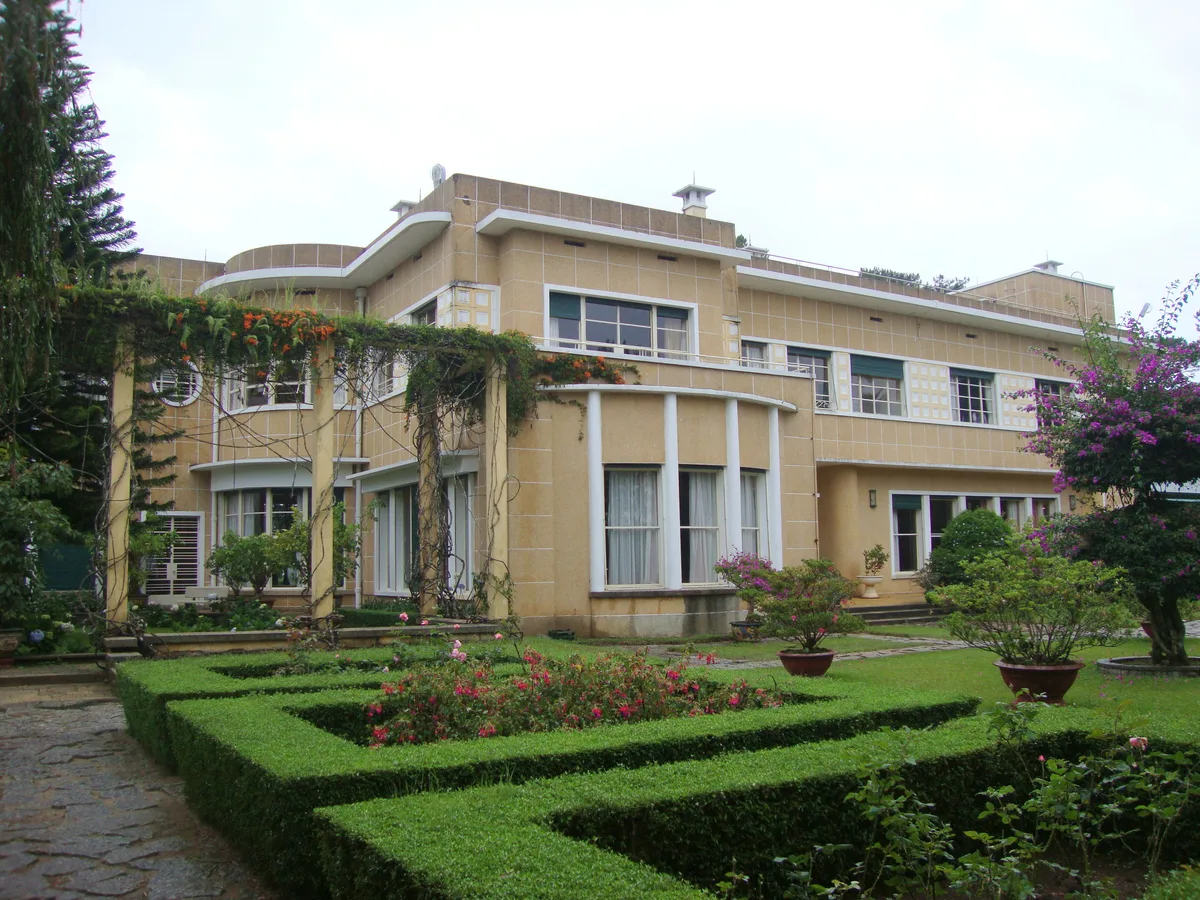
The road climbs through pine trees and stops at a long, pale house. It looks more like a 1930s seaside villa than a royal court. This was the summer retreat of Bảo Đại, the last emperor of the Nguyễn dynasty, completed in 1938. Locals still call it Dinh III, the third palace.
Don’t expect lacquered pillars or curved temple roofs. The building has clean, geometric lines, a flat profile and plain rendered walls, the European modernism of its decade. That is why it’s interesting. You’re walking through the house of a monarch who spent his summers living like a well-off French official, in a hill station the French built to get away from the lowland heat.
It is one of the most-reviewed sights in Da Lat. You won’t have it to yourself, but you can choose when to share it.
What the two floors hold
Most of the house is laid out the way the family lived in it.
- Ground floor: the reception rooms, the emperor’s working office and the formal dining room, where the official business of a summer took place.
- Upper floor: the private rooms, including the bedrooms of Bảo Đại, Empress Nam Phương and their children, plus a family sitting area.
- Outside: a terrace and landscaped gardens with clipped hedges and flower beds, framed by the pines.
The furnishings are simple and solid, dark wood with period fabrics, and you see them from behind ropes. Give the upper floor time. The family rooms are smaller and more personal than the state rooms downstairs. They show how ordinary a royal summer could look in the late 1930s.
Plastic over your shoes, ropes at the doors
Visitors are usually asked to cover their shoes before going inside. Plastic shoe covers are handed out near the entrance to protect the old floors. Put them on at the door and drop them in the bin when you leave.
The route through the house runs one way, room by room. It narrows to single file on the stairs and in the bedroom corridors. When a big group comes in behind you, step into a doorway and let them go by. Their guide will move them on within a few minutes, and the room is quiet again.

Moving through Dinh III with the crowds
This is a well-visited stop on almost every Da Lat city tour, so the trick is timing. Reasoning from how tours usually run, the coaches tend to arrive mid-morning, after hotel pickups. If you’re at the gate close to the 7:00am opening, you’ll usually walk through ahead of them.
A few habits help:
- Tickets: buy them at the booth by the gate. Current prices are posted there. Cash in Vietnamese đồng is the safest option.
- Inside: speak quietly, and don’t lean on or touch the furniture behind the ropes.
- Costume photos: stalls in the garden often rent out imperial-style áo dài and robes for photos. That’s where many Vietnamese visitors spend their time, and it’s part of the scene here.
- Getting around: Grab cars and motorbikes work well in Da Lat. Drivers know the palace as Dinh Bảo Đại.
Getting up Triệu Việt Vương hill
The palace stands at 1 Đường Triệu Việt Vương in Xuân Hương ward, on high ground southwest of the city centre. From Xuan Huong Lake or Da Lat Market, a taxi or Grab takes about ten minutes. Walking is possible, but the last stretch climbs steeply. Da Lat sits around 1,500 metres up, so the climb is harder than it looks.
If you’re arriving by air, Liên Khương Airport is roughly 30km south of the city. Go to your hotel first. The palace doesn’t need luggage-hauling energy.
Timing it around Da Lat weather
Da Lat is cool all year, and mornings on the hill can be chilly. Bring a light layer even if the coast was hot. The drier months, roughly December to March, give the clearest light on the gardens and the pines.
From about May to October, afternoon showers are common. That’s another reason to come in the morning: the indoor rooms are a good shelter, but the gardens are the best part when it’s dry. Opening hours are currently 7:00am to 5:30pm every day. Hours for heritage sites can change through the year and over holidays, so check the official listing before a late-afternoon visit.
Pairing it with southern Da Lat
The palace sits on a natural loop of sights south of the lake, so it combines easily into a half day:
- Hằng Nga Guesthouse (“Crazy House”): the organic, cave-like architectural fantasy, a short ride away and a sharp contrast to Bảo Đại’s restrained lines.
- Da Lat Railway Station: the 1930s station with its distinctive triple-peaked roof, from the same era as the palace.
- Trúc Lâm Monastery and the cable car: further south above Tuyền Lâm Lake, best kept for a separate morning.
- Xuan Huong Lake: the crescent lake in the town centre, good for a walk back towards cafés.
Do the palace first while it’s quiet. Crazy House is another stop that tour groups fill up as the day goes on.
Frequently asked questions
How long do I need at Bao Dai Palace 3?
Plan on 60–90 minutes. That covers both floors of rooms at an easy pace and a walk around the gardens. Add time if you want costume photos in the garden.
What time does Bao Dai Palace 3 open?
It currently opens 7:00am–5:30pm every day of the week. Hours for heritage sites can change with the season and on holidays, so check the official listing before you go, especially for a late visit.
How do I get to Bao Dai Palace 3 from central Da Lat?
It's at 1 Triệu Việt Vương, on a hill southwest of Xuan Huong Lake. A Grab or taxi takes around ten minutes from the lake or Da Lat Market. Drivers know it as Dinh Bảo Đại. Walking is possible, but the final approach is steep.
Is there anything I should know before going inside?
You'll usually be asked to wear plastic shoe covers, which are handed out at the entrance. The route through the rooms runs one way, and the furniture is roped off. Buy your ticket at the gate booth, where current prices are posted.
What can I combine with a visit?
Hằng Nga Guesthouse (Crazy House) and Da Lat Railway Station are both close, which makes an easy half-day loop. Trúc Lâm Monastery and its cable car, further south, work best as a separate outing.
Plan your trip to Da Lat
Vietnam eSIM & staying connected →
Some links above are affiliate links — if you book through them, Wander Atlas earns a small commission at no extra cost to you. It's how we keep every guide free.