A convict-era store full of Dutch timber
The building has stood here since the 1850s. It is a restored commissariat store, built in pale limestone when Fremantle was a convict settlement, and it sits one block back from the harbour on Cliff Street. Its long, high-ceilinged halls were built to hold colonial supplies. Now they hold what the Indian Ocean took from ships trying to reach the East Indies.
The centrepiece is the Batavia. This Dutch East India Company ship was wrecked on the Houtman Abrolhos islands in 1629, and the wreck was followed by one of the most notorious mutinies and massacres in maritime history. The recovered hull timbers stand reassembled in their own gallery. Beside them is the stone portico the ship carried as cargo, cut blocks meant for a gateway in Batavia (now Jakarta).
What fills the galleries
Most of the collection comes from wrecks off the Western Australian coast. Expect:
- Batavia gallery: the reconstructed stern section of the hull and the stone gateway
- Other Dutch wrecks: finds from the Vergulde Draeck (Gilt Dragon) and Zuytdorp, including coins, ceramics and cannon
- SS Xantho: an early steamship whose engine was raised from the seabed and conserved
- Maritime archaeology displays: how divers survey a wreck and how waterlogged objects are conserved
The labels go deep, so reading everything takes longer than you’d expect. Budget 1.5 to 2 hours, or 45 minutes if you only do the Batavia hall.
Timing your visit around the crowds
The museum opens every day from 9:30am to 5pm, with no closing day. On weekdays it’s calmest between 4pm and 5pm. That still leaves a full hour for the Batavia hall before the doors shut.
Weekends are harder. Try not to arrive between 11am and 4pm on Saturday or Sunday, because that’s when the galleries fill and the space around the hull gets crowded. If a weekend is your only option, come right at 9:30am.
Getting in and getting around the West End
Take the Fremantle line from Perth to Fremantle station at the end of the line. From there it’s roughly a 10-minute walk southwest through the West End’s Victorian streetscape. The free CAT bus also loops through central Fremantle. For entry arrangements, check the WA Museum’s official website before you go, not a third-party listing.
This is a museum where visitors read quietly, and school groups often come on weekday mornings. Photography of the displays is generally fine, but put the flash away near the conserved timbers. Pair the visit with sights close by:
- The Round House: WA’s oldest public building, a few minutes’ walk west, overlooking Bathers Beach
- Bathers Beach: the sand right behind the museum, good for a stop afterwards
- WA Maritime Museum: on Victoria Quay, the sister museum covering later maritime history
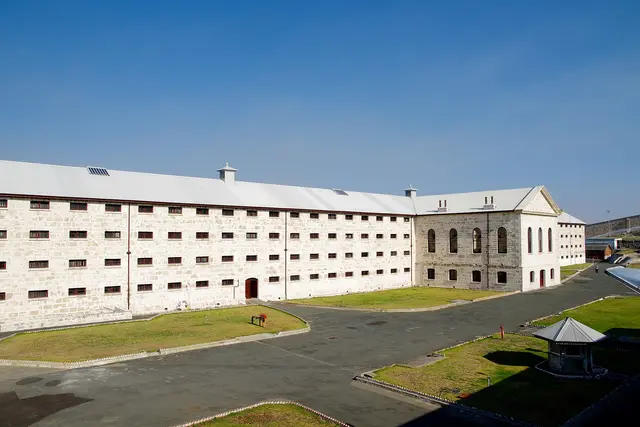
- Fremantle Prison: uphill on the town’s east side, for the rest of the convict story
Frequently asked questions
When is the quietest time to visit the WA Shipwrecks Museum?
On weekdays it's quietest between 4pm and 5pm. On weekends, avoid 11am to 4pm, which is the busiest stretch. Arriving at the 9:30am opening is your best option on a Saturday or Sunday.
How do I get there from Perth?
Take the Fremantle line train to Fremantle station, then walk about 10 minutes to 47 Cliff St in the West End. The free CAT bus also runs around central Fremantle.
How long should I spend inside?
Allow 1.5 to 2 hours to see all the galleries properly. If you only have time for the Batavia hull and stone portico, 45 minutes is enough.
Is it open every day?
Yes. It opens from 9:30am to 5pm, Monday to Sunday.
What else is nearby?
The Round House and Bathers Beach are a few minutes' walk away. The WA Maritime Museum on Victoria Quay and Fremantle Prison are both easy to add in the same day.
Plan your trip to Fremantle
Some links above are affiliate links — if you book through them, Wander Atlas earns a small commission at no extra cost to you. It's how we keep every guide free.