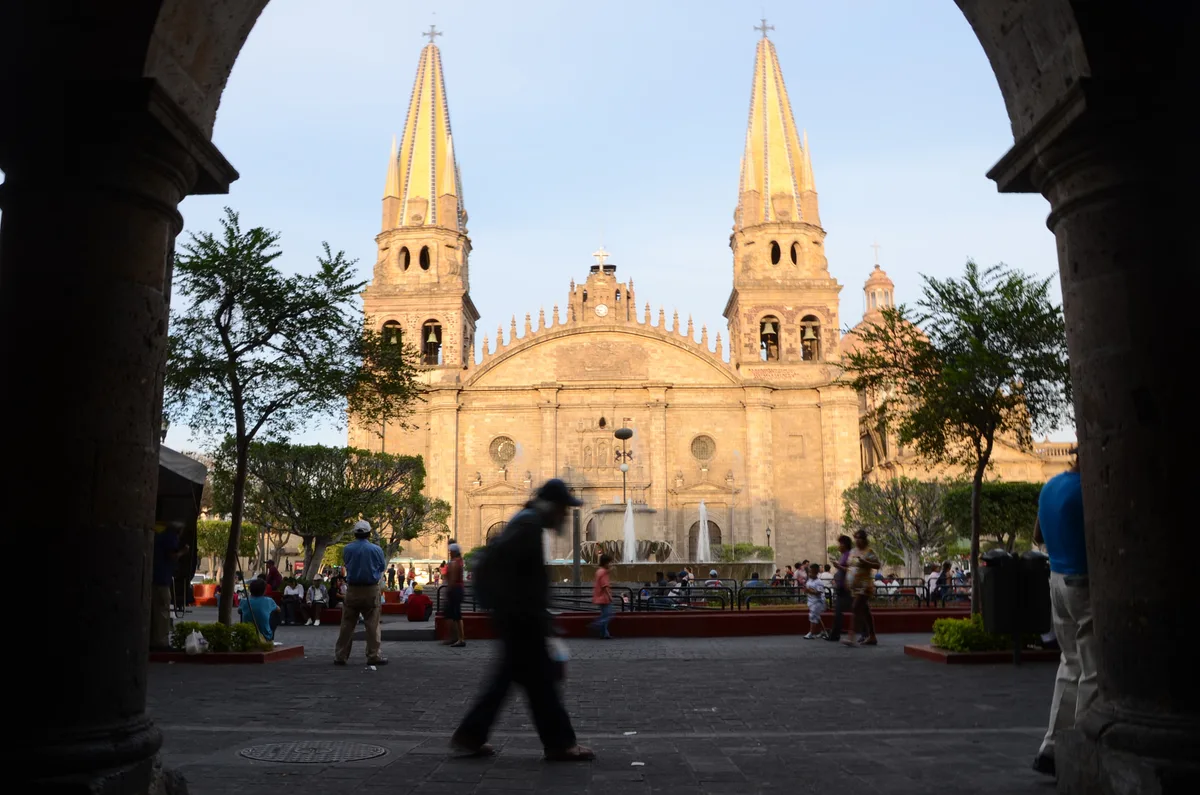
Two yellow spires over Zona Centro
The spires come first. Two tall neo-Gothic towers capped in yellow and blue tile rise over the centre of Guadalajara. You can see them from blocks away, so you’ll use them to find your way around downtown before you ever step inside.
The church below them is much older. Building began in the 16th century and finished in the 17th, which leaves the cathedral a mix of styles stacked over generations. The original towers fell in an earthquake in 1818. The ones you see now went up in the mid-1800s and became the city’s emblem.
Four plazas, one cross
The cathedral sits at the centre of four public squares laid out in the shape of a cross. Walk all of them and you’ve covered most of the historic centre in an hour.
- Plaza de Armas (south): a cast-iron bandstand, with the Palacio de Gobierno across the square. Inside, José Clemente Orozco’s huge mural of Miguel Hidalgo fills the stairwell.
- Plaza Guadalajara (west): the square in front of the main facade, with benches and the best straight-on view of the spires.
- Rotonda de los Jaliscienses Ilustres (north): a ring of columns honouring notable people from Jalisco.
- Plaza de la Liberación (east): an open plaza behind the apse, closed off by the columns of Teatro Degollado.
From there, the pedestrian Plaza Tapatía runs east to the Hospicio Cabañas. Orozco’s frescoes cover its dome, and the building is a UNESCO World Heritage Site.
Inside the nave
Step through the doors and the street noise drops away. The interior is lighter than the old stone facade suggests. White and gold neoclassical altars run down the side aisles, and the vaulted ceiling draws your eye along the nave toward the main altar.
Look out for the glass case holding the relics of St. Innocent, the cathedral’s best-known devotional object. A small cluster of worshippers usually stands in front of it.
Expect 20 to 30 minutes inside. Allow longer if you want to sit through part of a Mass.

Timing your visit
The doors open at 8am and close at 8pm every day of the week. That gives you a long window, but crowds are uneven across it.
On weekdays it’s calmest from 8am to 11am. That’s when morning light comes through the windows and you can walk the aisles without weaving between groups. On weekends the quiet window is shorter, 8am to 10am.
Avoid weekends from 12pm to 8pm. Families, tour groups and Sunday worshippers fill the nave then, and the plazas outside get packed with vendors and street performers.
A good plan is to go inside early, then come back at dusk. By then the floodlit spires look best from Plaza Guadalajara, and you only need to see them from outside.
Getting there
The cathedral is at Av. Alcalde 10, right in Zona Centro. The easiest way in is Line 3 of the city’s light rail (Mi Tren), which runs underground through the centre. Get off at Guadalajara Centro station and you come up a short walk from the facade.
Coming from Chapultepec or Colonia Americana, a taxi or ride-hail car can drop you on the edge of the pedestrian zone. Driving isn’t worth it. Streets around the plazas are partly pedestrianised and parking is scarce.
Visiting during Mass
This is a working cathedral first. Services run throughout the day and locals come in to pray between them, so a few habits go a long way:
- Dress: cover your shoulders and take off hats at the door. Shorts are tolerated but draw looks, especially at Sunday services.
- During Mass: stay in the back or the side aisles. Don’t walk up the central aisle while a service is going on.
- Photos: take them quietly, without flash, and never of people praying in the pews.
- Your voice: keep it low. Sound carries a long way under the vaults.
- Offerings: donation boxes and candle stands sit along the walls. If you light a candle, leave something in the box beside it.
Outside, vendors on the plazas sell snacks and religious souvenirs. Small peso coins and notes make buying easier than cards. If you want a proper meal afterwards, try a torta ahogada, the city’s signature sandwich drowned in salsa. Plenty of spots in the surrounding blocks serve it, and the Mercado San Juan de Dios is a short walk east past the Hospicio Cabañas.
Frequently asked questions
When is the quietest time to visit Guadalajara's Cathedral?
On weekdays it's calmest from 8am to 11am. On weekends it's calmest from 8am to 10am. Avoid weekends from 12pm to 8pm, the busiest stretch.
What are the opening hours?
It's open every day from 8am to 8pm. Mass is held through the day, so parts of the nave may be in use when you arrive.
How do I get there by public transport?
Take Line 3 of the Mi Tren light rail to Guadalajara Centro station. The cathedral is a short walk away, at Av. Alcalde 10 in Zona Centro.
How long should I spend there?
Allow 20 to 30 minutes inside. Add about an hour to walk the four surrounding plazas and look into the Palacio de Gobierno.
What else is nearby?
Plaza de Armas and the Palacio de Gobierno with its Orozco murals are on the south side. Teatro Degollado is to the east, and the Hospicio Cabañas and Mercado San Juan de Dios are at the far end of Plaza Tapatía.
Plan your trip to Guadalajara
Mexico eSIM & staying connected →
Some links above are affiliate links — if you book through them, Wander Atlas earns a small commission at no extra cost to you. It's how we keep every guide free.
Related guides
 attraction
 Regional Museum of Guadalajara: Travel Guide (4.5★)
 attraction
 Plaza de la Liberación: Guadalajara Travel Guide (4.7★)
 attraction
 Jardín Hidalgo: Guadalajara Travel Guide (4.7★)
 restaurant