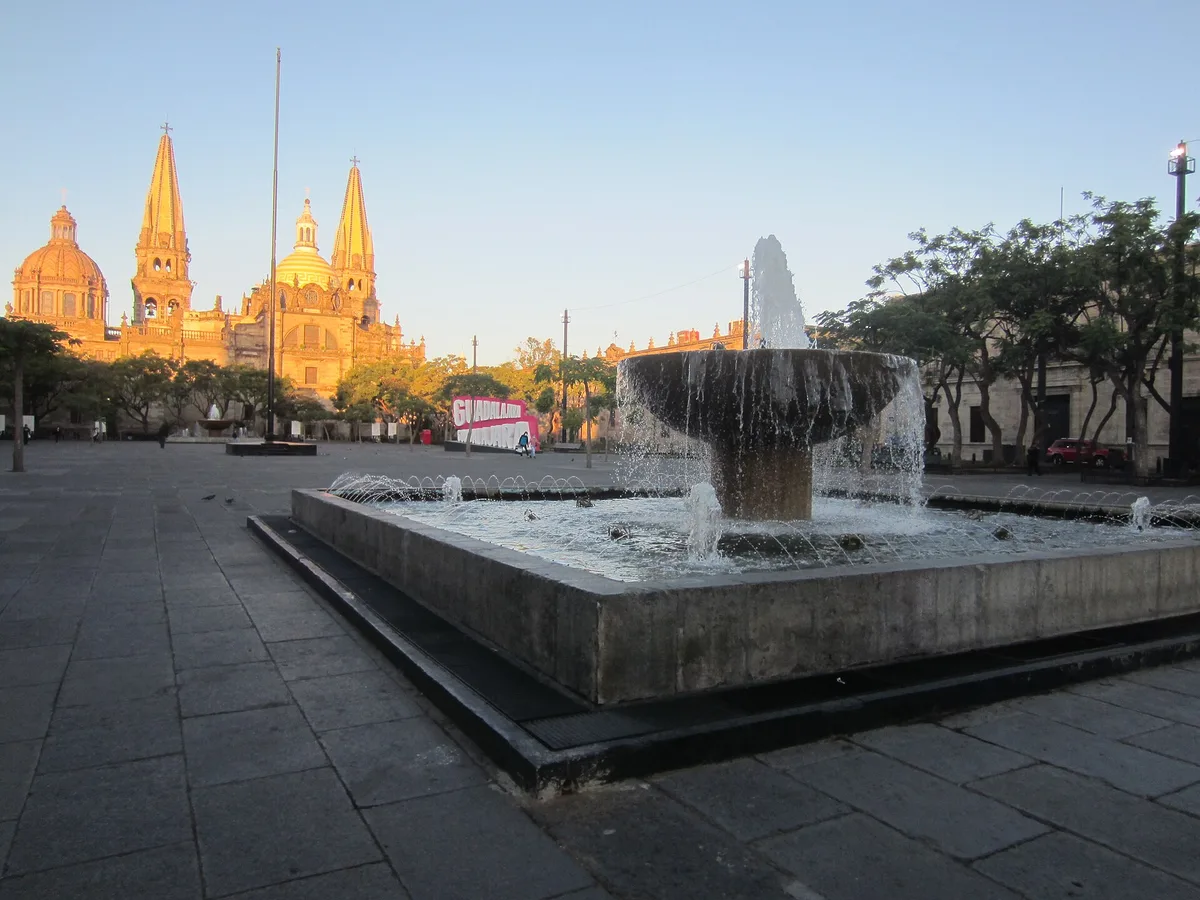
Cathedral spires behind you, theatre columns ahead
Stand with your back to the cathedral. The twin yellow-tiled spires of the Catedral de Guadalajara rise behind you, and a long open rectangle of pale stone runs east. At the far end, the Corinthian portico of Teatro Degollado closes the view like a stage set.
This is Plaza de la Liberación. Most Guadalajarans also call it the Plaza de las Dos Copas, after the two goblet-shaped fountains on either side of it. The square is wide and flat, with only low planting. That openness is the reason to come: you get full views of the buildings that line it.
It’s open all day and night with no ticket. You’ll walk across it at some point on any centro visit. It’s worth slowing down when you do.
The two cups and the broken chain
The “liberation” in the name refers to Miguel Hidalgo. A statue of him stands in the square. In December 1810, early in the War of Independence, Hidalgo issued his decree abolishing slavery here in Guadalajara. The plaza commemorates that act, which explains why his figure faces out across the stone and not toward the cathedral.
The square itself is newer than the buildings around it. It was cleared in the mid-twentieth century, when city blocks were demolished to open up the historic core. It was planned as one arm of the cross of plazas that now surrounds the cathedral. Before that, the theatre and cathedral didn’t share a clear line of sight.
Walking the cross of plazas
The cathedral sits at the centre of four squares, one on each side, and they’re laid out like a cross. Plaza de la Liberación is the eastern arm. The full loop takes about 20 minutes of easy walking:
- Plaza de Armas (south side of the cathedral): the wrought-iron bandstand, shaded by trees.
- Plaza Guadalajara (west, in front of the cathedral main doors): the classic façade photo.
- Rotonda de los Jaliscienses Ilustres (north): a circle of columns with statues of notable people from Jalisco.
- Plaza de la Liberación (east): the widest open space, between the cathedral and Teatro Degollado.
Keep going past the theatre and you reach Plaza Tapatía. It’s a long pedestrian promenade that ends at Hospicio Cabañas, the UNESCO-listed former orphanage with José Clemente Orozco’s dome frescoes. Walking it in one direction is the most natural way to see the old centre.
Orozco’s Hidalgo, one doorway away
The Palacio de Gobierno, Jalisco’s state government building, faces the square from its south side. Many visitors cross the plaza without going in. That’s a mistake: inside, above the main staircase, is Orozco’s mural of Hidalgo. It’s a huge image of the priest with a torch raised over scenes of struggle.
Seeing it right after standing beside his statue outside makes the plaza’s name click into place. Check visiting hours at the entrance, because it’s a working government building. Across the square to the north is the Palacio Legislativo, home of the state congress.

Teatro Degollado up close
The theatre deserves more than a photo from the far end of the square. Walk right up to the portico. Look into the pediment and you’ll find a carved relief of Apollo and the nine muses. The theatre opened in 1866, and its interior is a horseshoe of gilded balconies under a painted ceiling.
The Ballet Folclórico de la Universidad de Guadalajara has long performed here. Sunday morning shows are a tradition. Schedules and ticketing change, though, so check the theatre’s box office or official site before planning around a show.
Getting to Calle Pedro Loza
The plaza’s official address is C. Pedro Loza 27A, Zona Centro. In practice you’ll come in from the cathedral side or along Avenida Hidalgo. Your best options:
- Light rail Line 3, Catedral station: the closest stop. It’s a short walk past the cathedral.
- Light rail Line 2, Plaza Universidad station: a few blocks southwest. It works well if you’re coming along Avenida Juárez.
- Rideshare or taxi: ask for Teatro Degollado or the Catedral. Every driver knows both.
Driving into the centro means one-way streets and limited street parking. Paid lots around the cathedral blocks are the easier choice. The square is fully pedestrian.
Benches, vendors and the evening paseo
The plaza works best if you treat it as a place to sit for a while. These habits help:
- Carry small cash. Vendors selling paletas, cut fruit, balloons and snacks around the edges rarely take cards. Shoe-shiners work the area too, and they’re paid in coins and small notes.
- Expect demonstrations. The Palacio de Gobierno is here, so marches and sit-ins often gather in front of it. They’re usually peaceful. Give them room and don’t photograph participants up close without asking.
- Keep your voice down on the cathedral side. The back of the cathedral is still a church. Hats come off and conversations quieten if you step inside.
- Use the fountains for photos, not as a pool. Children dip their hands in, but climbing into the copas will draw attention from police patrolling the centro.
Because this is one of the most-visited spots in the city, don’t expect quiet. The most relaxed way to enjoy it is to arrive early on a weekday, before tour groups start working through the cross of plazas. Or come at dusk, when the floodlit façades take over.
Daylight versus after dark
Midday sun on the open stone is harsh. Shade is scarce here compared with the tree-lined Plaza de Armas next door. If you’re out in the middle of the day, do the quick photos here, then retreat under the trees.
Late afternoon is the sweet spot. The low western light hits the theatre’s columns directly, and the cathedral spires stand out against the eastern sky. After dark, the cathedral, the Palacio de Gobierno and Teatro Degollado are lit up. The square is open around the clock, but stick to the main lit axis between the cathedral and Plaza Tapatía late at night. Use rideshare for your way back rather than wandering the side streets.
Frequently asked questions
How do I get to Plaza de la Liberación by public transport?
Take light rail Line 3 to Catedral station. It's the closest stop, a short walk past the cathedral. Line 2's Plaza Universidad station is a few blocks southwest, off Avenida Juárez.
Is Plaza de la Liberación open at night?
Yes. It's a public square, open 24 hours every day. The cathedral, Palacio de Gobierno and Teatro Degollado are floodlit after dark. Late at night, stick to the lit central axis and use rideshare for the trip home.
How long should I spend there?
Allow 30 to 60 minutes for the square, the Hidalgo statue and the fountains. Add time for the Orozco mural inside the Palacio de Gobierno and a walk along Plaza Tapatía to Hospicio Cabañas, and it easily becomes half a day.
What is the best time of day to visit?
Late afternoon, when low sun lights the columns of Teatro Degollado, or after dark when the façades are illuminated. Midday is hot because the square has little shade. Early weekday visits usually beat the tour groups.
What is near Plaza de la Liberación?
The Catedral de Guadalajara (west), Teatro Degollado (east), Palacio de Gobierno with the Orozco murals (south) and Palacio Legislativo (north). Plaza de Armas and the Rotonda de los Jaliscienses Ilustres are steps away, and Plaza Tapatía leads to Hospicio Cabañas.
Plan your trip to Guadalajara
Some links above are affiliate links — if you book through them, Wander Atlas earns a small commission at no extra cost to you. It's how we keep every guide free.
Related guides
 attraction
 Gringo Gulch: Puerto Vallarta Travel Guide (4.5★)
 attraction
 Monumento Al Pipila: Guanajuato Travel Guide (4.7★)
 attraction
 Museo Histórico Casa de Allende: San Miguel de Allende Travel Guide
 attraction