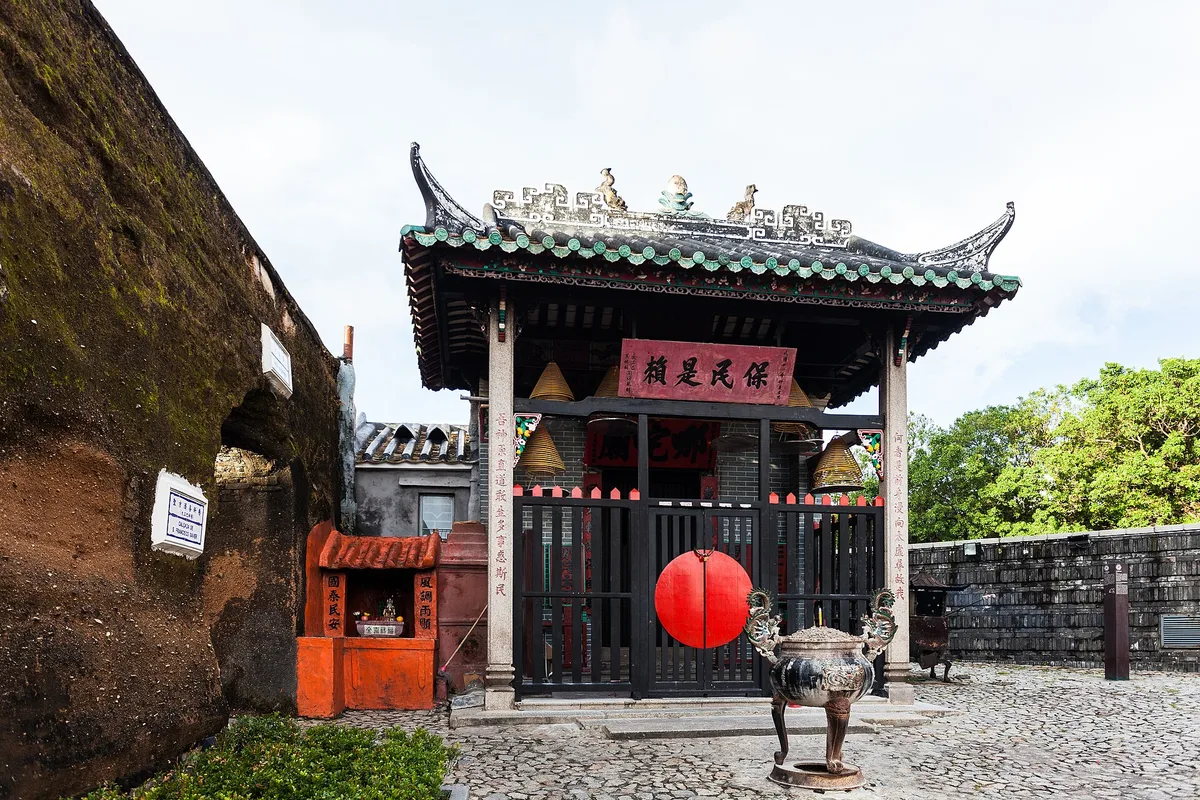
Beside the façade, not the beach
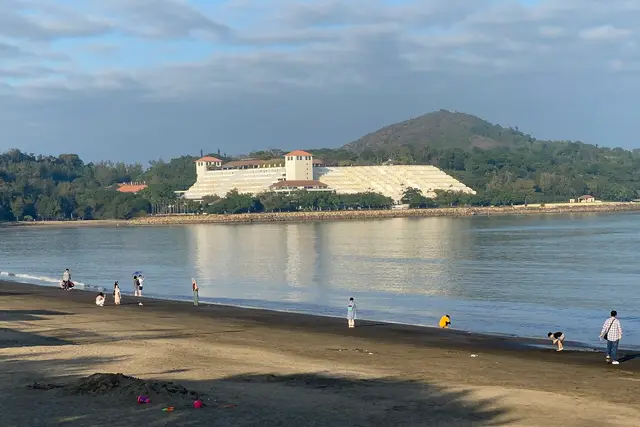
Location is the first thing to sort out. Some listings put this temple under Hac Sa, the beach district on Coloane. Its map code actually puts it on the peninsula, tucked behind the left shoulder of the Ruins of St. Paul’s.
That is useful to know, because Hac Sa is a bus ride south across the bridges. If you are at the beach, you are in the wrong place. If you are on the steps of St. Paul’s, you are about 30 seconds away.
A single room for a child god
The shrine is tiny. It is one low chamber of grey brick and granite, built in 1888 and dedicated to Na Tcha (Nezha). In Chinese folk religion he is a boy warrior, shown with a spear, a fire-tipped ring and wheels of wind and fire under his feet. Local accounts say the temple went up to ward off a plague.
The contrast is the point. A Jesuit church front looms over it while incense smoke drifts from a Chinese altar a few metres away. That pairing is part of why the temple is listed in the Historic Centre of Macao, a UNESCO World Heritage Site since 2005.
Next to the temple you will find:
- A surviving section of the Old City Walls, built from chunam, a compacted mix of earth, sand, straw and oyster shells
- The Na Tcha Exhibition Hall, which displays ritual objects and explains the festival
- The Museum of Sacred Art and Crypt, behind the St. Paul’s façade
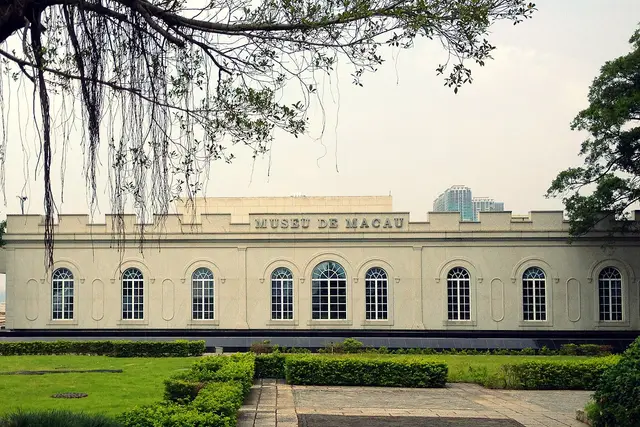
- Mount Fortress and the Macau Museum, up the stairs to the east
Getting there on foot
Walk it. From Senado Square, follow the tiled lanes of Rua de São Domingos and Rua de São Paulo uphill, past the almond-cookie and jerky shops, to the foot of the Ruins steps. Climb them, then bear left around the façade.
The whole loop takes about an hour, including the temple, the wall, the exhibition hall and St. Paul’s. Hours for the temple and hall are not fixed in our data, so confirm on site or with Macao Government Tourism Office listings before you build a day around them.
Stepping inside a working shrine
Locals still worship here, so it is not a museum. It is a quieter find than the crowded steps it sits beside, and most visitors pass it without stopping.
- Step over the raised threshold. Do not stand on it.
- Keep to the side of the altar if someone is praying or lighting incense.
- Photograph the building freely, but ask before you photograph worshippers.
- Do not point at the deity’s statue, and keep your voice down inside.
- If you want to give something, use the offering box rather than handing money to anyone.
Time a visit for Na Tcha’s birthday on the 18th day of the fifth lunar month, usually in June. Look up the exact date for the year you travel. Around then, the neighbourhood holds processions, lion dances and Cantonese opera, and the lane is busier than usual. On ordinary days, come before the tour groups reach St. Paul’s, or late in the afternoon.
Frequently asked questions
Is Na Tcha Temple actually at Hac Sa beach?
No. Some listings put it under Hac Sa, but the temple is on the Macau peninsula, right beside the Ruins of St. Paul's. Hac Sa beach is on Coloane, a bus ride south.
How do I get to Na Tcha Temple?
Walk uphill from Senado Square along Rua de São Domingos and Rua de São Paulo to the Ruins of St. Paul's. The temple is just behind the left side of the façade, about 10 minutes from the square.
How long should I spend there?
The temple itself takes 15 to 20 minutes. Allow about an hour to include the Old City Walls, the Na Tcha Exhibition Hall and the Ruins of St. Paul's.
When is the best time to visit?
Na Tcha's birthday on the 18th day of the fifth lunar month, usually in June, brings processions and lion dances. On normal days, the area is calmer before tour groups reach St. Paul's or late in the afternoon. Check opening times locally.
What else is nearby?
Right next door are the Na Tcha Exhibition Hall, a section of the Old City Walls, the Ruins of St. Paul's and the Museum of Sacred Art and Crypt. Mount Fortress and the Macau Museum are a short climb east.
Plan your trip to Hac Sa
Macau eSIM & staying connected →
Some links above are affiliate links — if you book through them, Wander Atlas earns a small commission at no extra cost to you. It's how we keep every guide free.