
A wall made of mud and oyster shell
It doesn’t look like a fortification. What’s left is a short, weathered run of grey-brown wall standing a few metres from the most photographed facade in Macau, and most people walk right past it.
Get close and you can see the layers. This is one of the last sections of the defensive walls the Portuguese started building around their settlement in the 1500s. Along with the church facade next door, it belongs to the Historic Centre of Macao, a UNESCO World Heritage Site since 2005.
Reading the chunambo
The material is the reason to come. The wall is chunambo, a building technique the Portuguese picked up in Asia. Builders packed sand, soil, crushed rock, rice straw and oyster shells into layers and rammed each one down hard.
Things to look for on the surface:
- Horizontal bands, each one a single rammed layer, stacked like sediment
- Pale flecks and fragments, the crushed oyster shell that helped bind the mix
- Rough, pitted faces where centuries of subtropical rain have worn the softer soil away
Then think about the climate. Macau gets typhoons and heavy monsoon rain, and an earth wall built in the 1500s is still standing. Standing in front of it makes the point better than any museum label could.
Na Tcha Temple and its odd neighbours
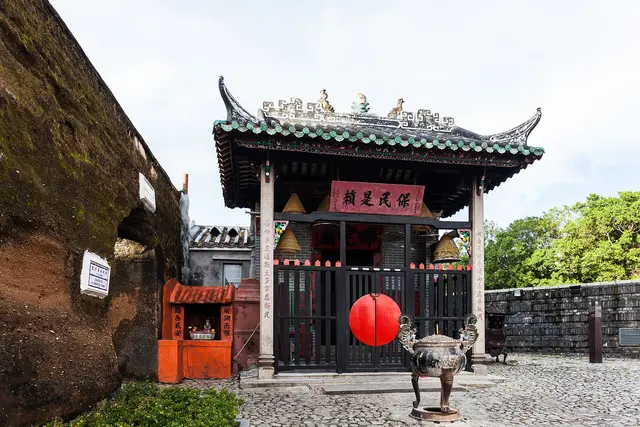
This section sits beside Na Tcha Temple, a small Chinese temple built in 1888. It honours Na Tcha, a child deity people prayed to for protection from disease. On one side is its tiled roof and on the other is the stone facade of a 17th-century Jesuit church.
That pairing is why the spot matters. A Portuguese wall, a Chinese temple and a Catholic ruin share one corner of a hillside. UNESCO cites exactly that mix of Chinese and Western influence in its listing.
The Ruins of St. Paul’s are what remains of the Church of Mother of God, completed in the early 1600s and gutted by fire in 1835. Only the carved granite front survived. Most visitors climb the broad stairway to that facade, take their photos and turn back down. The wall is just around the side.
Getting up the hill
The Macau Light Rail doesn’t reach this part of the peninsula, so you’ll walk the last stretch. Most people start at Senado Square (Largo do Senado). It’s a busy bus interchange on Avenida de Almeida Ribeiro, and many casino shuttle routes drop off within walking distance.
From the square, follow the black-and-white wave-patterned Portuguese paving uphill. Rua de São Domingos and then Rua de São Paulo are lined with almond-cookie and jerky shops. The climb takes roughly 10 to 15 minutes at an easy pace and ends at the foot of the St. Paul’s stairway.
From the top of the stairs, head to the side and rear of the facade toward Na Tcha Temple. The wall section is right there. If you’re looking at a map, the plus code is 5GXR+36P.
Beating the St. Paul’s crowd
The wall itself is rarely crowded. The problem is the stairway you climb to reach it. On weekends the quietest stretch is 7am to 4pm, and an early start gives you the stairs and the temple courtyard with the fewest people around. Avoid weekend evenings from 6pm to 11pm, when the area is at its busiest and the lanes below fill up.
The site has no gate and is listed as open 24 hours. You can come at first light and see the wall before the shops on Rua de São Paulo have opened.
A few things worth knowing on the spot:
- Don’t touch or lean on the wall. Chunambo is packed earth, so hands and backpacks wear it away. Photograph it, don’t sit on it.
- Na Tcha Temple is a working temple. Keep your voice down near the altar and don’t stand in the doorway while people are making offerings.
- Signs are in Chinese and Portuguese, often with English as well. In Portuguese the site is the Troço das Antigas Muralhas de Defesa, and in Chinese it’s 舊城牆遺址.
- Money: pataca is the local currency and Hong Kong dollars are widely accepted in the shops along the climb. You won’t need either for the wall.
How long to stay, and where next
Give the wall 10 to 20 minutes. That’s enough to read the layers, step into the temple and look back at the rear of the St. Paul’s facade, where you can see the steel supports that hold it up. The wall works best as one stop in a morning loop around the Historic Centre.
Nearby, all within a few minutes’ walk:
- Mount Fortress (Fortaleza do Monte): built by the Jesuits in the early 1600s on the hill just east of the ruins, with cannons and views across the peninsula
- Museum of Macau: inside the fortress grounds, covering the city’s trading and colonial past
- Museum of Sacred Art and Crypt: directly behind the St. Paul’s facade
- Senado Square and St. Dominic’s Church: on your way back downhill
If seeing this section makes you curious about the rest of the old defences, check the Macao Government Tourism Office site. It maps the other listed fragments of the old walls and the forts that once tied into them.
Frequently asked questions
Where exactly are the Walls of Macau?
The section is on the Macau Peninsula, next to Na Tcha Temple and just beside the Ruins of St. Paul's. Walk up the St. Paul's stairway and go around the side of the facade toward the temple. The plus code is 5GXR+36P.
When is the quietest time to visit?
On weekends it's calmest between 7am and 4pm. Try not to come from 6pm to 11pm on weekends, when the area around St. Paul's is at its busiest. The site is open 24 hours, so an early-morning visit works well.
How do I get there from Senado Square?
Walk uphill from Senado Square along Rua de São Domingos and Rua de São Paulo to the Ruins of St. Paul's. It takes roughly 10 to 15 minutes. The Light Rail doesn't serve this part of the peninsula, so most visitors arrive on foot from the square's bus stops or nearby casino shuttle drop-offs.
What is the wall made of?
It's chunambo, a rammed mix of sand, soil, rocks, rice straw and oyster shells. Builders packed it down in layers in the 1500s, and you can still see the horizontal bands and shell fragments in the surface.
How long should I spend there, and what's nearby?
Ten to 20 minutes covers the wall and the neighbouring Na Tcha Temple. Mount Fortress, the Museum of Macau and the Museum of Sacred Art and Crypt are all a few minutes' walk away, so it fits easily into a Historic Centre morning.
Plan your trip to Macau Peninsula
Macau eSIM & staying connected →
Some links above are affiliate links — if you book through them, Wander Atlas earns a small commission at no extra cost to you. It's how we keep every guide free.
Related guides
 hidden gem
 Lou Kau Mansion: Macau Peninsula Travel Guide (4.1★)
 hidden gem
 Lin Fung Temple: Macau Peninsula Travel Guide (4.2★)
 hidden gem
 Bairro Iao Hon Municipal Market: Macau Peninsula Travel Guide
 attraction