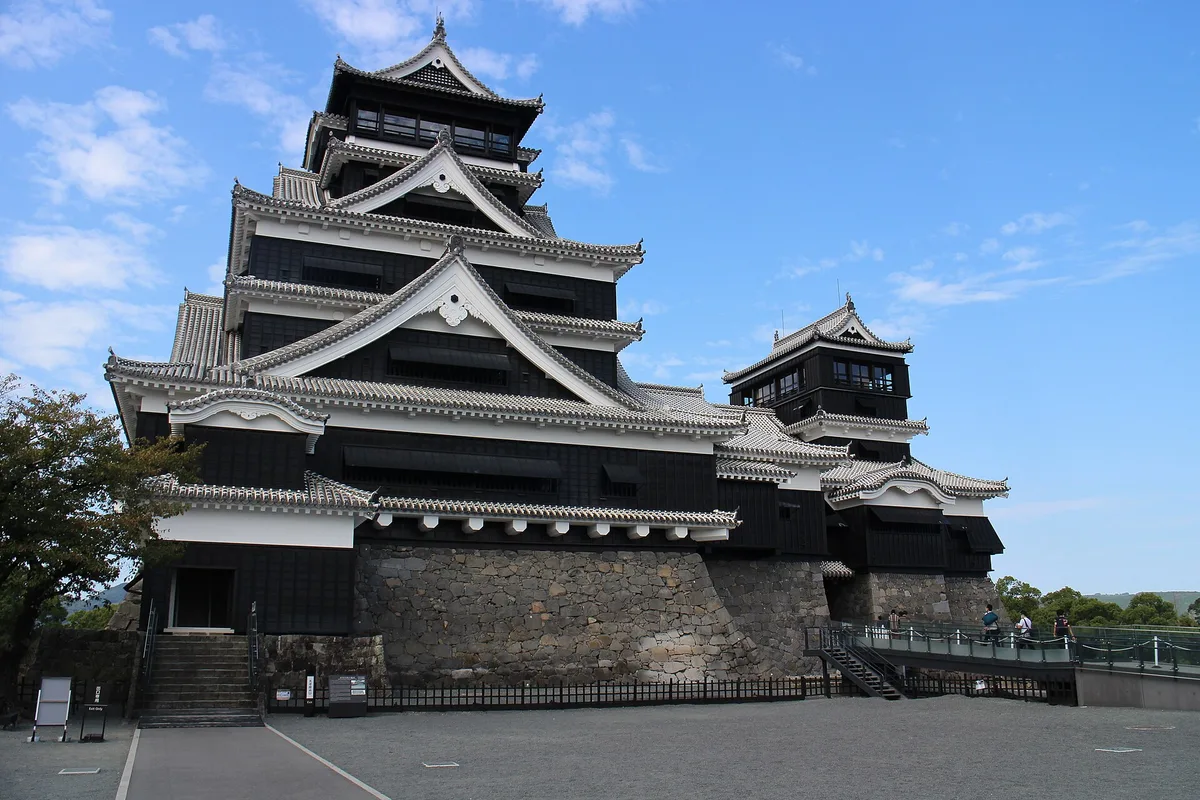
Why Kumamoto Castle still stops people in their tracks
The first view hits you from the moat road below: black-and-white walls stacked on a stone base that curves outward like a wave frozen mid-break. Locals call that curve musha-gaeshi, “warrior repeller”, because the overhang made the walls nearly impossible to scale. Even now, with scaffolding gone from the 2016 earthquake repairs, the main keep looks less built than grown out of the hill.
Kumamoto Castle was originally completed in 1607 under Kato Kiyomasa, one of the era’s most skilled castle engineers. What you see today is largely a reconstruction, but it’s done with enough care that the silhouette still matches old woodblock prints of the site.
Getting there and getting in
The castle sits in Chuo Ward, an easy tram ride from Kumamoto Station. Take the Kumamoto City Tram to Kumamoto-Jokaen-mae or Shiyakusho-mae stop, then walk uphill about 10 minutes through the stone-walled approach.
- Open daily, 9:00 AM–5:00 PM
- Plan for roughly 90 minutes to 2 hours inside
- Combine with Sakuranobaba Josaien, the restaurant and craft-shop street at the base, for lunch before or after
Confirm current admission fees before you go. They’ve shifted a few times since earthquake-recovery reconstruction began, and separate tickets sometimes apply to the museum floors inside the keep.

What you’ll actually see inside
The main keep isn’t a hollow shell. It’s a working history museum stacked over several floors. Displays walk through the Kato and later Hosokawa clan eras, samurai armor, and the 2016 Kumamoto earthquakes that collapsed sections of the stone walls and one turret entirely.
Glass panels on some floors let you look straight down into the wooden joinery, a rare chance to see how reconstruction engineers rebuilt centuries-old techniques with modern reinforcement hidden inside. From the top floor, the view opens over the city and, on clear days, toward the mountains ringing the Kumamoto basin.
Outside, follow the elevated walkway that was built as part of the earthquake recovery, it lets visitors pass close to walls still under repair without disturbing the stonework crews. It’s oddly one of the most memorable parts of the visit: scaffolding, cranes, and 400-year-old stone in the same frame.
When to go
Weekday mornings and afternoons are consistently calmer. The castle’s hours run 9am–5pm every day. Weekends compress visitors into the middle of the day, with the busiest stretch running 10am to 4pm.
If you’re set on a weekend trip, arrive right at opening or in the last hour before closing to dodge the thickest crowds. Cherry blossom season, late March into April, draws the heaviest weekend traffic of the year, when the castle grounds fill with pink alongside the black keep.
How to visit like a local
Kumamoto Castle is one of the most-visited landmarks in the region, so don’t expect a quiet secret. The smart move is timing, not stealth.
- Go on a weekday if your schedule allows; it’s measurably calmer than any weekend slot
- Buy tickets at the gate machines or online in advance to skip the counter line
- Cash and IC transit cards (Suica, ICOCA) both work at ticket counters and most Josaien shops
- Wear real shoes. The approach path is uneven stone, and the keep has several staircases
- Skip the direct main gate rush by entering through the Sakuranobaba Josaien side, which lets you eat first and beat the mid-morning crowd surge
The most common tourist mistake is treating this as a quick photo stop. Give the museum floors time, the earthquake recovery exhibits, in particular, are what separate this castle from a simple postcard shot.
Frequently asked questions
How do I get to Kumamoto Castle from Kumamoto Station?
Take the Kumamoto City Tram from the station to Kumamoto-Jokaen-mae or Shiyakusho-mae, then walk uphill about 10 minutes.
When is the quietest time to visit?
Any weekday during opening hours (9am–5pm) is measurably calmer than weekends. Weekends get busiest between 10am and 4pm.
How long should I plan to spend at the castle?
Budget 90 minutes to 2 hours for the keep and museum, more if you explore Sakuranobaba Josaien at the base.
Is Kumamoto Castle still under earthquake repair?
Some sections remain under restoration following the 2016 earthquakes, and an elevated walkway lets visitors pass close to the repair work. Confirm current access before visiting.
What's nearby for food or shopping?
Sakuranobaba Josaien, a shopping and dining street right at the castle's base, has local Kumamoto specialties and craft shops.
Plan your trip to Kumamoto
Japan eSIM & staying connected →
Some links above are affiliate links — if you book through them, Wander Atlas earns a small commission at no extra cost to you. It's how we keep every guide free.