A single hill rises from the flat floor of the Alazani Valley, and the whole of a royal city now fits on it. A curtain wall runs around the top. Behind it are a domed brick church and a squat, multi-storey tower. Below, along the road, cars pull into a small lay-by. Grapevines run off toward the Greater Caucasus on the far side of the valley.
The town Shah Abbas left behind
Gremi was a capital, not a monastery. From the mid-15th century it was the seat of the Kingdom of Kakheti. It had a royal residence, markets, baths and a merchants’ quarter strung along the Silk Road trade through eastern Georgia.
In 1615 the armies of Shah Abbas I of Persia sacked it. The town was never rebuilt, and the court moved on to Telavi. Archaeologists have traced the lower town in the fields around the hill, but what you can walk through today is the fortified citadel on top.
Keep that history in mind on the way up. The scattered stones and low walls at the foot of the hill once belonged to a busy city. The hilltop that survived was its royal and religious core.
Brick, frescoes and a king’s tomb
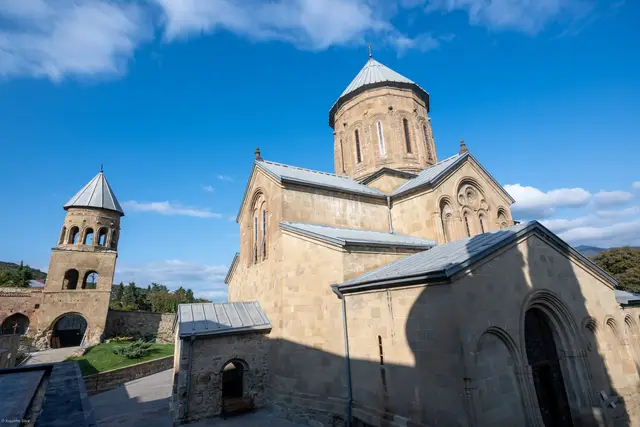
The Church of the Holy Archangels was built in 1565 by King Levan of Kakheti. It is made of narrow fired brick, not the dressed stone of most older Georgian churches. That gives it a warm, banded orange-brown surface that looks different from the grey monasteries elsewhere in Kakheti.
The plan is a cross-dome church under a tall drum, with arcaded galleries wrapped around the outside. Inside, the walls carry frescoes painted in 1577. Saints and royal donors fill the walls, and the colours are faded but still readable in the low light under the dome.
King Levan himself is buried here. The church was both the palace chapel and a dynastic statement, and it still works as a church. Expect icons, candle stands and sometimes a service in progress.
Up through the tower museum
The tower next to the church is the other half of the visit. Google’s summary calls it the bell tower, and it doubles as the royal tower of the old citadel. Its floors now hold a modest museum.
What you will find inside:
- Finds from excavations of the lower town
- Material on the Kakhetian kings and the 1615 destruction
- Narrow interior stairs between levels, so watch your footing
- Openings in the upper walls that frame the valley
The museum is small. Most people spend 20–30 minutes in it. Its real value is context: after it, the empty fields below the hill read as a lost street plan rather than farmland.
Before you step under the frescoes
This is an active Georgian Orthodox church, and the usual rules apply.
- Women: cover your head and wear a skirt below the knee. Georgian churches often keep wraps and headscarves by the door for visitors, but carrying your own scarf saves the scramble.
- Men: remove hats; long trousers are expected, not shorts.
- Shoulders: keep them covered, for everyone.
- Photos: look for signs at the door. Flash on old frescoes is a bad idea regardless, and never photograph people praying or a service.
- Candles: thin beeswax tapers are sold inside; locals light them before icons and stand quietly for a moment.
Speak softly inside and don’t step in front of the iconostasis. A greeting of gamarjobat (hello) and madloba (thank you) to whoever is minding the church goes a long way.
The museum in the tower charges for entry. The current price is posted at the ticket point, so carry some Georgian lari in cash in case card payment isn’t available.
Getting to Gremi from Telavi and Kvareli
Gremi stands directly on the main road between Telavi and Kvareli, so you can’t miss it. Its plus code, 2M26+V32, drops a pin right at the foot of the hill.
- From Telavi: the most common base, a short drive east through village vineyards. A taxi there and back, with waiting time, is the easy option.
- From Kvareli: a shorter hop west along the same road.
- Marshrutkas: minibuses between Telavi and Kvareli pass the site; ask the driver to stop at Gremi.
- From Tbilisi: a long day trip by car, usually combined with other Kakheti stops.
From the roadside, a path and steps climb to the gate in the citadel wall. The climb is short but steep in places, and the paving can be uneven.
Timing the climb and the valley view
At the moment the complex opens 10am–5pm every day. Like most Georgian heritage sites, the hours can shift with the season and around religious holidays, so check before planning a late-afternoon arrival.
Since 5pm is the current cut-off, a morning or early-afternoon visit gives you unhurried time in both the church and the tower. Arriving soon after 10am also usually puts you ahead of the day-trip vans running the Telavi circuit.
On clear days the walls give a long view across the Alazani Valley to the Caucasus ridge. Spring brings green fields and snow on the peaks. Autumn is the rtveli grape harvest, when the vineyards below are busy and the region is at its most lively.
Folding Gremi into a Kakheti day
Gremi takes about an hour to an hour and a half, which makes it an anchor stop, not a full day. It pairs easily with other sites along the same road.
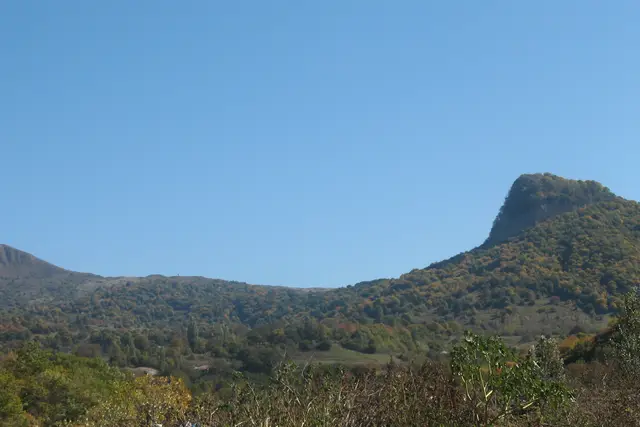
- Nekresi Monastery: on a forested hillside a short drive away, with views back across the valley.
- Kvareli: home to the Ilia Chavchavadze house museum, birthplace of the writer, and to wineries cut into tunnels in the hills.
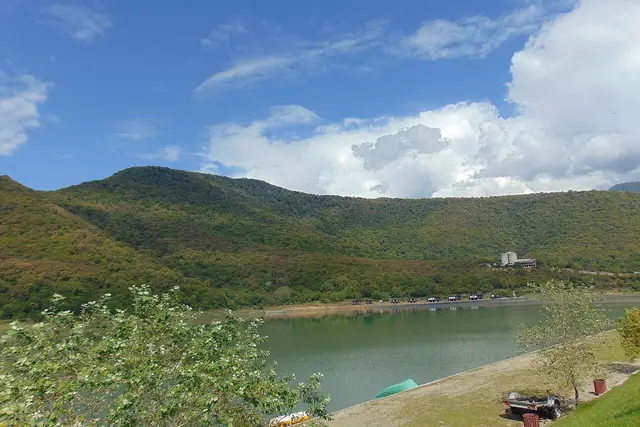
- Lake Kvareli: a quiet stop for a meal at the edge of the Caucasus foothills.
- Telavi: the regional centre, with the Batonis Tsikhe fortress of the later Kakhetian kings.
If you’re doing a wine tour, put Gremi first. Stairs, a dark museum and church etiquette are all easier before the tastings start.
Frequently asked questions
Where exactly is Gremi and how do I get there?
It stands right on the Telavi–Kvareli road in Kvareli municipality, Kakheti (plus code 2M26+V32). Most visitors take a taxi from Telavi or Kvareli. Minibuses between the two towns pass the site and will stop if you ask the driver for Gremi.
What are the opening hours?
At the moment it opens 10am–5pm every day. Hours at Georgian heritage sites can shift with the season and around religious holidays, so confirm before you go, especially late in the day.
How long should I spend at Gremi?
Plan on 1–1.5 hours. That covers the climb, the Church of the Archangels and its 1577 frescoes, the tower museum, and the views from the walls.
Is there a dress code?
Yes, it is an active Orthodox church. Women should cover their heads and wear a skirt below the knee. Men remove hats and wear long trousers, and everyone keeps their shoulders covered. Wraps are often available at the door, but bring your own scarf to be safe.
What else can I combine with Gremi?
Nekresi Monastery is nearby. Kvareli has the Ilia Chavchavadze house museum, tunnel wineries and Lake Kvareli. Telavi has the Batonis Tsikhe fortress. Do Gremi early, before any wine tastings.
Plan your trip to Kvareli
Georgia eSIM & staying connected →
Some links above are affiliate links — if you book through them, Wander Atlas earns a small commission at no extra cost to you. It's how we keep every guide free.