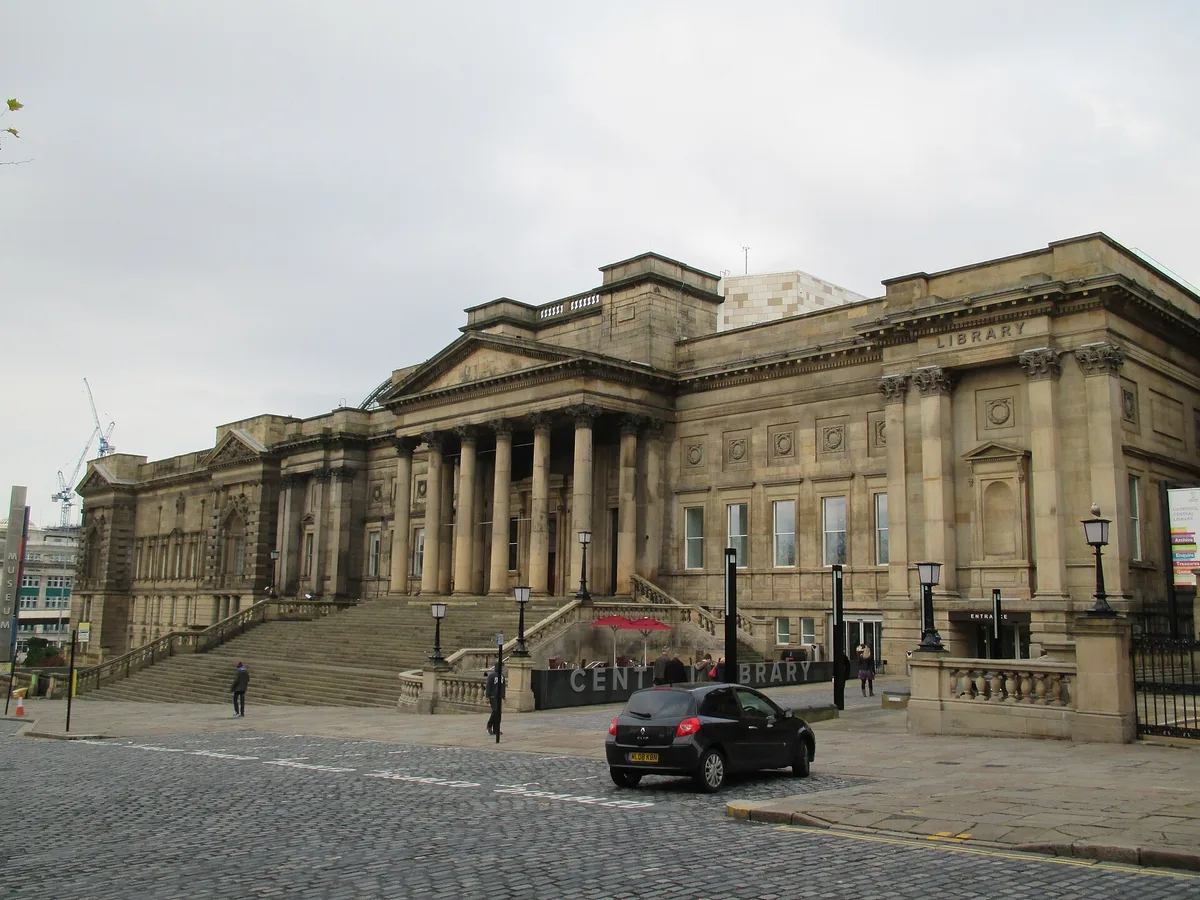
A Victorian Facade on Liverpool’s Museum Row
Start with the columns. World Museum faces William Brown Street with a Victorian classical front, and the whole street works like an open-air hall of civic pride. Across the road, St George’s Hall fills the skyline. Next door are the Central Library and the Walker Art Gallery, all in matching heavy stone.
The museum grew out of the natural history collection left to the city by the 13th Earl of Derby in the mid-1800s. The building was badly damaged in the Liverpool Blitz of 1941. What you walk into today is a mix of the old stone shell and a bright modern atrium, with lifts and stairs connecting five floors.
It’s one of the most-reviewed museums in the north of England, and families, school groups and visitors on day trips all pass through. Don’t expect a quiet corner. Expect a lot to see, packed in closely.
What’s Stacked Across the Five Floors
Every floor covers a different subject. You can drift from fossils to Egyptian coffins to the night sky without leaving the building. The galleries most people come for:
- Ancient Egypt: one of the largest Egyptian collections in Britain, with mummies, coffins and grave goods in a gallery that was enlarged in 2017.
- Natural history: mounted animals, minerals and dinosaur skeletons, with the Earl of Derby’s original specimens at the root of it.
- Aquarium and Bug House: live fish and insects, a favourite with small children who would rather watch something move.
- World Cultures: objects from Africa, Asia, the Americas and Oceania, including Japanese armour.
- Space and Time, and the planetarium: astronomy displays and a domed theatre with scheduled shows.
The hands-on natural history areas let children handle specimens and look through microscopes. Staffed sessions run on a timetable, so check the screens or desk when you come in.
Under the Planetarium Dome
Most of the museum is free, and you can walk around it any way you like. The planetarium works differently. Shows run at set times with limited seats, so it’s the one part of your visit to plan around rather than wander into.
Book or collect planetarium tickets as soon as you arrive. The museum’s website and front desk say whether a show is ticketed and whether there’s a charge. Then build the rest of your route around that time.
The shows are pitched at mixed audiences, and many are suitable for young children. If you’re visiting with toddlers, ask staff about the length and content first. Twenty-odd minutes in a dark dome works for some three-year-olds and not for others.

Getting to William Brown Street
The museum is one of the easiest major attractions in the city to reach on foot. Liverpool Lime Street, the main rail station for trains from London, Manchester and the rest of the country, is a short walk away. Come out of the station towards St George’s Hall, cross over and head up William Brown Street.
From Liverpool Central on the Merseyrail Northern and Wirral lines, it’s a slightly longer walk north through the shopping streets. Plenty of city bus routes stop around Queen Square bus station, close to the bottom of the street.
Driving into the centre means paying for a city car park. There are several within walking distance, but central Liverpool traffic is slow at peak times. Arriving by train is simpler.
Beating the School Groups Through the Atrium
You don’t need a ticket for general entry. Walk in, pick up a map and go. A donation box sits near the entrance, and many visitors leave something because entry is free. Card donations are usually possible too.
The museum is very popular, so the useful skill here is timing. On term-time weekdays, school trips tend to come in the mornings and leave by mid-afternoon. A later weekday start often means emptier galleries. Weekends and school holidays bring families all day.
At the moment the doors open at 10am Tuesday to Sunday, and the museum is closed on Mondays. Hours can change around holidays and through the year, so check the National Museums Liverpool website before you go. Plan to be in the galleries you care about most before the 5pm close. The upper floors empty out first as staff start winding down.
- Head straight up to the top floor and work down. Most visitors start at the bottom, so you’ll be moving against the crowd.
- Visit the Egyptian gallery early if mummies are the reason you came. It’s the busiest room.
- Use the lifts with a pushchair. The stairs between some levels are steep and slow.
Making a Day of the Street
There’s no need to travel far afterwards. The Walker Art Gallery is next door and is also free, with Pre-Raphaelite paintings and old masters. Between the two is the Central Library, where you can look into the domed Picton Reading Room, a round Victorian space lined with books.
Across the road, St George’s Hall has guided tours of its great hall and law courts. St John’s Gardens sits behind it if you want a bench and some grass. The waterfront at the Royal Albert Dock, with the Merseyside Maritime Museum and Tate Liverpool, is about a 20-minute walk downhill or a short bus ride.
A sensible full day: the museum in the morning, lunch around Lime Street, the Walker in the afternoon. That’s two major collections, both free, without crossing a single main road more than once.
How Long to Give It
Two to three hours covers the highlights at a steady pace, with time for one planetarium show. Families who stop at every touch-table or watch the aquarium tanks for ages can easily spend a full day.
If time is short, pick two floors and do them properly instead of rushing all five. The Egyptian collection and the natural history galleries make the strongest pair for a first visit.
Frequently asked questions
How do I get to World Museum from Liverpool Lime Street station?
Walk out towards St George's Hall, cross the road and head up William Brown Street. The museum is on the right, next to the Central Library and the Walker Art Gallery. It's a walk of a few minutes.
Is World Museum open on Mondays?
Not at the moment. It currently opens 10am–5pm Tuesday to Sunday and is closed on Mondays. Hours can change for holidays and through the year, so check the National Museums Liverpool website before you go.
Do I need to book tickets?
Not for general entry, which is free and needs no booking. Planetarium shows run at set times with limited seats, so check the official website or the front desk when you arrive to see whether a show needs a ticket.
How long should I spend at World Museum?
Give it two to three hours to see the highlights and one planetarium show. Families who use the hands-on natural history areas and the aquarium often stay most of the day.
What else is nearby?
The Walker Art Gallery and the Central Library, with its Picton Reading Room, are next door. St George's Hall and St John's Gardens are across the road, and the Royal Albert Dock is about a 20-minute walk away.
Plan your trip to Liverpool
United Kingdom eSIM & staying connected →
Some links above are affiliate links — if you book through them, Wander Atlas earns a small commission at no extra cost to you. It's how we keep every guide free.
Related guides
 attraction
The Three Graces: Liverpool Travel Guide (4.8★)
 attraction
Liverpool Cathedral: Travel Guide (4.8★)
 attraction
Newsham Park & Garden: Liverpool Travel Guide (4.4★)
 hidden gem