National Museum of Archaeology: Madrid Travel Guide (4.7★)
When to visit Spain: month-by-month weather, crowds and holidays →
✓ Facts verified via Google Places · Sep 9, 2026
At a glance
Opening hours
- Monday: Closed
- Tuesday: 9:30 AM – 8:00 PM
- Wednesday: 9:30 AM – 8:00 PM
- Thursday: 9:30 AM – 8:00 PM
- Friday: 9:30 AM – 8:00 PM
- Saturday: 9:30 AM – 8:00 PM
- Sunday: 9:30 AM – 3:00 PM
Live foot-traffic data via BestTime.app
How this guide is made
Produced with AI assistance and reviewed against live data sources. Facts such as hours, ratings, and location come from Google Places; images are licensed or public domain. Details can change — please verify before visiting. Editorial policy
Why go
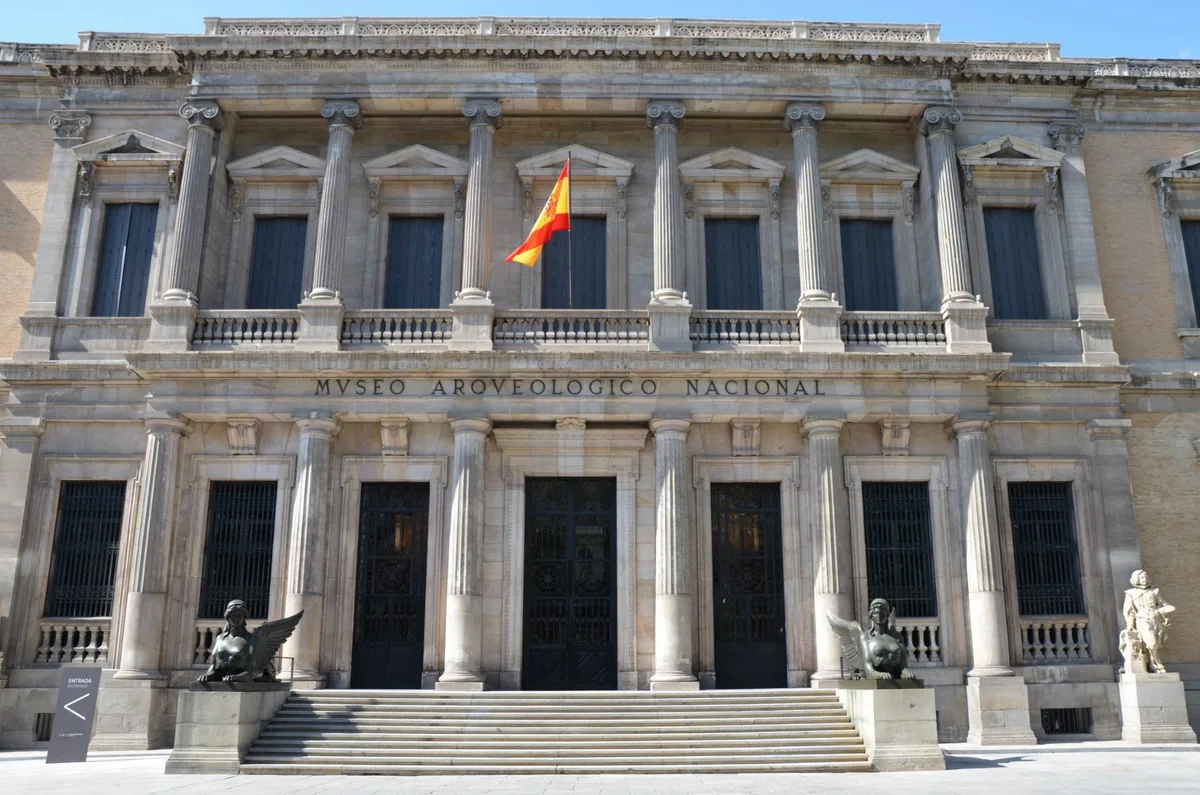
You come up out of the Salamanca district’s grid of shuttered boutiques and quiet apartment blocks and suddenly there’s this long neoclassical façade on Serrano, columns and pale stone, looking more like a ministry than a museum. That’s deliberate, the building dates to the 1860s, built to house the royal collections, and it still has the bones of a nineteenth-century palace of learning: high ceilings, long galleries, natural light pooling on stone floors.
Inside, the scale of what’s collected catches people off guard. This isn’t a single-civilization museum. You move from Paleolithic flint tools to Iberian warrior sculpture to Roman mosaics lifted whole from Hispania’s villas, then into Visigothic votive crowns and Islamic lusterware, and it keeps going into the medieval and early modern period. Few museums in Europe let you walk this much continuous human history in one afternoon.
Getting there
The museum sits at Calle de Serrano, 13, in Salamanca, directly beside the Biblioteca Nacional (they share the same building complex, though separate entrances). The closest metro is Serrano on Line 4. Walk out and you’re a couple of minutes from the entrance. Retiro station on Line 2 also works, about a 10–12 minute walk through the northern edge of the park. If you’re coming from Sol or Gran Vía, it’s a straightforward 20-minute walk east, or a short bus ride up Calle de Alcalá or Serrano itself.
What to see
Start on the lower floor with prehistory and the Iberian pieces (the Dama de Elche and Dama de Baza are here, two of the most-recognized sculptures in Spanish archaeology, both worth slowing down for. The Roman galleries hold mosaics pulled from villas around the country, along with bronzes and glasswork that show how thoroughly Romanized Hispania became. Don’t skip the reproduction of the Altamira cave paintings in the basement) the original cave in Cantabria is closed to casual visitors, so this scaled replica, with its bison rendered in ochre and charcoal, is as close as most people will get.
The Islamic and medieval rooms upstairs are quieter but shouldn’t be rushed: the ataifor bowls and carved ivories from Al-Andalus are some of the finest Islamic-era pieces on public display in Spain.
When to go
The museum tends to be busiest on weekends, so if you’re visiting Saturday or Sunday, try to arrive right at opening or push your visit later in the afternoon to avoid the thickest crowds. Weekday evenings are generally the calm window, giving you long empty stretches in front of the mosaics and sculpture halls.
If your schedule is flexible, a weekday visit generally beats a weekend one across the board. Two to three hours covers the highlights properly; history-minded visitors could easily spend half a day.
Nearby
Retiro park is a five-to-ten-minute walk south, good for decompressing afterward with a paseo around the Estanque lake. The Prado, Thyssen-Bornemisza, and Reina Sofía, Madrid’s “Golden Triangle” of art museums, are all within a 15–20 minute walk down Paseo del Prado, so it’s realistic to pair the archaeology museum with one of them in the same day if you start early.
How to visit like a local
Locals treat this as an evening museum rather than a morning one (the collection rewards a slower, later visit when the school groups and tour clusters from earlier in the day have cleared out. Buy tickets online in advance if you can; it saves time at the entrance, though walk-up admission is usually fine outside peak weekend hours. Cash isn’t really necessary) card and contactless are standard for tickets and the small museum shop.
There’s no strict dress code or photography ban in most galleries, but flash is typically restricted around the more fragile pieces, so check signage as you go. The mistake most first-time visitors make is treating this like a quick one-hour stop before rushing to the Prado. The collection is deep enough that rushing means missing entire wings, particularly the Islamic and medieval galleries upstairs, which get skipped far more than they should.
Frequently asked questions
How much time should I budget for the National Archaeological Museum?
Plan on two to three hours for the highlights (Dama de Elche, Roman mosaics, Altamira replica, Islamic pottery); history enthusiasts can easily spend half a day.
What's the closest metro station?
Serrano on Line 4 is closest, just a couple of minutes' walk. Retiro on Line 2 is about 10-12 minutes away through the park.
When is the museum quietest?
Weekday evenings between 6pm and 8pm see the fewest visitors. Weekends, especially Saturday between 10am and 8pm, are the busiest window, so aim for opening time (9:30am) or later afternoon if visiting on a Saturday; on Sundays the museum closes at 3pm, so an early visit is best.
Can I combine this with other Madrid museums in one day?
Yes — the Prado, Thyssen-Bornemisza, and Reina Sofía are all within a 15-20 minute walk down Paseo del Prado, and Retiro park is five to ten minutes away for a break in between.
Is the famous Altamira cave art the real thing?
No, it's a full-scale, faithful replica in the museum's basement. The actual Altamira cave in Cantabria is closed to general public visits to preserve the paintings, so this is the most accessible way to see them up close.
Plan your trip to Madrid
Some links above are affiliate links — if you book through them, Wander Atlas earns a small commission at no extra cost to you. It's how we keep every guide free.