Plaza Mayor: Madrid Travel Guide
✓ Facts verified via Google Places · Sep 9, 2026
At a glance
How this guide is made
Produced with AI assistance and reviewed against live data sources. Facts such as hours, ratings, and location come from Google Places; images are licensed or public domain. Details can change — please verify before visiting. Editorial policy
Why go
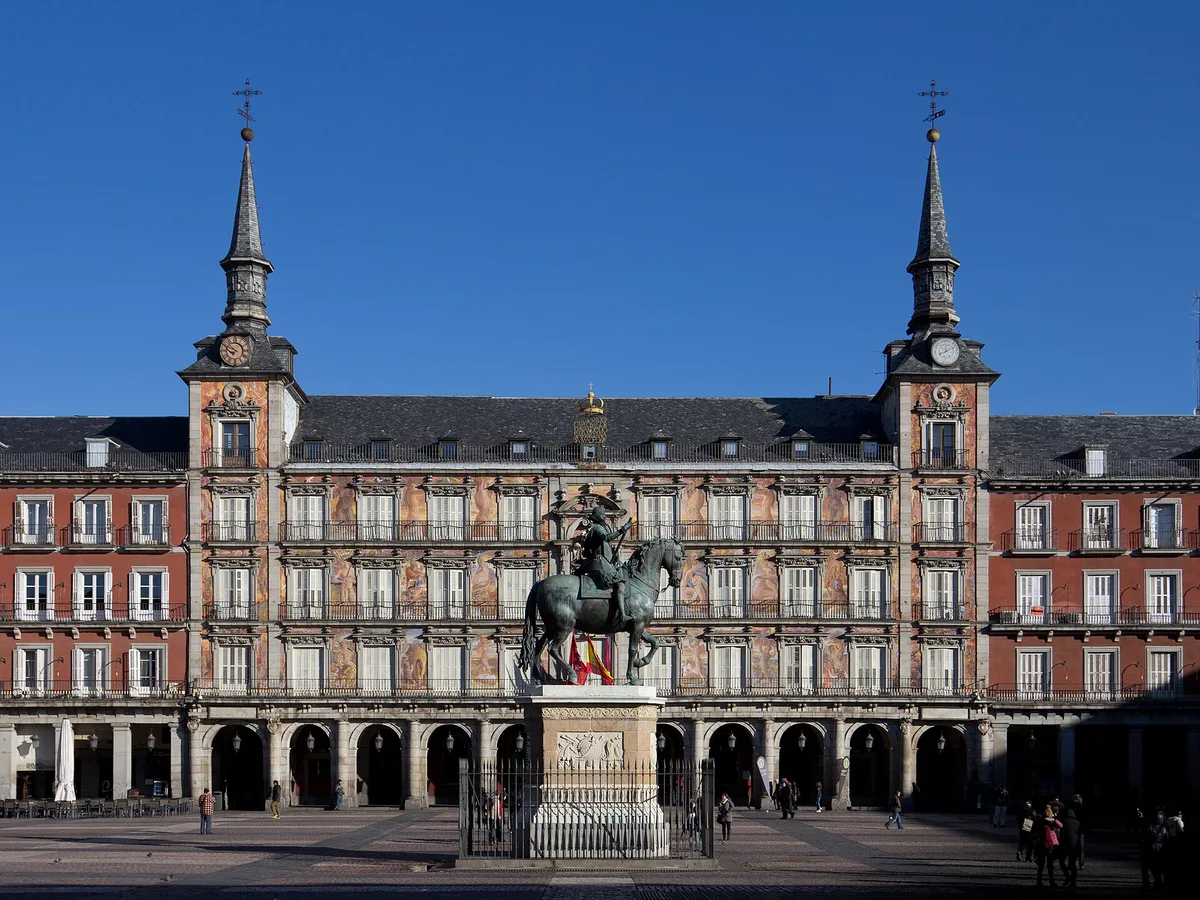
You come up out of the narrow streets of old Madrid and suddenly the buildings pull back and the sky opens above a vast rectangular square, hemmed in on all four sides by uniform façades of dark red brick and grey slate roofs, three storeys of wrought-iron balconies stacked above a continuous stone arcade. Plaza Mayor was built to impress, and after four centuries it still does.
In the middle sits a bronze equestrian statue of Philip III, the king who ordered the square’s construction in the early 1600s, reins in hand, looking out over whatever is happening below, street performers in gold body paint, caricature artists, a small crowd photographing the frescoed Casa de la Panadería on the north side, whose façade is covered in painted mythological figures that were repainted as recently as the 1990s.
Getting there
The plaza sits in Madrid Centro, roughly halfway between Puerta del Sol and the Mercado de San Miguel. The nearest metro is Sol (Lines 1, 2, and 3), from there it’s a flat, five-minute walk down Calle Mayor or through Calle de Postas. Ópera (Lines 2 and 5) works almost as well if you’re coming from the Royal Palace side, about seven minutes on foot through Calle de Arenal.
There’s no dedicated parking at the square itself, and driving into this pedestrianized core is more hassle than it’s worth, public transport or a walk from your hotel is the way nearly everyone arrives.

What to see and do
Walk the full perimeter first. Nine gated entrances puncture the arcade, the grandest being the Arco de Cuchilleros on the south side, where stone steps drop down toward Calle Cava de San Miguel and the tapas bars of Cava Baja. Look up at the Casa de la Panadería, the former bakers’ guild hall, its painted exterior is the square’s single most photographed detail after the statue itself.
The plaza has worn many faces over the centuries: it hosted bullfights, public executions during the Inquisition, coronations, and markets, and the numbered floor tiles under your feet mark out the same grid used for royal ceremonies. Today the arcade shelters souvenir shops, a stamp-and-coin market on Sunday mornings, and cafés with outdoor seating, pleasant for a coffee if you don’t mind paying a premium for the view, but skip a full meal here and walk two minutes toward Cava Baja or Mercado de San Miguel for better food at better prices.
When to go
This is one of the most visited squares in Spain, and it feels it by mid-morning through early evening, when tour groups and street performers fill the open center and every bench is taken. Come at 8 or 9am and you’ll largely have the arcade and the statue to yourself, with soft low light raking across the brick façades. Evening works too: after dinner, when the day-trippers have thinned out, the plaza is lit from the balconies and the frescoes on the Casa de la Panadería glow under floodlights.
December brings a large Christmas market that fills the square with wooden stalls selling ornaments and roasted chestnuts, worth seeing even if you have to accept the crowds that come with it.
How to visit like a local
This square is squarely on the tourist circuit, so the local move is really about timing and habits, not secrecy. Madrileños pass through Plaza Mayor on their way somewhere else (to Cava Baja for tapas, to Mercado de San Miguel for a vermouth, to Sol for the metro) rather than lingering at an arcade café. Do the same: treat the plaza as a five- or ten-minute stop for photos and the statue, then walk on to eat and drink where prices drop and portions improve.
If you do sit down for a coffee under the arches, a card is accepted almost everywhere now, though tipping is not expected the way it is in the US, rounding up or leaving small change is plenty. The single biggest mistake visitors make is arriving at 1 or 2pm expecting a quiet look at the architecture; that’s peak tour-bus hour.
Come at opening light or after dinner instead, and give yourself fifteen to twenty minutes, not more, before moving on to the older, narrower streets around Cava de San Miguel.
Frequently asked questions
How do I get to Plaza Mayor by metro?
Take Line 1, 2, or 3 to Sol station, then walk about five minutes down Calle Mayor. Ópera (Lines 2 and 5) is a similarly short walk from the west side.
Is there an entry fee?
No, Plaza Mayor is a public square with free, open access at all times.
When is the quietest time to visit?
Early morning, around 8-9am, before tour groups arrive, or after dinner in the evening when the plaza is lit up and less crowded. Avoid roughly midday to early evening on weekends.
How long should I spend there?
Fifteen to twenty minutes is enough to walk the arcade, see the statue of Philip III, and admire the Casa de la Panadería's painted façade.
Should I eat at the cafés in the plaza?
They're convenient for a coffee but priced for tourists. For better value and food, walk two minutes to Cava Baja's tapas bars or Mercado de San Miguel.
Plan your trip to Madrid
Some links above are affiliate links — if you book through them, Wander Atlas earns a small commission at no extra cost to you. It's how we keep every guide free.
Related guides
More Madrid guides: Temple of Debod 1.3 kmThe Weeknd – After Hours Til Dawn TourEl CamperoEvanescence Madrid 2026Formula 1 Spanish Grand Prix (MADRING)Maché