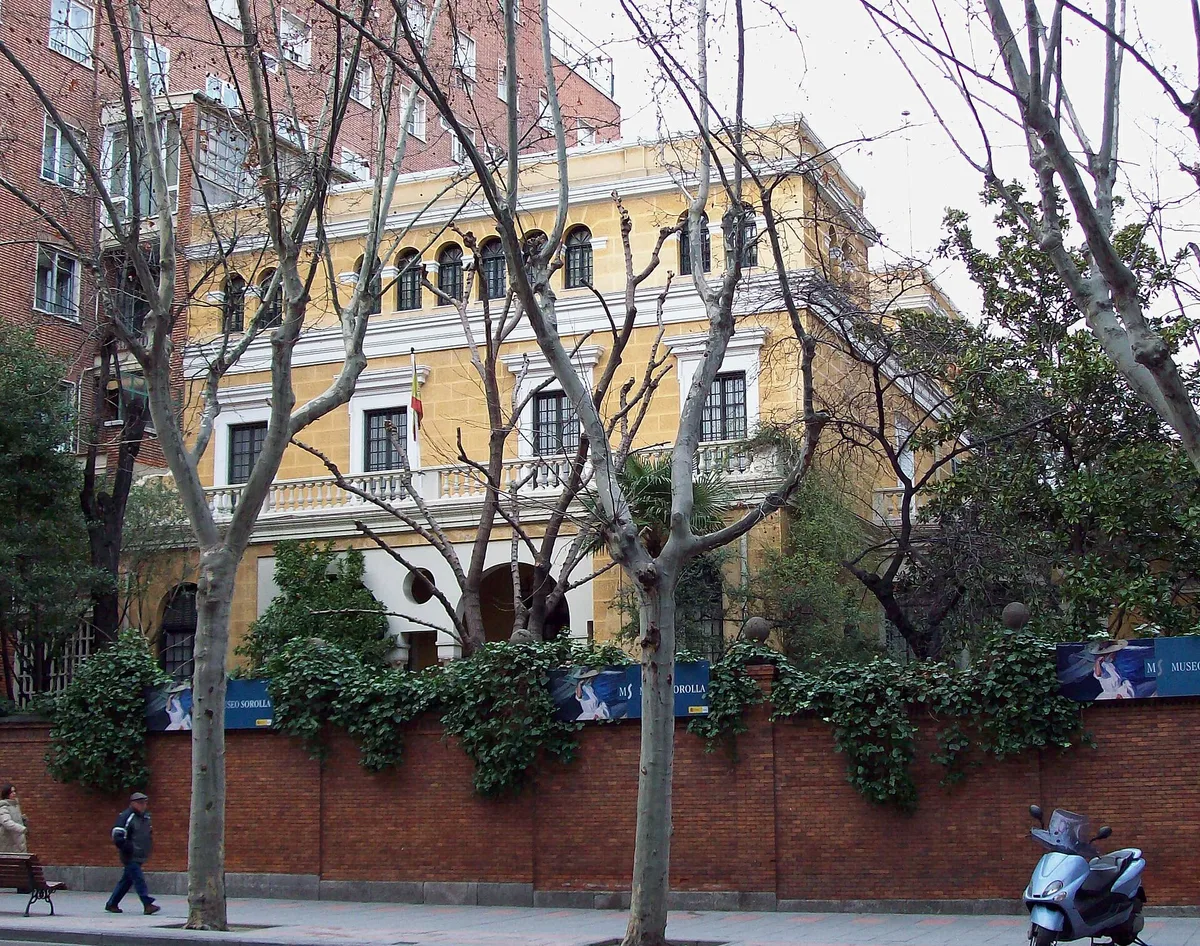
A house built around the light
Sorolla designed this place for painting. He had the house on Calle de Zurbano built in the early 1910s, and it holds his studio, his family rooms and the garden he laid out himself. His widow, Clotilde, left the house and its contents to the Spanish state. It opened as a museum in 1932.
Behind a brick façade on a quiet Chamberí street, you get a rare thing in Madrid: a painter’s work hung where he made it. The canvases are mostly Valencian beaches, children in the surf, white linen against blue water. Hanging on domestic walls, they feel much closer than they would in a gallery.
Through the gate and into the garden
You enter through the garden, and that order is deliberate. Sorolla modelled it on the Andalusian gardens he admired in Seville and at the Alhambra in Granada. Expect these features:
- Tiled benches and glazed ceramic pots
- Narrow channels of water and small fountains
- Trees and climbing plants that shade the paths
- Marble and bronze sculpture set among the greenery
He painted this garden repeatedly, so you will meet it again inside on canvas. Take a slow loop before you go in. It also works as a calm place to sit once the rooms have filled up.
The studio, the canvases, the brushes
The ground-floor rooms keep much of the family’s furniture and decoration. The biggest of them is the main studio, a tall, high-ceilinged room where large canvases hang. His working tools are displayed around it: palettes, brushes and paint boxes, set out as if he had just put them down.
Look for Paseo a orillas del mar (Walk on the Beach), painted in 1909. It shows his wife and daughter in white dresses, their veils lifted by the wind. La siesta is another highlight, a loose, sun-flattened study of figures dozing in grass.
Upstairs, where the family once slept, the rooms are now galleries. They show smaller oil sketches, portraits and work from his travels. The quick beach sketches on small boards are worth a close look. They show how fast he worked outdoors to catch the light before it changed.
Getting to Calle de Zurbano
The museum sits in residential Chamberí, north of the city centre. Three metro stations are within walking distance:
- Rubén Darío (Line 5), probably the closest
- Iglesia (Line 1), a short walk west along Paseo del General Martínez Campos
- Gregorio Marañón (Lines 7 and 10), just to the north
Paseo de la Castellana runs a block east, and its buses connect you to the Prado and Recoletos areas. The address is a townhouse rather than a grand public building, so look for the garden gate on Zurbano rather than a big sign.
Beating the rush to a small house
This is a very popular museum in a building that was never meant for crowds. The rooms are domestic in size and fill quickly, so timing matters more here than at the Prado.
- Mind the schedule. At the moment it opens 9:30am–8pm Tuesday to Saturday and 10am–3pm on Sunday, and it is closed on Monday. Museum hours shift through the year and on holidays, so check the official site for this month’s times.
- Go early on a weekday. Arriving at the 9:30am opening usually puts you ahead of school groups and the weekend crowd.
- Expect weekend queues. Saturdays and the short Sunday session draw the most visitors, and a line can form along the garden wall.
- Book ahead. Tickets are sold online through the museum’s official website, which also posts current prices and any reduced-rate or free-entry times.
- Bags. Larger bags and backpacks usually have to go in the cloakroom, so travel light.
- Phones. Photo rules can vary by room and by exhibition. Watch for signs and the attendants rather than assuming.
Speak quietly in the upstairs rooms. They are small, and voices carry.
Pairing it with the rest of the neighbourhood
Chamberí is a good area to linger in once you leave. The streets around Zurbano are lined with 19th and early 20th-century apartment blocks, and the cafés here serve office workers more than tour groups.
The Museo Lázaro Galdiano on Calle de Serrano is a walk away across the Castellana. It is another private collection displayed in a former mansion, which makes it a natural second stop. If you would rather sit outside, head west toward Plaza de Olavide with its ring of terraces. For something larger, the Prado is a straight run south down the Paseo.
Frequently asked questions
Which metro station is closest to the Sorolla Museum?
Rubén Darío (Line 5) and Iglesia (Line 1) are both a short walk from Calle de Zurbano 68. Gregorio Marañón (Lines 7 and 10) is also close by.
How long should I spend at the Sorolla Museum?
Most visitors need 60–90 minutes for the garden, the ground-floor studio and the upstairs galleries. Add time if you want to sit in the garden afterwards.
Is the Sorolla Museum open on Mondays?
No. Under the current schedule it is closed on Monday, open 9:30am–8pm Tuesday to Saturday, and open 10am–3pm on Sunday. Hours can change seasonally and on holidays, so check the official site before you go.
Do I need to book tickets in advance?
Booking ahead is wise because the house is small and popular, and weekends draw queues. Tickets and current prices are on the museum's official website.
What else is nearby?
The Museo Lázaro Galdiano on Calle de Serrano is walkable, Plaza de Olavide has café terraces, and Paseo de la Castellana leads south toward the Prado.
Plan your trip to Madrid
Spain eSIM & staying connected →
Some links above are affiliate links — if you book through them, Wander Atlas earns a small commission at no extra cost to you. It's how we keep every guide free.