Push through the doors at 360 Rue Saint-Jacques and the scale changes. The ceiling sits far above you, coffered and painted, with chandeliers hanging on long chains over rows of laptops. This was the main banking hall of the Royal Bank of Canada’s head office, and the room still behaves like one: stone underfoot, long counters, and voices that carry.
Crew Collective & Cafe now uses that hall for two jobs at once. It’s a coworking space and a café that anyone can walk into. You come for a coffee and end up staring at the ceiling.
The banking hall on Rue Saint-Jacques
The building went up in the late 1920s. At that time Rue Saint-Jacques was the financial centre of Canada, lined with bank headquarters that competed on grandeur. The Royal Bank tower was among the tallest in the British Empire when it was finished, and the hall was built to impress depositors.
Look for these details as you walk in:
- The ceiling: deep coffers with painted and gilded detail, best seen from the middle of the room.
- The chandeliers: large bronze fixtures, low enough to frame a photo against the ceiling.
- The old counters: the bank’s long service counters still run through the hall, and the café works out of this setting.
- The stone and marble: floors and walls from the original fit-out, which explains why the room echoes.
“Cathedral-style” is how the place is usually described. You’ll understand why as soon as you walk in.
What’s on the counter
The menu is short and practical. Expect coffee drinks plus a café menu of sandwiches, soups and quiches, food that suits someone staying a few hours with a laptop. Prices sit in the mid-range for Montreal coffee shops. Today’s prices are on the menu at the counter.
This isn’t a long-lunch restaurant. Treat it as a coffee stop with a light meal attached. If you want a proper sit-down dinner, Old Montreal’s restaurants are a few blocks south toward Rue Saint-Paul.
Sharing the room with people at work
Most people at the long tables are working. That shapes how the room behaves, and a little care goes a long way.
- Order first, then sit. Pay at the counter, then find a seat. Taking a table and leaving it empty while you wander around is frowned upon here.
- Pay by tap or card. Cards and phone payments are standard in Montreal cafés. The terminal will usually offer a tip prompt, and leaving a tip at the counter is normal in Quebec.
- Start with “Bonjour.” Staff in Old Montreal switch easily to English. A greeting in French first is the local courtesy, and you’ll often hear “Bonjour-hi” in reply.
- Photograph the room, not the people. The ceiling is fair game. Pointing a phone at someone’s screen or face is not, so shoot upward or from the entrance.
- Keep calls short. Stone carries sound, so a speakerphone call reaches the whole hall.
The coworking members have their own areas. If a space looks set apart or marked for members, stay in the public café seating.
Timing your visit
At the moment the hall opens at 8am every day. It closes at 8pm Tuesday through Saturday, and earlier, at 6pm, on Sunday and Monday. If you’re planning an evening coffee, avoid those two days.
This is one of Montreal’s most photographed interiors, so you won’t have it to yourself. Arriving close to the 8am opening usually beats the tourist flow, because most walking tours of Old Montreal start later in the morning. Light through the tall windows also helps photos earlier in the day.
For a look and a coffee, allow 30–45 minutes. If you plan to work, settle in for a morning, and buy something again if you stay a long time.
Getting to 360 Rue Saint-Jacques
The nearest metro is Square-Victoria–OACI on the Orange Line (Line 2). From there it’s a few minutes’ walk east along Rue Saint-Jacques. Place-d’Armes station, also on the Orange Line, is a similar distance away and puts you nearer Notre-Dame Basilica.
The entrance is on Rue Saint-Jacques itself, behind a tall stone façade typical of the street. Once you spot the old bank buildings lined up along the block, you’re on the right stretch. Street parking in Old Montreal is scarce and metered, so the metro is the easier option.
The old financial district around it
Crew sits on the street where Canada’s money used to be made. Plan an hour around it on foot:
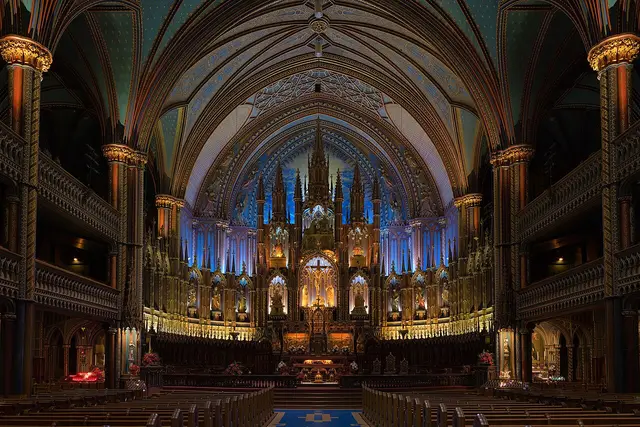
- Notre-Dame Basilica on Place d’Armes, with its blue-and-gold interior, a short walk east.
- Place d’Armes itself, ringed by older bank buildings, including the Bank of Montreal head office with its columned façade.
- Rue Saint-Paul and Place Jacques-Cartier, the cobbled heart of Old Montreal, a few blocks south and downhill.
- The Old Port, along the waterfront past Rue de la Commune.
A sensible loop starts with an early coffee at Crew, crosses to the Basilica, and drifts down toward the river. You’ll see the stone-built money district first and the tourist streets after it. It’s also a good way to understand why a café occupies a bank: the whole street was once built to look this important.
Frequently asked questions
How do I get to Crew Collective & Cafe by metro?
Take the Orange Line (Line 2) to Square-Victoria–OACI and walk a few minutes east along Rue Saint-Jacques to number 360. Place-d'Armes station, also on the Orange Line, is about as close.
What are the opening hours?
Currently it opens at 8am every day. It closes at 8pm Tuesday to Saturday and at 6pm on Sunday and Monday. Check before you go, as hours can change.
When is the best time to visit for photos and a seat?
Try to arrive close to the 8am opening. It's a very popular stop, and you'll beat most of the walking-tour traffic that builds later in the morning.
Can I visit without working there?
Yes. The café is open to anyone. Order at the counter and sit in the public seating, and leave areas set aside for coworking members alone. Be discreet with photos, as many people are working.
How long should I spend there, and what's nearby?
For a coffee and a look at the ceiling, 30–45 minutes is enough. Notre-Dame Basilica on Place d'Armes is a short walk east, and Place Jacques-Cartier and the Old Port are a few blocks south.
Plan your trip to Montreal
Canada eSIM & staying connected →
Some links above are affiliate links — if you book through them, Wander Atlas earns a small commission at no extra cost to you. It's how we keep every guide free.
Related guides
 attraction
Notre-Dame Basilica of Montreal: Travel Guide (4.7★)
 hidden gem
Le Vieux Montréal: Montreal Travel Guide (4.7★)
 hidden gem
Montréal Underground City: Montreal Travel Guide (4.4★)
 restaurant