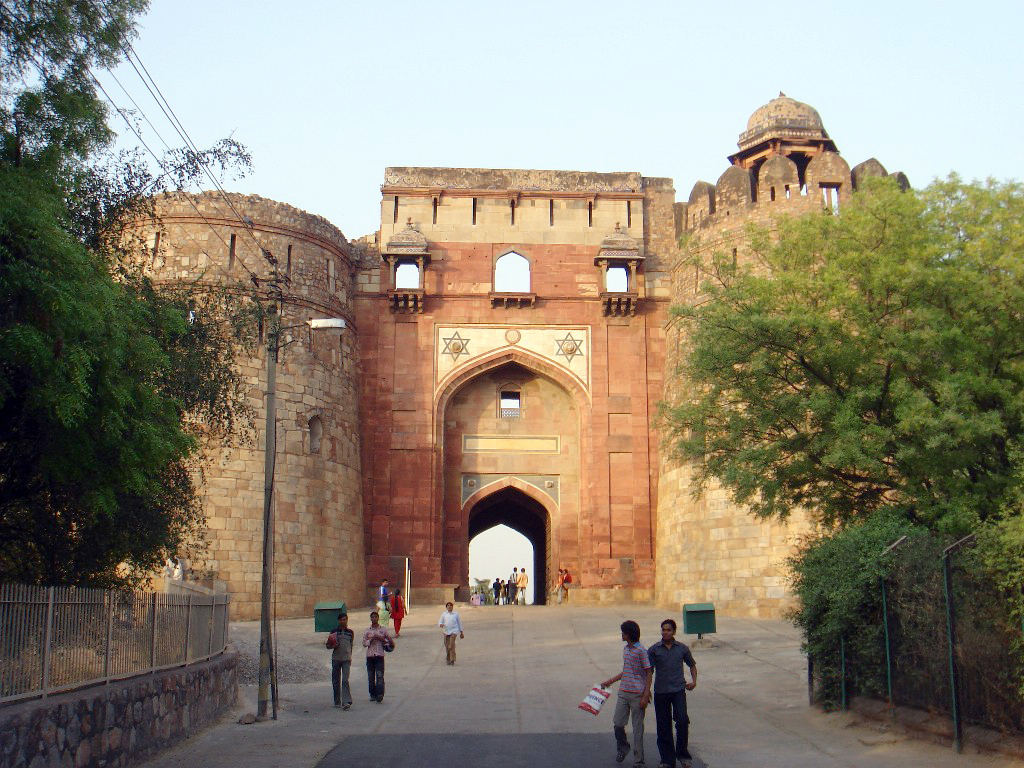
Walls older than the city around them
You come in through the Bara Darwaza, a triple-storeyed western gate. Its rubble-stone bulk is trimmed with red sandstone and white marble inlay. Inside, the fort opens into a wide, grassy enclosure rather than a packed maze of buildings. Humayun began the fort as the city of Dinpanah in the 1530s. Sher Shah Suri took it over after driving him out in 1540 and rebuilt much of what stands now.
Local tradition holds that this mound was Indraprastha, the Pandava capital in the Mahabharata. Archaeological Survey of India excavations have found pottery here from before the Mauryan period, with layers of settlement running up through Mughal times. A small site museum near the entrance displays some of the finds.
Structures inside the fort
There are only a few standing monuments, so walk the whole enclosure:
- Qila-i-Kuhna Mosque (1541): Sher Shah’s single-aisled prayer hall. Look for the five arches with pointed profiles and the dense red, white and black stone inlay across the façade. Plan to spend the longest here.
- Sher Mandal: a two-storey octagonal tower in red sandstone. Humayun used it as a library, and in 1556 he fell down its steep stairs and died from his injuries. You can see it from outside only.
- Humayun Darwaza: the southern gate. It looks toward Humayun’s Tomb, about 2km south.
- Talaqi Darwaza: the northern gate, called the “forbidden gate”. It is sealed and best seen from the ramparts.
- The ramparts and lake: the walls run about 2km in a loop. Below the fort, the old moat is now a lake.

Timing your visit around the crowds
The fort opens daily from 7am to 5pm, with the same hours every day. The early hours are the real advantage. It’s calmest between 7am and 10am on weekdays, and between 7am and 9am on weekends, while the stone is still cool and the lawns are empty.
Try not to arrive after 10am on a Saturday or Sunday. From then until the 5pm close is the busiest stretch, with families, school groups and couples filling the lawns. Budget 1.5 to 2 hours for the monuments, the museum and part of the rampart walk. Winter mornings, from November to February, are the most comfortable time. In May and June, the midday sun on open stone is punishing.
Tickets, the metro and what to pair it with
Entry is run by the Archaeological Survey of India. The current fee is posted at the ticket window by the Bara Darwaza and on the ASI’s online booking portal. Booking online and showing the QR code at the gate saves time on a weekend. At the counter, UPI payment is widely used in Delhi alongside cash.
The nearest metro stop is Supreme Court station on the Blue Line, formerly called Pragati Maidan. From there it’s a walk of roughly 15 minutes along Mathura Road. An auto-rickshaw or ride-hail car can drop you at the gate. Security checks bags at the entrance, so carry little.
For a half-day loop:
- Delhi Zoo (National Zoological Park): directly next door on the same road.
- Sher Shah Suri Gate (Lal Darwaza) and Khairul Manazil mosque: directly across Mathura Road.
- Humayun’s Tomb: a short ride south. Go after the fort if you’ve come at opening.
Stay off the ramparts’ crumbling edges. There are few railings, and guards will wave you back.
Frequently asked questions
When is the quietest time to visit Purana Qila?
It's quietest from 7am to 10am on weekdays and 7am to 9am on weekends. On weekends it's busiest from 10am until the 5pm close.
What are Purana Qila's opening hours?
It's open every day from 7am to 5pm. There is no weekly closing day.
What is the nearest metro station?
Supreme Court station on the Blue Line, formerly called Pragati Maidan. From there it's a walk of about 15 minutes along Mathura Road to the Bara Darwaza entrance.
How long should I spend at Purana Qila?
Allow 1.5 to 2 hours to see the Qila-i-Kuhna Mosque, the Sher Mandal and the site museum and walk part of the ramparts.
What can I combine with a visit?
Delhi Zoo is right next door. The Sher Shah Suri Gate and Khairul Manazil mosque are across Mathura Road, and Humayun's Tomb is a short ride south.
Plan your trip to New Delhi
Some links above are affiliate links — if you book through them, Wander Atlas earns a small commission at no extra cost to you. It's how we keep every guide free.