Glass, Granite and a Long Ramp
The building is the first artwork you walk through. Moshe Safdie designed it, and it opened in 1988. It is made of pink granite and a lot of glass, and its glazed towers echo the Library of Parliament across the water.
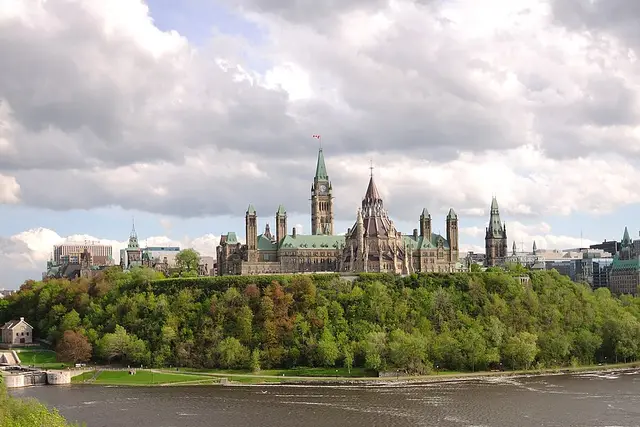
Inside, the Colonnade does the work. It is a long, gently rising glass corridor that carries you up from the entrance toward the Great Hall. To your left are the Ottawa River and the Gatineau Hills. On a clear day the Parliament buildings sit framed in the windows like a painting you didn’t pay extra for.
The Great Hall at the top is a tall glass room with open views over the river. Most people stop here before choosing a direction. It is also where you get your first sense of the scale: this is a spacious museum, and you will need more than an hour.
Under Maman’s Legs
Before the door, there is the spider. Maman, Louise Bourgeois’s giant bronze, stands on the plaza out front. Her legs are long enough that people walk right underneath. A sac of marble eggs hangs from her body.
She is the Ottawa photo everyone takes, so expect a small crowd posing between her legs at any reasonable hour. Shoot from the steps for the full silhouette against the glass, or from the Sussex Drive side with the Notre-Dame Cathedral Basilica’s twin silver spires behind her.
The Rooms That Hold the Country
The core of the collection is Canadian art, displayed alongside Indigenous art. This is where you come face to face with the paintings Canadians grew up seeing in textbooks:
- Tom Thomson’s The Jack Pine, a lone tree against a lake at dusk
- The Group of Seven, whose rugged Northern Ontario landscapes shaped how the country pictures itself
- Emily Carr’s West Coast forests and totem poles
- Barnett Newman’s Voice of Fire, the tall red-and-blue stripe painting whose purchase set off a national row in 1990
The international galleries add European old masters, Impressionists and modern work. The contemporary spaces change more often than the rest. Temporary exhibitions are announced on the gallery’s official site, so check what’s on before you plan your route.
One room catches almost everyone off guard. The Rideau Chapel is a nineteenth-century convent chapel interior, with a fan-vaulted ceiling and carved columns. It was saved from demolition and rebuilt inside the gallery. It is usually quieter than the painting halls and makes a good place to sit for ten minutes.

Thursday’s Long Evening
The hours have a twist worth planning around. At the moment the gallery opens at 9:30am Tuesday to Sunday and is closed on Mondays. Most days it closes at 5pm, but on Thursdays it stays open until 8pm.
That Thursday evening matters. The quietest weekday window is 5pm–6pm, and Thursday is the only weekday the doors are still open then. The daytime crowds thin out and the light over the river changes through the Colonnade glass. It’s the best time for a slow walk through the Canadian galleries.
These are this week’s hours. Museums adjust schedules around holidays and special exhibitions, so confirm the current month’s times on the official site before you go.
Getting to 380 Sussex Drive
The gallery sits on Sussex Drive at the edge of Lowertown, between the ByWard Market and Nepean Point.
- By O-Train: take Line 1 (Confederation Line) to Rideau Station. From there it’s roughly a 10–15 minute walk north through the market streets.
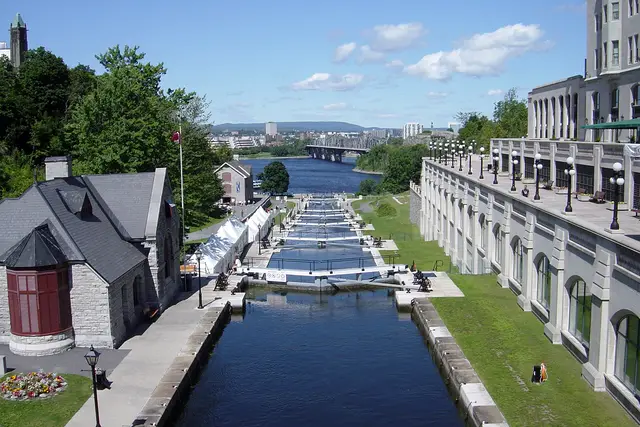
- On foot from Parliament Hill: cross Rideau Canal at the Château Laurier and walk through Major’s Hill Park. You arrive at the gallery’s side in under 20 minutes.
- From Gatineau: the Alexandra Bridge lands you almost at the door. Cyclists and walkers can use the bridge path.
The Royal Canadian Mint is the next building north on Sussex, so it pairs easily with your visit.
Moving Through the Galleries Without the Crowd
The building rewards a bit of strategy. On weekends, try not to arrive between 1pm and 4pm. That’s when the halls fill up and the queue for the coat check backs up. Saturday or Sunday 10am–11am is the quietest weekend hour, so be at the door just after it opens.
A few habits make the visit smoother:
- Check your coat. In winter, Ottawa parkas are bulky, and carrying one through several floors gets old fast.
- Start with what you came for. Most visitors drift through in order. If the Group of Seven is your priority, go there first while you’re fresh.
- Read in both languages. Every label is in English and French. In French the gallery is the Musée des beaux-arts du Canada, which is the name you’ll hear across the river in Gatineau.
- Photograph without flash. Taking pictures is generally allowed in the permanent collection. Some loaned exhibitions restrict it, so look for signs at the entrance to each.
- Pace with the cafés. The gallery has two cafés plus a seasonal lounge. A break halfway through beats rushing the last rooms at 4:45pm.
Payment works the way it does across Canada. Card and tap are standard at the cafés and shop. Admission prices and any free or discounted periods are posted on the official site, so check there rather than relying on old advice.
Beyond the Doors
When you come out, you’re in one of Ottawa’s best walking areas. Cross Sussex to see inside the Notre-Dame Cathedral Basilica, with its starry blue ceiling. Or walk five minutes south into the ByWard Market for lunch.
For the view the building was designed to answer, climb Nepean Point behind the gallery. You’ll see the Samuel de Champlain statue, the river and the Parliament buildings laid out together. In summer, Major’s Hill Park next door is the natural place to sit down after a few hours inside. Plan on two to three hours for the gallery itself, longer if a major exhibition is on.
Frequently asked questions
When is the quietest time to visit the National Gallery of Canada?
On weekends it's calmest 10am–11am. On weekdays the quietest hour is 5pm–6pm, which only works on Thursdays, when the gallery stays open until 8pm. Avoid weekends between 1pm and 4pm, the busiest stretch.
Is the National Gallery of Canada open on Mondays?
No. It is currently closed Mondays and opens 9:30am Tuesday to Sunday. It closes at 5pm on most days and 8pm on Thursdays. Hours can change around holidays, so check the official site first.
How do I get to the National Gallery by public transit?
Take O-Train Line 1 (Confederation Line) to Rideau Station, then walk about 10–15 minutes north through the ByWard Market to 380 Sussex Drive.
How long should I spend at the gallery?
Allow two to three hours to see the Canadian and Indigenous galleries, the international collection and the Rideau Chapel. Add more time for a major temporary exhibition or a stop at one of the two cafés.
What is there to see nearby?
Directly nearby: the Notre-Dame Cathedral Basilica across Sussex Drive, the Royal Canadian Mint next door, Nepean Point and Major's Hill Park behind the gallery, and the ByWard Market a few minutes' walk south. Parliament Hill is under 20 minutes on foot.
Plan your trip to Ottawa
Canada eSIM & staying connected →
Some links above are affiliate links — if you book through them, Wander Atlas earns a small commission at no extra cost to you. It's how we keep every guide free.