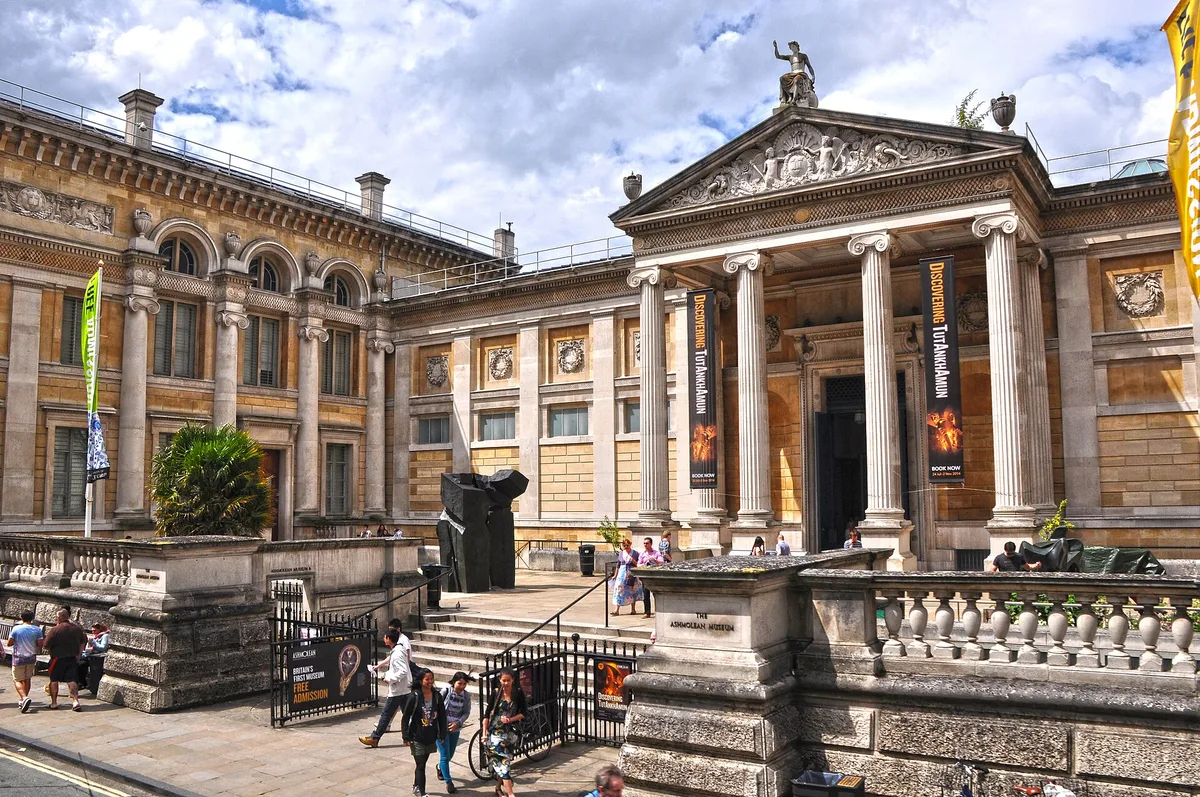
A temple front on Beaumont Street
Eight Ionic columns hold up a pale stone pediment, and the grand steps run down to the pavement. Across the road stands the Randolph Hotel. This is Charles Robert Cockerell’s 1840s facade, and it promises a classical museum of the old school.
Then you walk in. Behind the frontage, Rick Mather’s 2009 extension opens into a white, light-filled atrium. Staircases and glass-sided walkways link floor after floor of galleries. You get a Victorian portico in front and a modern spine behind, and the building makes sense once you’ve seen both.
Britain’s first public museum
The Ashmolean opened in 1683. That makes it Britain’s oldest public museum and the first university museum anywhere in the world. Its founding gift came from Elias Ashmole. Much of what he gave was the collection of the gardeners John Tradescant, father and son, who filled a London house with curiosities from around the globe.
The museum still belongs to the University of Oxford. You feel it in the quiet: students sketching on gallery benches, and labels that assume you’re curious rather than in a hurry. The collection spans ancient and modern art and antiquities from civilisations worldwide, plus fine and applied arts. It is too much for a single visit, so plan on that.
Tradescant’s Ark and the Alfred Jewel
Most first-timers try to see everything and end up seeing nothing properly. Build your visit around a short list of objects that exist nowhere else:
- The Alfred Jewel: an Anglo-Saxon piece of gold and enamel inscribed with words meaning “Alfred ordered me to be made”, linked to King Alfred the Great.
- Powhatan’s Mantle: a deerskin hanging decorated with shell, one of the original Tradescant objects, associated with the Powhatan people of Virginia.
- Guy Fawkes’ lantern: the lantern said to have been carried by Fawkes when he was caught beneath Parliament in 1605.
- The “Messiah” Stradivarius: a 1716 violin in barely-played condition, often described as the finest surviving Stradivari.
- Uccello’s The Hunt in the Forest: a dark, glowing Renaissance panel of riders and hounds running into the trees.
If one of these is the reason you came, ask at the information desk where it is on the day. Objects sometimes move for conservation or loans.

Reading the floors
The building works best if you treat it as stacked themes rather than a maze. The ground floor holds the ancient Mediterranean: Egyptian mummy cases and shrines, Greek sculpture and Roman stonework. Higher up, the galleries move through Asia and Europe toward paintings, with Pre-Raphaelite and Impressionist works among the collections.
Arthur Evans, who excavated Knossos on Crete, was keeper here. The museum’s Aegean collection reflects that, so it’s a good stop if Minoan pottery is your thing. The modern atrium means you can always step out to the central stairs and change floors. You won’t need to retrace your steps through rooms you’ve already seen.
Moving through the galleries without the crowds
This is one of Oxford’s most visited attractions, and it’s busy for good reason. A few habits make the visit calmer:
- Arrive at 10am opening. Coach parties and school groups tend to build through the morning, so an early start gives you the best gallery space.
- Go up first. Most visitors start with the Egyptian galleries by the entrance. Taking the stairs to the top and working down keeps you moving against the flow.
- Travel light. Expect bag checks at peak times. A small bag is quicker, and large luggage is a nuisance in the narrower rooms.
- Photography: non-flash photos for personal use are generally fine in the permanent galleries. Special exhibitions often have their own rules, so look for the signs at the entrance.
General admission is free, and donation boxes stand near the entrance. If you value the visit, this is the moment to give. Temporary exhibitions are usually ticketed and can sell out on weekends. Current prices are listed on the official Ashmolean website, which is also the best place to book a timed slot ahead.
Getting there and timing your day
The address is Beaumont St, Oxford OX1 2PH. From Oxford railway station it’s a walk of roughly ten to fifteen minutes east along Hythe Bridge Street and George Street. Gloucester Green coach station, where the London coaches stop, is closer still.
Don’t drive into the centre. Parking is scarce and the city runs Park & Ride sites on the ring road, with buses into town. At the moment the museum opens 10am–5pm daily. Museum hours change for holidays and events, though, so confirm on the official site, especially around Christmas.
Two to three hours covers highlights and one or two floors in depth. A full day is easy if you take a lunch break. The museum has a café on site and a restaurant on the top floor of the Mather building.
What’s around the corner
The museum sits at a junction of some of Oxford’s best walks. Within ten minutes on foot you can reach:
- The Martyrs’ Memorial and St Giles’: the broad tree-lined street just east of the museum.
- Balliol and St John’s Colleges: both front onto St Giles’ and Broad Street. Opening to visitors varies by college.
- Broad Street and the Bodleian Library: home to the Sheldonian Theatre and Radcliffe Camera beyond.
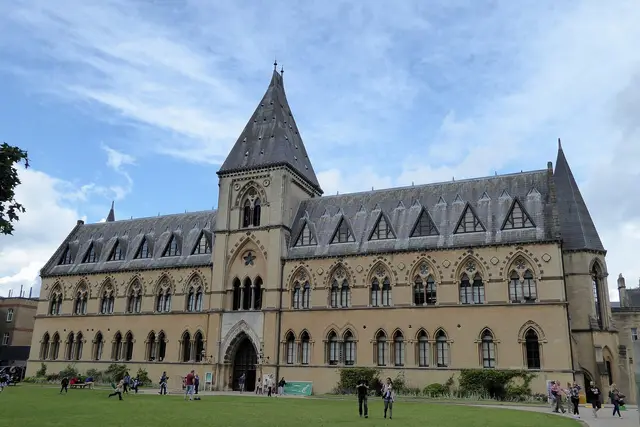
- Oxford University Museum of Natural History and the Pitt Rivers Museum: up Parks Road, the natural next stop if you still want more collections.
A good day pairs the Ashmolean in the morning with a walk down Broad Street to the Radcliffe Camera after lunch. You can finish in the Pitt Rivers, whose dense cases are the opposite of the Ashmolean’s airy galleries.
Frequently asked questions
Is the Ashmolean Museum free to enter?
Yes, general admission to the permanent collection is free, and donation boxes are near the entrance. Special exhibitions are usually ticketed. Current prices and timed booking are on the official Ashmolean website.
How long should I spend at the Ashmolean?
Allow two to three hours for the highlights, such as the Alfred Jewel, the Messiah Stradivarius and the Egyptian galleries. Plan a full day if you want to cover every floor properly with a lunch break.
How do I get to the Ashmolean from Oxford station?
It's about a 10–15 minute walk east from Oxford railway station via Hythe Bridge Street and George Street to Beaumont Street. Gloucester Green coach station is even closer. Avoid driving, as central parking is scarce, and use the Park & Ride buses instead.
What are the opening hours?
At the moment it opens 10am–5pm every day. Hours can change for holidays and events, so check the official website before visiting.
What else is near the Ashmolean?
The Martyrs' Memorial and St Giles' are right outside, and the Randolph Hotel is opposite. Broad Street, the Bodleian Library and the Radcliffe Camera are a few minutes' walk away. The Pitt Rivers Museum and the Natural History Museum are up Parks Road.
Plan your trip to Oxford
United Kingdom eSIM & staying connected →
Some links above are affiliate links — if you book through them, Wander Atlas earns a small commission at no extra cost to you. It's how we keep every guide free.