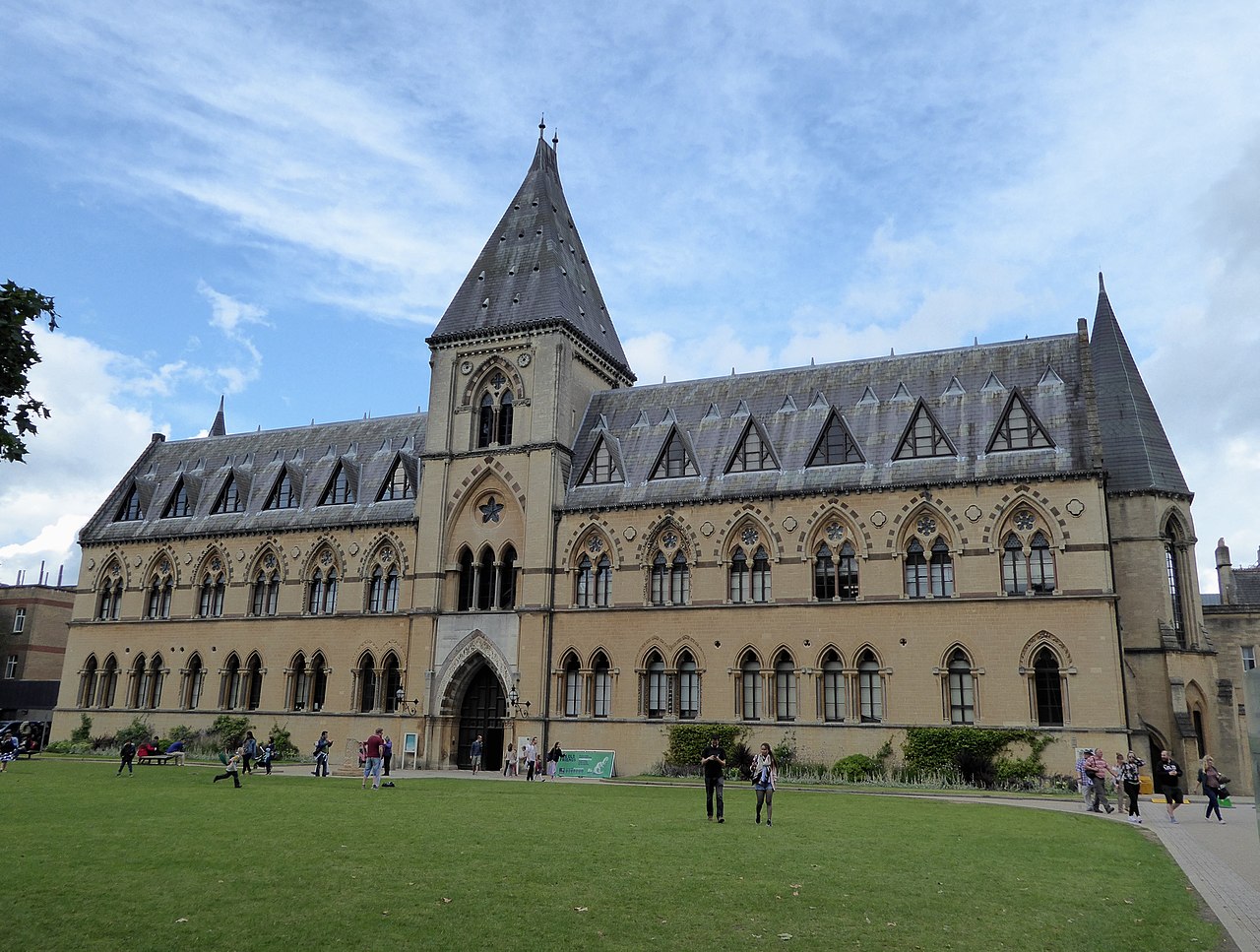
Under the Glass Roof
Step through the doors and look up. Slender cast-iron columns rise from the floor and branch into ribs, and they hold a roof made almost entirely of glass. Daylight falls straight onto rows of skeletons. It feels like a Gothic cathedral built for the natural world, which is roughly what its Victorian backers intended.
The building went up between 1855 and 1860 to designs by the Irish architects Deane and Woodward. The critic John Ruskin argued for it loudly. The outside is pale stone with pointed arches and a steep central tower. Inside, one huge square court holds the main collections, with arcaded galleries on the floor above.
The Dodo, the Megalosaurus and What You Can Touch
The most famous residents are extinct. The museum holds the remains of the Oxford Dodo, the only dodo specimen with any surviving soft tissue. There is also a model of the bird, the version everyone photographs.
Charles Dodgson, who wrote as Lewis Carroll, taught mathematics at nearby Christ Church. The dodo here is widely thought to have inspired the Dodo in Alice’s Adventures in Wonderland.
Look for these in the court:
- Megalosaurus bones: William Buckland described them in 1824, making Megalosaurus the first dinosaur ever scientifically named.
- A Tyrannosaurus rex skeleton cast, which towers over the central aisle.
- Mounted skeletons of large mammals and whales, lined up under the glass.
- Touch tables where you can handle specimens such as fossils, minerals and fur. Signs mark what is fair game.
The upper galleries cover entomology and geology in more detail. They are worth the stairs if the ground floor has filled up.
Read the Columns
This is the detail most visitors walk straight past. The stone columns around the court are each cut from a different British rock, and each is labelled with its type and origin. The whole arcade works as a geology lesson you can put your hand on.
Now look at the capitals on top. Carvers, most famously the O’Shea brothers, decorated them with leaves, flowers and branches taken from real plant species. On the front of the building, some carvings stop half-finished. That’s worth checking out on your way in or out.
1860: The Argument That Happened Here
In June 1860, while the building was still being completed, the British Association met here. It hosted one of the most retold debates in the history of science. Thomas Henry Huxley defended Darwin’s theory of evolution, published the year before, against Samuel Wilberforce, Bishop of Oxford.
No verbatim record survives, and the famous exchange about apes and grandparents has been polished over the years. Still, standing in the room where evolution was argued in public changes how the dodo and the dinosaurs read. A plaque and displays mark the event.

Swifts in the Tower
Each summer, roughly May to August, swifts nest in the museum’s tower. Researchers have studied the colony there since 1948, making it one of the longest-running studies of a single bird population anywhere. Stand outside on Parks Road on a summer evening and you may see and hear them screaming around the tower.
Through the Back Door to the Pitt Rivers
At the far end of the court, a doorway leads into the Pitt Rivers Museum. It is the university’s archaeology and anthropology collection, and it feels completely different. The light is dim and the wooden cases are packed tight with objects, arranged by type rather than by region.
The two museums are reached through the same entrance, so plan your time around both. Give the natural history court an hour or two. Then allow at least another hour for the Pitt Rivers, whose top floors reward slow browsing.
Getting to Parks Road
The museum is at Parks Rd, Oxford OX1 3PW. It sits in the university’s Science Area, opposite Keble College’s striped red-brick buildings. The University Parks begin just behind it.
- From the city centre: walk north from Broad Street past the Sheldonian Theatre and up Parks Road, roughly 10 minutes.
- From Oxford railway station: allow about 20 to 25 minutes on foot through the centre, or take a local bus towards the city centre and walk from there.
- By car: parking in central Oxford is tight. The Park & Ride sites on the ring road, with buses into the centre, are the usual answer.
Afterwards, walk into the University Parks for a stroll along the River Cherwell. Or head back down to the Radcliffe Camera and the Bodleian Library, both a few minutes away.
Timing Your Visit and Museum Manners
It’s calmest between 10am and 6pm on weekdays, so a weekday morning is the easy choice. On weekends, avoid 12pm to 4pm. That’s the busiest window, when families fill the court and the touch tables get crowded. The same 10am to 6pm weekend window can still be comfortable if you come at either end of it.
Opening hours were not confirmed for this guide, and university museums change them for holidays and events. Check the museum’s official website before you go.
General admission has long been free, and you don’t need to book. Donation boxes sit near the entrance, and a contribution is the usual way to say thanks. Special exhibitions or events may work differently, so check the official site for current details.
A few habits that help:
- Start upstairs if the court is packed. The galleries are quieter, and you get the best view down onto the skeletons.
- Touch only what’s labelled. The touch tables are hands-on; the mounted specimens are not.
- Keep flash off, especially in the Pitt Rivers, where many objects are light-sensitive.
- Pace yourself. Seeing both museums in one go is a lot, so pick your priorities before you walk through that back doorway.
Frequently asked questions
When is the quietest time to visit the Oxford University Museum of Natural History?
It's calmest between 10am and 6pm on weekdays. On weekends the busiest stretch is 12pm to 4pm, so arrive earlier or later than that if you can.
How do I get to the museum from Oxford station?
It's about 20 to 25 minutes on foot through the city centre to Parks Road. You can also take a bus into the centre and walk roughly 10 minutes north from Broad Street.
How long should I spend there?
Allow one to two hours for the natural history collections. Add at least another hour if you continue into the Pitt Rivers Museum, which you enter through the back of the main court.
Do I need to book tickets?
No booking is needed for general entry, which has long been free, and donations are welcome. Special exhibitions or events may work differently, so check the official website for current details and opening hours.
What is nearby?
The Pitt Rivers Museum is attached. The University Parks and the River Cherwell are right behind it, Keble College is across Parks Road, and the Radcliffe Camera and Bodleian Library are a short walk south.
Plan your trip to Oxford
Some links above are affiliate links — if you book through them, Wander Atlas earns a small commission at no extra cost to you. It's how we keep every guide free.