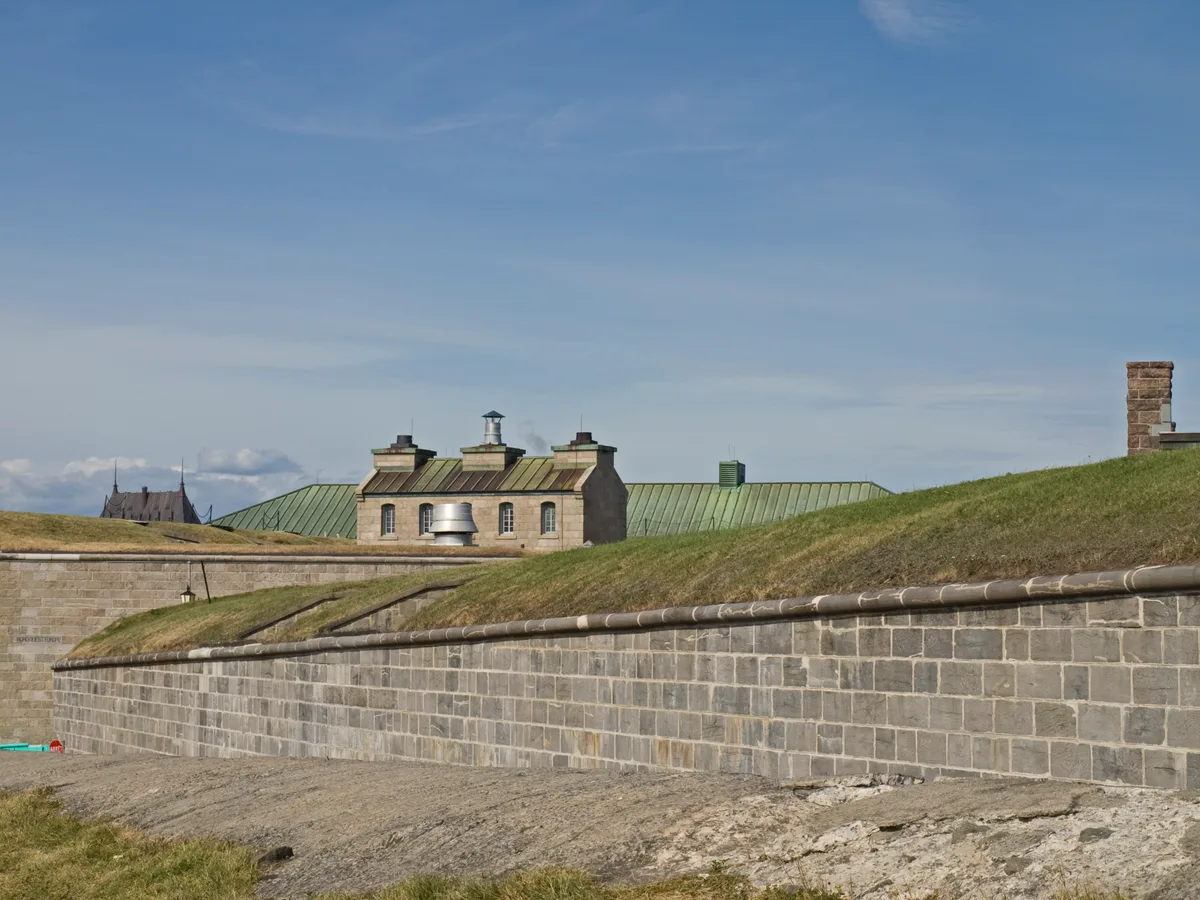
A fort that still has a garrison
Most old fortresses are museums. This one has soldiers living in it. The Citadelle of Québec is home to the Royal 22e Régiment, the French-speaking infantry unit Canadians call the “Van Doos.” It is also an official residence of the Governor General of Canada.
The British built it between 1820 and 1850. It sits on Cap Diamant, the cliff above the St. Lawrence River. From the outside you mostly see grass-topped ramparts and stone walls angled into points. That bastioned star shape was designed so defenders could cover every approach with fire.
Inside the walls
You reach the entrance by walking up Côte de la Citadelle, the slope that climbs from just inside Porte Saint-Louis. A deep dry ditch runs around the walls. You cross it to the gate, and the parade square opens up inside: wide and flat, with barracks and officers’ buildings around the edges.
Because this is a working base, you can’t wander the interior on your own. A guide walks your group through the grounds. The tour covers:
- Why the British fortified Québec after the American invasion of 1775
- How the bastions, ditch and ramparts work as a defensive system
- The history of the Royal 22e Régiment, from the World Wars to today
- The views over the river to Lévis from the ramparts
The Royal 22e Régiment Museum is on site. Its uniforms, medals and weapons fill in what the tour only touches on. Allow about 1.5 to 2 hours for the tour and museum together.
Red tunics and bearskins
The Changing of the Guard is the Citadelle’s best-known ceremony. Soldiers in scarlet tunics and tall black bearskin hats march across the parade square, often joined by the regimental band. The regiment’s goat mascot, Batisse, sometimes parades with them.
The ceremony runs in summer only, and its season and start time are set each year. Check the official Citadelle site for this year’s dates before you plan a morning around it. Outside that season you won’t see it, though the guided tour still runs.
Beating the crowds at the top of the hill
The Citadelle is one of Quebec City’s most-visited sights, and tour groups climb the hill all day in summer. Our crowd data shows where the gaps are. On weekdays the quietest window is 4pm–5pm. On weekends it’s calmest from 10am to 1pm and again from 3pm to 5pm.
The catch on a weekday is that 4pm is close to closing. Check the time of the last guided tour before you head up late. Currently the site opens 10am–5pm, but hours change with the seasons and around holidays. The official site lists this month’s schedule.
Getting past the gate: tours and etiquette
Buy your ticket at the reception building near the entrance, or ahead of time on the official site, where current prices are posted. Cards are accepted. Tours run in French and English, so ask which language the next departure is in. Choose French if you’d like to practise.
A few habits keep the visit easy on an active base:
- Stay with your guide; parts of the fort are off-limits military areas
- Photograph the sentries, but don’t block or touch them
- Keep to the paths on the ramparts; the drops are real
- Say “bonjour” first; staff switch to English without fuss
In winter the ramparts are exposed to wind off the river. Bring a proper hat and gloves for the outdoor parts of the tour.
Walking on from the ramparts
The Citadelle sits between several of the city’s main sights, so plan to leave on foot:
- Plains of Abraham (Battlefields Park): open parkland right next to the fort, where the 1759 battle was fought
- Promenade des Gouverneurs: a boardwalk and stair route that hugs the cliff down to Dufferin Terrace
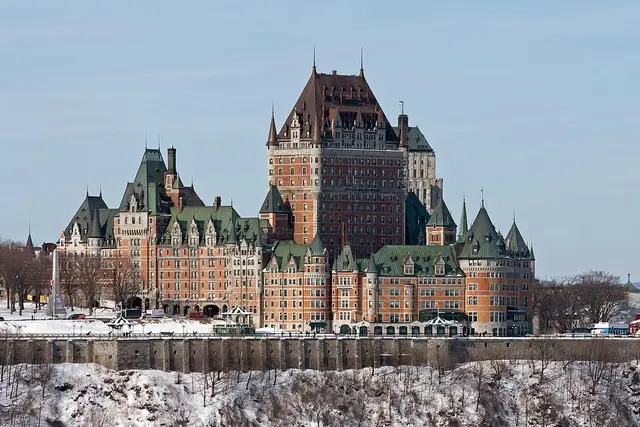
- Dufferin Terrace and Château Frontenac: the wooden boardwalk below the hotel, with the Old Québec Funicular down to Petit-Champlain
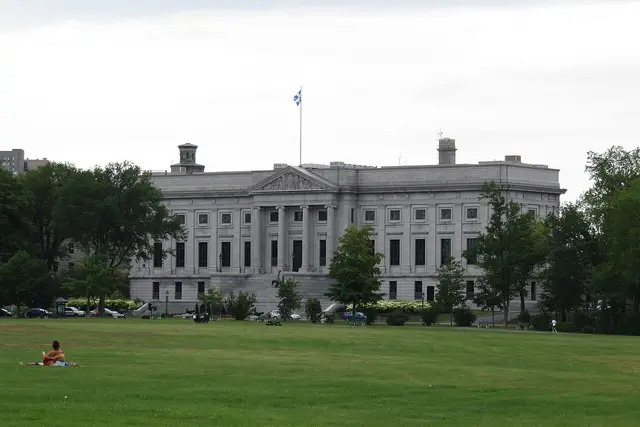
- Parliament Building: a short walk out along Grande Allée
The full ring of the Fortifications of Québec is walkable from here too. Few walled cities survive in North America, and it is one reason Old Québec is a UNESCO World Heritage Site.
Frequently asked questions
When is the quietest time to visit the Citadelle of Québec?
On weekdays it's calmest between 4pm and 5pm. On weekends the quiet windows are 10am–1pm and 3pm–5pm. If you go late on a weekday, check when the last guided tour leaves.
How do I get to the Citadelle from Old Québec?
Walk through Porte Saint-Louis and head up Côte de la Citadelle to the entrance at 1 Côte de la Citadelle. You can also climb the Promenade des Gouverneurs stairs from Dufferin Terrace, beside Château Frontenac.
Can I explore the Citadelle on my own?
Only partly. It's an active military base, so you see the interior on a guided tour, in French or English. The Royal 22e Régiment Museum on site adds more detail. Allow about 1.5 to 2 hours.
When is the Changing of the Guard?
It runs in summer only, and the dates and start time are set each year. Check the official Citadelle website for the current schedule before you go.
What's near the Citadelle?
The Plains of Abraham are right next door. Dufferin Terrace, Château Frontenac and the Parliament Building are all a short walk away.
Plan your trip to Quebec City
Canada eSIM & staying connected →
Some links above are affiliate links — if you book through them, Wander Atlas earns a small commission at no extra cost to you. It's how we keep every guide free.
Related guides
 attraction
Fairmont Le Château Frontenac: Quebec City Travel Guide
 attraction
Place Royale: Quebec City Travel Guide (4.7★)
 restaurant
L'Antiquaire Buffet: Where to Eat in Quebec City (4.5★)
 attraction