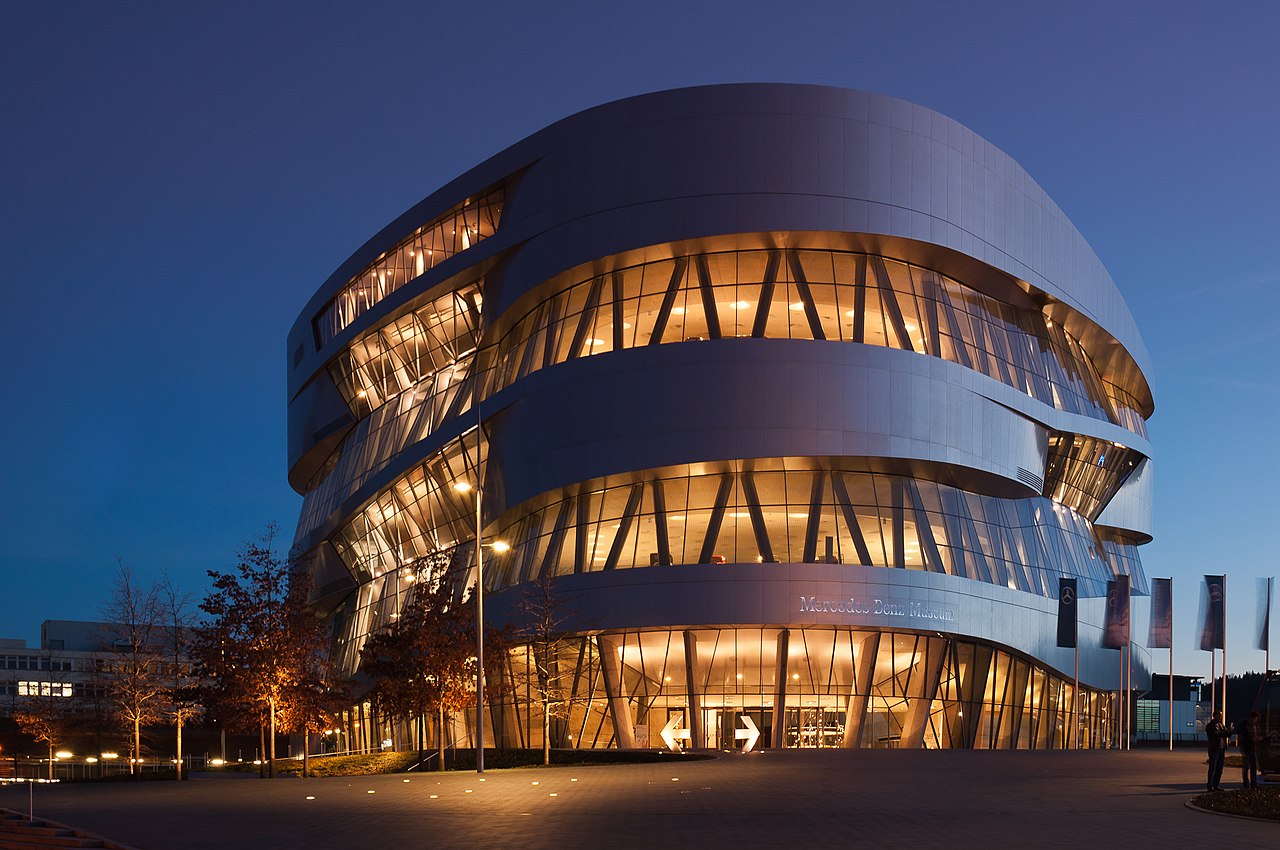
A silver lift pod carries you up through a bare concrete shaft and opens at the top of the building. You walk out into a dim room with a horse standing in it. That’s where the story of the car starts here: with the thing it replaced. From that point everything runs downhill, one gentle ramp at a time, for nine levels and more than 130 years of engineering.
Ride up, walk down
You can’t really get lost in this building. You take the lift to the top floor, and from there the whole museum is one descent. The ramps spiral down past the exhibits, and the last one drops you near the exit on the ground floor.
That changes how you pace yourself. There’s no doubling back to a wing you skipped, so take your time on the upper floors. That’s where the earliest machines are, and that’s where the story makes most sense:
- The Benz Patent-Motorwagen of 1886, the three-wheeler usually credited as the first automobile
- The Daimler Riding Car, a wooden-framed motorised bike from the same pioneering years
- Early Daimler engines, shown as objects in their own right
Plan on three to four hours if you read the panels. Two hours is a sprint.
Legends or Collections: picking your spiral
There are two routes down, and they wind around each other. The Legend rooms tell the story in order, decade by decade. They put the cars beside the history of their time: two world wars, the economic miracle, the oil crisis. Wall timelines run alongside, so a 1930s limousine sits next to the decade that made it.
The Collection rooms group vehicles by theme instead. You’ll find buses and trucks, emergency and service vehicles, and cars that belonged to famous owners. They’re brighter, more open spaces with less text, and they’re good for children who have had enough reading.
The two routes cross at several points, so you can switch whenever you like. Most first-time visitors follow the Legends and step into a Collection room as each one appears. In total the building holds about 160 vehicles and well over a thousand other exhibits.
Silver Arrows on the banking
The descent ends with motorsport, and it’s the room people remember. The Silver Arrows racing cars, from pre-war Grand Prix machines to modern Formula 1 cars, are lined up on a steeply banked track. They tilt toward you as though they’re taking a corner.
Give yourself time here. It’s the best photo spot in the building, and the banking makes the scale of these cars easier to read than a flat display floor would. On a busy weekend afternoon this is where people bunch up, which is one more reason to arrive early.
A building shaped like a double helix
The museum opened in 2006. It was designed by the Dutch studio UNStudio, led by Ben van Berkel. From outside it’s a rounded mass of aluminium-clad bands and triangular glass panes, a little under 50 metres tall. Inside, its two interlocking ramps follow a double-helix layout, the same twisting idea as a DNA strand.
That’s why the floors seem to slide into one another rather than stack. Look up from the central atrium and you’ll see the ramps crossing overhead. The building matters here as much as the cars do. It’s worth a slow lap outside before you go in.
Getting to NeckarPark
The museum sits in NeckarPark, Bad Cannstatt’s events district east of the city centre. The simplest way there is the S1 S-Bahn from Stuttgart Hauptbahnhof to Neckarpark station. From there it’s a signposted walk of roughly ten minutes past the stadium grounds.
On match days and big events, extra trams serve the NeckarPark area and the crowds swell. Check the VfB Stuttgart fixture list before you choose your date. There’s a car park on site if you drive, though arriving by car at a car museum does make some sense.
Beating the weekend crush
This is one of the most-reviewed museums in Germany, and it fills up. On weekends the busiest stretch runs from 11am to 5pm. Turn up at lunchtime on a Saturday and you’ll queue for the lifts and shuffle through the Silver Arrows room in a crowd. Here’s how people who know the place handle it:
- Arrive at 9am on weekends. You get a head start of a floor or two on the late-morning wave.
- Pick a weekday if you can. It’s open Tuesday to Sunday, but the museum is closed on Mondays, which catches out plenty of people who plan a long weekend.
- Book online. Tickets and current prices are on the official Mercedes-Benz Museum website, and having one already saves you the ticket-desk line.
- Take the audio guide. It’s handed out at the start, comes in many languages, and is set off by where you’re standing, so the commentary plays as you reach each exhibit.
- Pay by card. Cards are standard at the desk, the shop and the café.
- Leave big bags at the cloakroom. The ramps are long, and a backpack gets heavy around level four.
Don’t plan to arrive late in the afternoon. Doors close at 6pm, and with this one-way layout you’ll rush the lower floors, which hold the modern cars and the racing room.
After the last ramp: Bad Cannstatt and beyond
The museum’s neighbours are sports and festival grounds. The Mercedes-Benz Arena, home of VfB Stuttgart, is right next door. Beyond it is the Cannstatter Wasen, the open ground that hosts the Stuttgart Spring Festival and the autumn Cannstatter Volksfest, one of Germany’s biggest beer festivals.
If you’d rather see something other than cars, Bad Cannstatt’s old town and its mineral springs are a short ride away. Its spa tradition goes back centuries. If you want more cars, the Porsche Museum is in Zuffenhausen on the other side of the city. Plenty of visitors do both in one weekend, but a single day is a lot of chrome.
Frequently asked questions
What are the opening hours of the Mercedes-Benz Museum?
It's open Tuesday to Sunday, 9am to 6pm, and closed on Mondays. Arrive with at least three hours to spare before closing, because the one-way route makes it hard to rush the lower floors.
When is the best time to avoid crowds?
Avoid weekends between 11am and 5pm, which is the busiest stretch. If you're visiting on a Saturday or Sunday, arrive at the 9am opening. A weekday visit is usually the easier choice.
How do I get to the Mercedes-Benz Museum by public transport?
Take the S1 S-Bahn from Stuttgart Hauptbahnhof to Neckarpark station, then follow the signs for a walk of about ten minutes through the NeckarPark area in Bad Cannstatt.
How long does a visit take?
Plan on three to four hours to follow the Legend rooms, step into the Collection rooms and spend time with the Silver Arrows display. A fast walk-through takes about two hours.
What else is nearby?
The Mercedes-Benz Arena is next door, and the Cannstatter Wasen festival grounds are just beyond it. Bad Cannstatt's old town and mineral springs are a short ride away, and the Porsche Museum in Zuffenhausen is across the city.
Plan your trip to Stuttgart
Some links above are affiliate links — if you book through them, Wander Atlas earns a small commission at no extra cost to you. It's how we keep every guide free.
Related guides
 hidden gem
 Old Castle: Stuttgart Travel Guide (4.7★)
 attraction
 Heidelberg Castle: Travel Guide (4.7★)
 attraction
 Stadtmauer Rothenburg: Rothenburg ob der Tauber Travel Guide
 attraction